 More than 30 years ago I promised a dying friend that I would tell his story. It all began with a hand scrawled letter, which arrived long after we left our VISTA stints in Idaho, fighting “the Big One” as Bob called the War on Poverty. While I had returned home to pursue a career, Bob spent the following years in Malaysia, Japan, Alaska, and now Montana. His postcard questioned my more conventional lifestyle choices via a parable—

Hey Ned,
I was up in the high country awhile back skinning out a buffler when an old Sioux Chief came into camp. Through sign, I was able to learn from him that he’d been to the Great White Father’s house in Wash. D.C. He said he had heard from a Mohican that you had gotten fat & worked an 8 to 5 every day. I jumped up & slapped him around a bit, much to the dismay of the 400 painted warriors w/him — I made him take back what he said and other stuff like you being a pork eater & all. As he was leaving camp he promised me that you were still the bull of the lick back in N.Y. and it did my heart good. But it sure did hurt to see that red devil cry — Wall
P.S. Got some news. Went to the hospital the other day. Came out with pancreatic cancer. Giving me 4-6 months.
Bob Wall went by many names—Robert to family, Hondo or just plain Wall to friends, but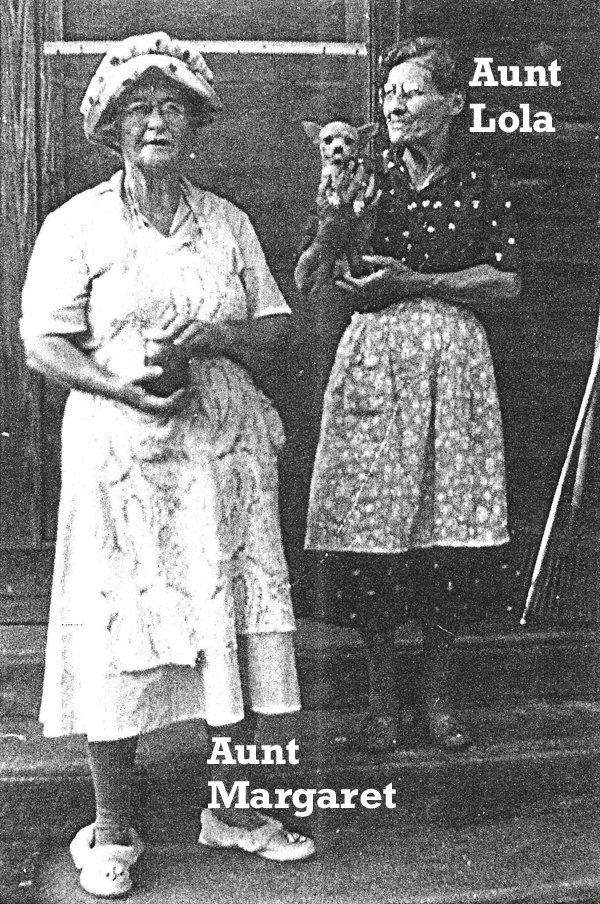 to me he was always The Dirty Drifter. He’d been given that title by his Aunt Lola. She had whispered conspiratorially over tea to Bob’s favorite aunt, Aunt Margaret, “that Robert ain’t nothing but a dirty drifter.”
Aunt Margaret had replied, “I think he’d like that.”
I first met the Dirty Drifter back in ‘73 at the Mayflower Hotel in Seattle—our VISTA training site. After flying cross-country I arrived well after midnight, and was deep into jet-lagged, rem-sleep when he stumbled into our room and flipped on the lights.
“Wake up ya damn Yankee!”
I squinted up at the silhouette swaying over me. My brain dimly registered a beard, a southern accent, and what appeared to be a gigantic boom box on the figure’s shoulder.
“Wake up, and show some respect for your elders,” the figure commanded. He then set the boom box on my nightstand and stabbed a button on the machine.
The same voice crackled out of the machine, “My 87 year-old great aunt is seeing her first tape recorder and I am going to ask her to share some of her special views on life. Are you willing to do that Aunt Margaret?”
A thin, reedy voice answered, “Yes sir!”
The southern mountain man’s voice asked, “Aunt Margaret, what do you think of this tape recording device?”
“I think it’s mighty special. Science is doing some wonderful things…inventin’ things. I’ve never lived no where’s else, and I’ve lost all my people. But we’ve had a joyful life together and I wouldn’t take nothin’ for it!”
Now fully awake, I tried to introduce myself to the person I assumed would be my roommate during our 6-week VISTA training stint. But the figure directed my attention back to Aunt Margaret who warbled on like an Appalachian Foxfire character about how to cure a country ham (“Lee Hendricks would come up to butcher the hogs…and rub that meat with good old timey salt, not no sugar-cured…wrap it tight in brown paper, put it in a sack, and hang it up to dry”), how cousin Alan shot hisself in the foot tryin to do the fast-draw (“it didn’t bleed nor nothin”), how granddaddy Amos and his three brothers all fought in the Civil War (“they all fought on the right side”), about Robert’s ex-girlfriend from Ohio (“you mean the one who was a Yankee and a Catholic, too?”) and how Robert was going to Seattle, Washington (“and I don’t know if’n I’ll ever see him again”).
While driving cross country to Seattle in his VW microbus, Robert had been sideswiped by a tractor trailer outside Billings, Montana. According to Bob, the bus was “all stove-in” on the driver’s side, but still drivable—good enough to get to the Little Bighorn National Monument for the night. That’s where he recorded the second tape he forced me to listen to that night…
“Vehicle’s crippled. Temperatures droppin outside.
Gettin cold in here. Wind’s howling… rockin the van.
I can hear the ghosts of the Cheyenne circlin’ me.
Lucky if I make it through the night.
(long pause) Gotta keep talkin’.”
The morning after our introduction, we walked from the Mayflower to a parking lot to inspect the damage to Bob’s VW. Wooden shelves, loaded with cook gear, water jugs, a propane stove, boxes of ramen, bottles of Dr. Bronner’s Soap, and a duffel bag lined one side of the van, and a wood and canvas cot filled the other. The superficial crease on the “stove-in” side of the bus belied the drama of Bob’s Last Stand at the Little Bighorn.
“Who is this guy?” I wondered.
Bob grew up in Monroe, North Carolina, just across the border from South Carolina. Aunt Margaret lived in the mountains nearby and electricity had found its way to her cabin just a couple years prior. The Walls owned a funeral home and sent Bob and brother Buddy out to pick up the carnage from drunken, late-night car crashes. Bob lived in a tent while attending college, only partly to save money. Mostly he loved everything he read about the Wild West and could not wait to get out of Monroe to find it.
Over the next six weeks Bob and I spent a lot of time together—eating fiery two dollar dinners at the Guadalajara Restaurant, drinking, and carousing around Seattle. But just two or three beers would send Bob back to our room’s bathroom at the hotel, throwing-up drunk. Between retching he’d cry out, “Give ‘em hell, Bob.”
VISTA sent Bob to the mountains and lakes of Coeur d’ Alene, Idaho and me to the deserts of Homedale in the southern part of the state. We lost touch for months after VISTA, until finally I received an audiotape postmarked Yokohama, Japan (you can hear his 1 minute/30 second Dramatic War Tape, “Hey Sarge” here):
Bob had moved to Japan and was teaching English to Japanese executives.He drilled them on using the Southern pronoun, “Y’all”. And taught them useful idioms, like if something is really bad, all Americans say, ‘that’s lower than a snake’s belly in a wagon rut.’”
A fellow American language instructor set him up on a blind date with a Japanese woman. Since Itsuko spoke no English, the instructor taught her one line to say to Robert. When they were introduced, Itsuko solemnly bowed and announced, “I love you, no shit, buy me Honda.” Shortly afterward they married.
In the fall of 1975 my wife, Kay and I put our careers on hold and set off on an around-the-world trip. Our route connected everyone we knew around the globe…my brother in Colorado, a friend in California, Bob and Itsuko in Japan, a college buddy serving as the CBS news correspondent in Moscow, and Kay’s relatives in Denmark.
Our travel plans, including flights and train tickets were set, with us traveling east to west. But just a month before departure, another audiotape arrived from Japan, with Bob explaining why we should travel west to east instead. That way, he reasoned, we could spend the winter in Japan, then come spring we could all go to Alaska.
You can hear 1 min/40 seconds of this tape below…if you can withstand the profanity and racist language. (I like to believe that Bob’s inappropriate and racist language is actually mocking racists…because this was a guy who married a Japanese woman and spent a year in VISTA and 4 years in the Peace Corps.)
We ended up sticking to our original east-west route, spending most of December, including Christmas day in Yokohama with Bob and Itsuko. Most days Itsuko served as our tour guide while Bob was teaching. But one Saturday I accompanied Bob to a Bōjutsu shop…a store that sold nothing but wooden staffs, or “Bō’s” for the Japanese martial art form of stick fighting, or Bōjutsu.
Bob explained to me that when he tried to sign up for the class, the sensei refused to accept him. When Bob persisted, the sensei asked him why he didn’t take karate or jujitsu, like most westerners.
“I don’t want to get that close to the guy,” Bob told him.
“But why Bōjutsu?” the sensei probed.
“I like it ‘cause it’s dirty,” Bob told him.
“Dirty?”
“Yeah, like in the cowboy movies, when the guy gets knocked down, he grabs a fistful of dirt and throws it in the other guys’ eyes.”
“Cowboy movies?”
“Or, like, when the angry crowd gathers, and some guy in the back of the crowd yells out, ‘get a rope’—I always wanted to be that guy.”
Somehow Bob talked his way into the class, which led us to the Bōjutsu shop. The sticks hung neatly from the shop’s low rafters in twelve foot lengths. As traditional Japanese fighting sticks are between five and six feet long, one of the shop keepers cut the stick Bob selected in half with a tight-kerfed handsaw. While he chamfered the sharp edges of one half, Bob took out his pocketknife and started working on the other.
When our clerk said something in Japanese to the second shop keeper, Bob looked up sharply from his work, stared at them and growled, “it works, don’t it?” Both men froze, and bowed continuously, one after the other, until we left.
Outside on the sidewalk, I asked what the guy had said.
“What he said was, look how I cut away from myself and the stupid American cuts toward himself,” Bob explained. “All that bowing was just them tryin’ to save face.”
In Yokohama, at least in those days, you could phone restaurants and bars to have food and drink—even a single beer—delivered to your home via bicycle. Delivery men roamed the city, with wooden crates strapped to their bike racks, filled with bricks of fresh tofu. The delivery men announced their arrival by blowing on a brass horn, called a tofu ropa—Japanese good humor men, but for curdled soymilk.
On Christmas Eve, Kay and I visited food wholesalers with Itsuko, in search of the only Christmas gift Bob wanted—a tofu ropa. We were told it is illegal for individual citizens to own them. But we begged one supplier after another to sell us one for a “crazy American friend who would soon be leaving the country”—until one finally relented.
When Bob opened his gift on Christmas morning, he bellowed “Wagh” (apparently favored
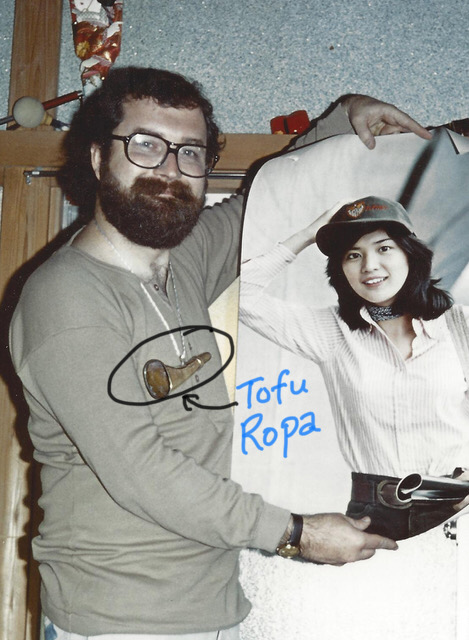
Christmas morning ’75.
by the old Rocky Mountain trappers and mountain men), ran downstairs, jumped on his motor scooter, and blasted around the neighborhood tooting on his tofu ropa. Neighbors streamed out of their houses, empty containers in hand, searching for the phantom tofu man.
One of Bob’s students arrived after dinner one evening for private language tutelage. Kay and I offered to go for a long walk during the lessons, but Bob insisted we stay and participate. The four of us sat cross-legged on tatami mats, drinking sake and smoky-sweet dried squid, warmed on top of the room’s kerosene space heater. The entire lesson consisted of Bob telling stories—including one about riding his motorcycle into the Silver Dollar Saloon in Leadville, Colorado. (You can hear this 3 minute story, in Bob’s own words, right here:)
But Bob spent most of that evening trying to convince poor Mr. Furuhashi to move to Brazil. When his student left, I asked Bob what that was all about.
Bob explained that most of the businessmen he taught questioned nothing, but he recognized a spark of independence in Mr. Furuhashi. So, he was simply trying to get Mr. Furuhashi to be a little bit more adventurous.
“You know, for his own good,” Bob clarified.
My face probably registered the skepticism I was feeling.
“Besides,” Bob continued. “I heard it’s really fat in Brazil. So, if I can get him to check it out, and if it’s really good, then maybe I’ll go there too.”
This made me question whether traveling around the world—particularly the next leg of our trip on the Trans-Siberian Railroad—had actually been my idea. In his correspondence Bob had talked up the route—particularly the price. Just $140 for a private compartment, including meals. But as we were about to leave Japan, Bob expressed his anxiety.
“Watch what you say, ‘cause your compartment will definitely be bugged by the KGB.”
Almost cartoonishly, two hulking men in black wool overcoats and kludgy black leather shoes intercepted us in the airport in Niigata and announced in thick accents, “you are going to Khabarovsk.” They were KGB agents (but that’s a whole other story).
Bob and Itsuko eventually moved to Montana, outside West Yellowstone. The land was dry and therefore cheap. They built a log cabin but had to truck in their water. It may have been the water or the grizzly bears, but after a couple years, Itsuko flew back to Japan to visit family, leaving her collection of prized silk kimonos in Montana. She never returned.
In 1988, the summer that Yellowstone burned, Kay and I flew to Wyoming to climb the Grand Teton. From the summit, the vistas just appeared hazy. However, descending at night, ash from the forest fires drifted across the beams of our headlamps. Driving toward Yellowstone afterward, the south entrance appeared abandoned, and we drove through the park with trees on both sides of the road ablaze. We exited the park at West Yellowstone, and spent several days visiting Bob at his cabin. “Don’t even think about goin’ to the outhouse at night,” he warned us. “Grizzlies.”
A year later I received the postcard from Bob about his pancreatic cancer and having just a few months to live. I flew to Montana the following weekend to say goodbye. The cabin overflowed with visitors—Snake, from North Carolina, sister-in-law Nita, nephews Colt and Tex, a friend and his Thai wife from Peace Corps days, plus several Blackfoot Indian friends (“Hide the firewater!” Bob shouted when he learned they were coming).
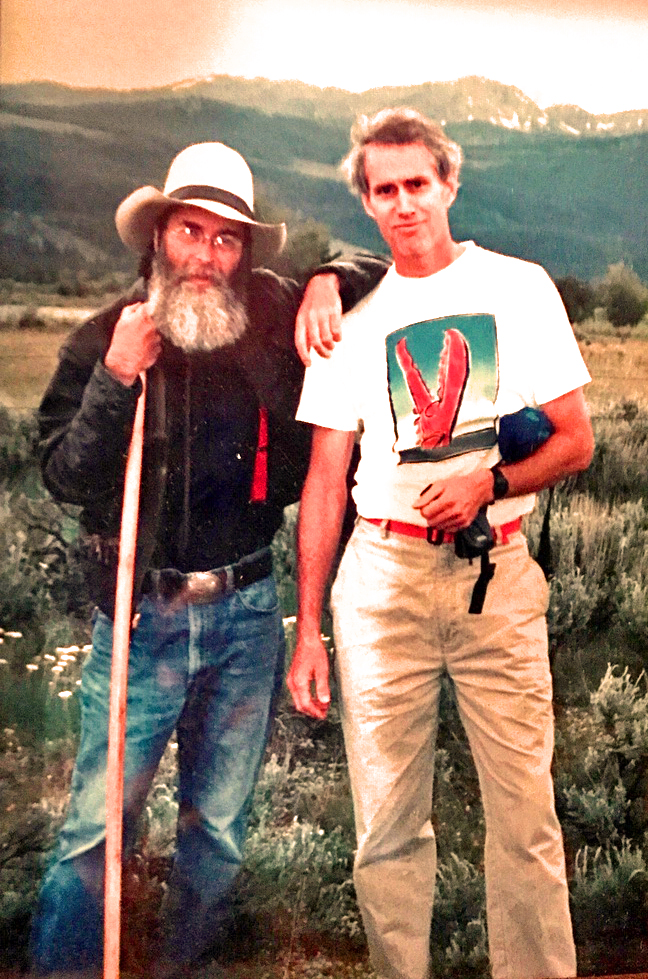
Sayin’ goodbye.
Visitors slept all over the cabin, on the floor, in chairs, on couches, with Bob settled onto a bed in the living room because he was too weak to safely navigate the stairs to his bedroom in the loft.
“Somebody here deserves to get some sleep, so take my bed upstairs,” Bob told me. “No arguments.”
“Oh, and there’s a six-shooter on the nightstand,” he continued. “It’s loaded, so if any bats land on the big logs supportin’ the roof, shoot ‘em. Just don’t shoot ‘em if they’re on the planks,” he explained. “Puts holes in the roof.”
The next day, dozens of friends staged an afternoon cookout on the shores of nearby Hebgen Lake in Bob’s honor—a preemptive wake of sorts. After a couple hours of greeting everyone, Bob pulled me aside and asked me to take him home.
Mementos from Bob’s travels covered one two-story wall inside his cabin…cowboy hats, a Chunichi Dragons baseball cap, Buddhist prayer beads, an Indian headdress, a buffalo skull, a yellow “wildcatter’s” hardhat blackened with oil, Japanese fans, a photo of Aunt Margaret in a rocker with a shotgun across her lap, an Alaskan license plate, a bamboo flyrod. A lifetime’s worth of memories receded into shadows higher up.
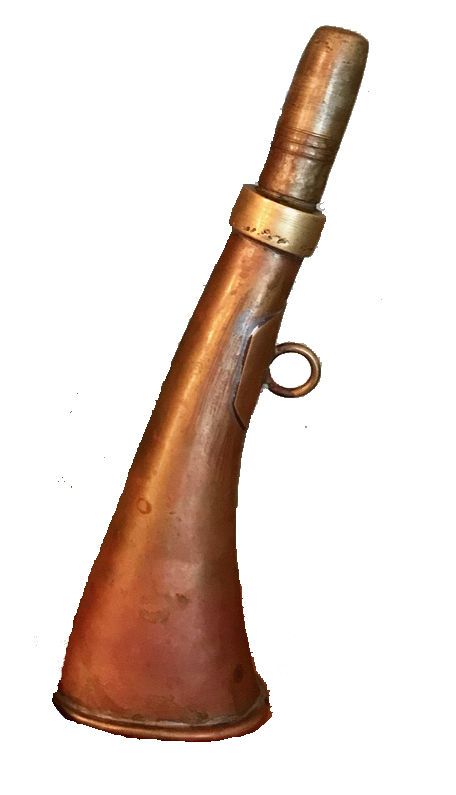
“I think you should have this,” Bob said, handing me the tofu ropa.
“Fetch that pole over there, will ya’ Ned?”
Bob took the pole and reached high into the shadows of the wall, searching. When he brought it down, he handed me the brass tofu ropa, and said, “I think you should have this.”
Bob held on twice as long as the doctors predicted. Six months after he died, I received a postcard in his handwriting. It carried a recent postmark from Montana —
Hey Ned,
Just wanted you to know that I’m livin on another planet, where I’ve fulfilled my dream of becoming a singing cowboy. I love you like a brother,
The Dirty Drifter
P.S. That Tofu Ropa looks good on your wall there!
 Searching for Malcolm
Great to read it again, Ned, thanks! Hope you are all well. All good wishes from the Windy City. Ed
LikeLike
The Ol’Dirty Drifter would be proud, even if you’re still a pork eating Yankee.
LikeLike
I don’t take kindly to that nomenclature…much prefer pork eating Red Sock.
LikeLike
This manages to be moving and hilarious at the exact same time.
LikeLike
Thank you so much for your story of Bob Walls,I know it’s real cause you said so,I only wish I was half the man he was.
LikeLike
Well, he was the Dirty Drifter, and you were known as “Yank”—which to me, is pretty ironic for a guy with (what I think) is an authentic British accent. So, just as colorful if you ask me. Besides, you have an entire website named after you!
LikeLike