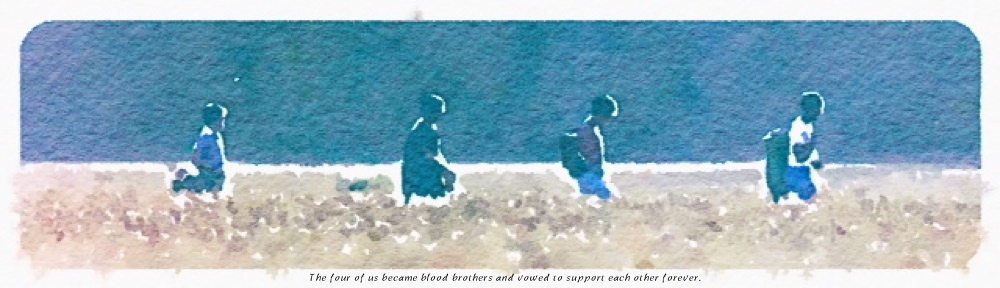
I abducted my old friend Steve Wadsworth and whisked him off to England in November of ‘03. It was a friendly sort of kidnapping though, mostly inspired by Steve’s leukemia. What could be a better last hurrah than going to find Malcolm Howorth — who we hadn’t seen since he moved away from Johnstown when we were kids? Somehow I cajoled Dan Duross, the fourth member of our childhood gang, into joining the adventure.
I sleuthed my way online to an email address for Malcolm’s daughter, Sarah. She proposed luring her dad to The Higher Trapp Inn near where they lived in Lancashire.
The place was a drafty, overly decorated country inn right out of Fawlty Towers. We arrived just before dinner in a turmoil, because that morning I had left my video camera in a cab back in London. But after several phone calls, a local video shop delivered a rental replacement to the inn.
“You look like you’re from the Channel Six News Team,” Steve said as I balanced the suitcase-sized camera on my shoulder.
I tested the camera as we wandered into the inn’s pub, which smelled as sour and malty as a frat house. The matronly bar maid who introduced herself as Margaret knew right away that we were The Americans. She took us on a tour, introducing us to the kitchen and wait staffs who all looked to be expecting us. Margaret next showed us the private room reserved for Malcolm and his family, and then hustled us back to the bar.
She wagged her finger at us and said, “No peeking. I’ll come and get you when they arrive.”
It’s not like we had a plan, but with the outlandish video camera as a prop, we decided to use it when we confronted Malcolm. After a round of pints, Margaret summoned us from the pub back into the private room.
I hid my face behind the big camera as I walked in and announced, “We’re a film crew from America doing a documentary on typical English pub life. Would you folks be kind enough to tell us what brings you out mid-week?”
A perky blonde woman who I took to be Malcolm’s wife spoke right up, “My name is Sally and that’s my husband Malcolm,” she said, gesturing across the table to a man dressed in black. “We’re taking our daughter Sarah and her boyfriend Thomas out for a meal.” The woman spoke energetically, answering for everyone.
I panned the camera around the table, pausing on Sarah.
“Sarah, can you look right at the camera and say, “All you need is love. Love is all you need?” Steve asked Malcolm’s daughter.
Sarah barely managed to recite the lines, clearly excited by her role as co-conspirator.
Next to her perched her boyfriend, a thin twenty-something young man with wire rim glasses and close-cropped hair. He sported a two-day old beard and spoke the Beatles’ lyrics with such uncertainty, I wondered if he was too young to know who they were.
“How about you?” Steve said, addressing the man in black. “Can you say it?”
As I studied Malcolm from the anonymity of the camera’s viewer, I easily recognized the thirteen-year old we had known. Though you wouldn’t call him heavy, he carried his weight comfortably, you might even say athletically. The slimming effect of his all-black, Johnny Cash style outfit certainly helped. If I had not been zoomed in on his face, I would never have seen the flash of contempt in his eyes.
Steve continued to badger him. “Come on, you look like you must have grown up with the Beatles.”
That sparked another dangerous look. Malcolm seemed to be weighing his options. He stared at the camera, and in a monotone muttered, “All you need is love. Love is all you need.”
Dan may have sensed the same tension. “Do you have any friends or family in America you’d like to say hello to?” he asked.
Malcolm slowly raised his head and looked closely at Dan for the first time. “Actually, I once lived in America. But that was long ago.” His eyes seemed to warm, then just as quickly hardened.
Dan cocked his head and peered into the lens. “This is an amazing coincidence ladies and gentlemen.” He turned back to address Malcolm. “And where did you live in America, my good man?”
Malcolm half rose from his seat and hesitated, clearly caught between fight and flight. He slumped back down, the fight draining out of him, and looked up at Dan. “Believe me, you’ve never heard of the place.” He paused before adding, “My good man.”
Fearing we were pushing our luck, I removed my hat and moved my face out from behind the camera, while continuing to record. The movement caught Malcolm’s attention. I felt certain that I detected a flicker of recognition in his eyes.
“Any old friends you’d like to give a shout out to?” I asked.
Malcolm slowly turned to me and stared intently for an uncomfortable length of time. He looked like a man coming out of a daze. His gruff exterior seemed to wash away in streaks, like the dust off of a car left out in the rain. Finally, he softly said, “I would suggest that you are Ned.”
“No way!” Steve immediately cried out.
I kept right on taping, but gestured to Dan with my free hand and asked, “And do you know who this is?”
Malcolm studied Dan for a good twenty seconds. Each second seemed like either a repudiation of our old friendship, or an indictment of how much Dan had changed. I figured Malcolm would identify him through association. Instead, he shook his head sadly, and said, “I’m sorry, too much time has passed. He just looks a weary world traveler to me.”
Steve cackled victoriously. Nonplussed, Dan stepped forward and said, “I’m Dan Duross.”
Malcolm’s squeezed his eyes shut tightly as if he were in pain. Dan immediately reached out and embraced him. Malcolm buried his face into Dan’s chest. They held each other as the rest of us watched in silence. I felt like an eavesdropper but kept the camera rolling. Finally, Dan stepped back and asked, “And who do you think this guy is?”
“This would have to be Steve,” Malcolm said, as Steve stepped forward. They embraced until Malcolm finally inhaled a mighty sniff, quickly blotted one eye then the other on his upper sleeves as he composed himself, and declared, “I am absolutely gob-smacked.”
“Gob-smacked,” Steve, Dan, and I cried out in unison. “What’s that mean?” Steve asked.
“A total loss for words,” Malcolm said. “I just can’t believe it.”
“Did you think there was something a bit quirky going on tonight,” Dan asked in a surprisingly good British accent.
“Yes, I definitely did,” Malcolm admitted. “Normally I’d be having an evening soak right about now after a hard game on the pitch.” Noticing the puzzled looks on our faces, he clarified, “Wednesday is four-on-four football night. It’s just so unusual for us to be going out midweek. I’ve been thinking me daughter is engaged and this is how they’re going to break the news — in a public place where I can’t rant and carry on.”
“They should give you some medication to calm you down like they did for me,” Steve said, which made all the Brits laugh a bit nervously.
Malcolm shook his head sadly. “They probably wouldn’t work on me. I’m the most miserable bloke you’ll ever meet.”
“Why?” Steve cried out. “What have you got to be unhappy about?”
“It’s true, he’s miserable,” Sally laughed. Sarah and Thomas nodded their heads in agreement.
“The bloody taxes, and the government, and the Royal Family,” Malcolm said.
“He always told Sarah here and our son to forget the U.K. and move to America,” Sally said softly.
Malcolm’s slumped body language told the story as he filled in the missing blanks about his sudden departure so many years prior. His family had moved back to the U.K. spontaneously because his grandfather had grown too ill to care for himself.
“Wouldn’t most people check out the situation first?” Malcolm asked. He stared at us, as if expecting an answer. “Just one letter from home and they pack up the whole kit and caboodle and move us back here?”
“So, did you all move in with your grandfather?” I asked.
Malcolm shook his head sadly. “We were all split up between various relatives. I lived the first year in Manchester with me aunt and uncle.”
“I had to use an outhouse to go to the toilet,” Malcolm continued, the tone of his voice neutralizing my beer buzz. “I’m not sure which was worse — freezing me arse off in the winter — or the retching stench when it was hot.”
There was an embarrassed pause around the table until Steve said, “Well, we still had the Cayadutta Creek and that stunk.”
“But you had indoor plumbing,” Malcolm pointed out. “It seems to me that every morning back in Johnstown, I’d wake up to blue skies and clean, fresh air. True or not, that’s the way I remember it.”
We watched Malcolm, more curious than ever about the parts of his life we had missed.
“I wore me old football jerseys from Johnstown and all the Manchester kids who wore nothing but black called me Yank and said I wore clown clothes.”
It was impossible not to notice that Dan, Steve, and I all sported colorful outdoor clothing, while Malcolm’s dress shirt, trousers, and shoes were all black.
“You know, in Johnstown, me mum would occasionally return home from work with a ball glove or a ball as a surprise. It wouldn’t be Christmas or my birthday or anything,” Malcolm said. “But when we came back here, there was no more of that,” he said, shaking his head. “I barely saw me parents.”
Our waiter set a tray down in front of Dan, choked with half a dozen pints. Dan passed the glasses around the table in both directions.
“The thing is it all felt so innocent and pure,” he continued.
“What was innocent?” Steve asked.
“Everything,” Malcolm said. “Walking to the movies, playing football on the Knox Gelatin lawn, dreaming about playing under the lights at Knox Field, discovering our Indian village. Anything seemed possible.” He stared down at his hands and inhaled deeply.
“And when I went back, it wasn’t anything like I remembered it,” Malcolm continued.
“Wait a minute. You went back to Johnstown?” I asked. “When?”
Malcolm looked puzzled. “I don’t know,” he said. “I think it was the summer of ’72 or ‘73. I’d been working as an auto mechanic and had an accident in the pit. I got burned pretty badly and had to get my head back on straight.”
Steve looked focused for the first time that evening. “That was just before I had my bout with mental illness, too.”
“And you never tried to find any of us?” I interrupted.
“That’s what I’m tryin’ to tell ya. Everything had changed,” Malcolm said. “I remembered the air as a kid as being fresh and every day was sunny. But when I went back it wasn’t like that at all. The town seemed broken down, like an old man.” He looked at us sadly. “I couldn’t grasp which had changed more — me or the place. I had planned to stay, but I didn’t know anyone, so I came back after two or three weeks.”
Woody stood up, raised his glass, and toasted us all. “I just want to say that I’m having the best night of my life.”
He swept his glass in the direction of Dan, Malcolm, and me, and said, “Here’s to old  friends.” Then he raised his glass to Sally, Sarah, and Thomas and said, “And here’s to new friends.”
We all raised our glasses. “Here’s to Searching for Malcolm — the movie,” Dan toasted. “To Searching for Malcolm,” everyone repeated, as we stretched across the table to clink our glasses.
“Tell me,” Dan said, turning to Malcolm. “Now that Searching for Malcolm has become such a big hit, what do you plan to do with your newfound fortune?”
Malcolm’s eyes danced, relishing the role-playing. “If Searching for Malcolm becomes a big hit, I hope to…”
“Now that,” Dan corrected him. “Now that Searching for Malcolm has become such a big hit.”
Malcolm grinned with delight just like he did when we were kids. Then he composed himself and started again, acting serious. “Now that Searching for Malcolm has become such a big hit I plan to take the Rochdale Football Club to the premier league.”
“And be the coach,” Steve suggested.
“The player-coach,” Dan corrected.
“Yes, as player-coach, and owner of the team, I plan to take the team to the English premier league championship,” Malcolm continued.
“And lead the league in scoring,” I threw in.
“And score the winning goal in the championship game,” Dan concluded.
“Money will be no object,” Malcolm went on, explaining the success of the team.
Then Malcolm turned the tables and acted as the interviewer, posing the same question to us. When he got to Steve, I suspected that Steve might have wished for a lifetime supply of Gleevec, the forty thousand dollar a year drug that was keeping him alive. But Steve had yet to tell Malcolm about his leukemia. So instead, Woody raised his glass and said, “I’ll remember this night for as long as I live.”
Malcolm frowned. “That’s not even a wish.”
Woody raised his glass and tried again. “Let’s get together again before another forty years blips by on the calendar.”
“Here, here,” Malcolm called out. It sounded so quaintly English, like the comical huzzahs from the white-wigged Members of Parliament in the House of Commons, we all joined in. “Here, here,” we echoed.
AFTERWORD
Later that evening Steve pulled Malcolm aside to tell him about his leukemia. In the space of one dinner we managed to lift Malcolm out of a forty-year funk…only to drive him right back in. The following morning Malcolm and Sally sat us down for a conference in their living room. After talking most of the night, they had reached a decision. They would remortgage their house to help pay for Steve’s medication.
Steve never took them up on their offer. Instead, he simply stopped taking Gleevec — refusing to be extorted by Novartis Pharmaceuticals. His doctors expected him to die. But as it turned out, spiriting Steve off to England was a total bust as last hurrahs go. He has tested negative for leukemia ever since. I like to tell him it was the trip that cured him.
As if that weren’t enough of a happy ending, Malcolm and Sally did return to America and Johnstown the year after our reunion. That visit and others since have helped Malcolm reconcile leaving the U.S. so many years ago and he no longer claims to be the most miserable bloke in the world.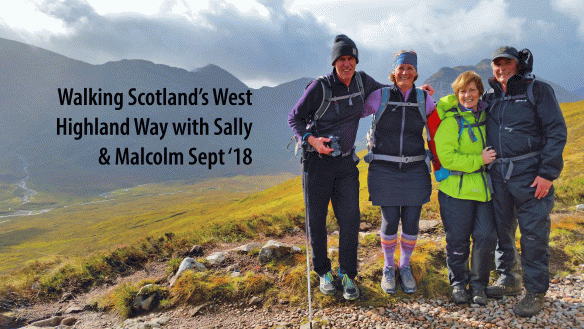
For me, the reunion unleashed a flood of childhood memories about days that are always fresh and sunny. I have written these stories as if they were fiction, about characters with made up names. I don’t know what I was thinking. A story in which someone remortgages his home in order to save a long-lost childhood friend is mediocre fiction at best. Yet that really did happen, along with Steve’s cure, both of which are truly remarkable. This is why I have decided to come out of the closest so to speak—and just use our real names from now on.
Like life itself, not every outcome of our reunion had a storybook ending. In Steve, I kept one friend who I feared I would soon lose. With Malcolm, I found a friend I believed had been lost for forty years. But for Dan and myself, friends of more than half a century, we have only grown more distant since that reunion fifteen years ago. This has left me to ponder whether there is some cosmic order that determines how many true friends we are allowed to have in our lives. If we regain two, are we destined to lose one? I’m not suggesting that losing a friend isn’t painful and sad, but if that’s the equation, I’ll take it every day.


Dammit, makes me cry every time. Lovely conclusion.
LikeLike
I’m glad you went with the truth, much more powerful.
LikeLike