When I tell the story about kidnapping my friend Woody, I always start by going back to  1961. That was just before our childhood cocoon began unraveling, accelerated by a drumbeat of national headlines: Families Building Backyard Bomb Shelters… Bay of Pigs…Cuban Missile Crisis…Medgar Evers…JFK…Martin Luther King…Bobby Kennedy…Viet Nam.

We were still happy and oblivious on that first day of seventh-grade, when Dondi, Woody, and I stopped by Malcolm’s house to pick him up on our way to school.
We expected Malcolm to be waiting for us on his front porch. Instead, we had to ring the bell to the upstairs flat. When he appeared, framed behind the aluminum storm door, he stood barefoot, sporting plaid boxer shorts and a white t-shirt. Instead of caroming between us, joking, and calling us blokes, he took just one step out onto the porch, while continuing to use the door as a shield.
“Hurry up man, you’re going to make us all late,” Dondi said.
Wedged behind the door, Malcolm said nothing.
“You’re not feeling a little peaky are you?” I asked, teasing him with one of his own expressions.
“Yeah, you can’t play hooky on the first day of school,” Woody said.
We all watched Malcolm more closely now, waiting for his response. That’s when I realized he actually did look a bit peaky.
“If you’re scared you’ll have to sing, we’ll protect you,” I said. On the first day of school, older kids would corner the younger ones and try to make them sing the alma mater.
“On your bike,” Malcolm said — his polite way of telling me to piss off.
“We’re walking,” I said, playing dumb.
“You know what I mean,” Malcolm said. “That singing shite don’t scare me.”
But his eyes betrayed his words. He looked like his faithful dog had died. But he didn’t have a dog.
That’s when Malcolm dropped his head, mumbled something, and disappeared as the storm door wheezed behind him and clunked shut.
We couldn’t even agree on what his parting words were.
“He said he was sick,” Dondi insisted.
“I thought he said he had to move,” I argued.
“Bowels no move,” Woody suggested, reciting the punchline to one of our favorite jokes.
Whatever he said, Malcolm’s behavior rattled us, and we did what we always did when one of us got out of sorts — we gave him some space.
By the time we circled back the next day, Malcolm’s front door was locked. Neighborhood kids informed us that the family had returned to England.
If we had been a little older, we might have hunted down our friend’s new address and written to tell him we would miss him as quarterback of our south end football team. We could have told him what a loyal friend he had always been and that our group wasn’t the same without his enthusiasm. Perhaps we would have admitted that life in our little upstate town had become flavorless without his English ways. If we weren’t twelve-year old boys, we might have even confessed that we felt guilty about taking his positive nature and loyalty for granted.
I joked with Woody and Dondi for the next 40 years that we should embark on a grand international adventure to find Malcolm. They never took me seriously. But when Woody wrote to tell me he had been diagnosed with leukemia — likely from inhaling compounds of benzene while shaving skins as a young man in the leather mills —I decided to kidnap Woody and take him to England, to find our long-lost friend.
I lured Woody to Williamstown, Massachusetts on the pretext of seeing a college soccer game, insisting at halftime that we leave to grab some lunch. We wound south on Route 7 with the promise of a great sandwich place, but by the time we passed through New Ashford and kept going, Woody started getting twitchy.
“I’ve got a knot in the pit of my stomach,” he complained, both hands clutching his belly.
“You’re probably just hungry,” I said, hoping to change the subject.
“I’m not hungry,” Woody said. “I’m nervous.” He held up two fingers. “Despite taking a Paxil this morning, and another one when you kidnapped me.”
Woody had clearly stopped believing my ruse about lunch.
“Are we going to be gone overnight?” he asked.
This question caught me off guard. I wanted to keep him in suspense at least until we reached the airport. “Why would we be gone overnight?”
“You tell me. But if you didn’t bring my meds, I’m a dead man.”
“Don’t worry, I’ve got your drugs,” I replied, with more conviction than I felt. Woody’s wife had promised to stow his suitcase of clothes, his Paxil, and his Gleevic in the trunk of my car when she went to find the ladies room during the game. Upon returning, she gave me a wink and a quick thumbs-up. At the time, I took that to mean the luggage transfer had been a success. In hindsight, I worried that it simply meant she had found the bathroom.
As I veered toward the East Lee entrance to the Mass Pike, Woody continued complaining about the pain in his stomach. That’s what made me cave on my original plan to keep him in the dark.
“There’s a present for you in the glove box,” I told him.
Woody pressed the button, reached inside, and removed a brand-new black ball cap with the letters “SFM” stitched in gold on the front. He sat there studying it, rolling the cap back and forth, as if seeing the letters from different angles would suddenly reveal their meaning.
We barreled eastward on the Mass Pike for a good half hour.
“So, does he know we’re coming?” Woody asked quietly, finally breaking the silence.
I studied my old friend, wondering if he was just trying to flush out a clue. “Does who know we’re coming?”
Woody tapped the letters on his hat one at a time as he answered, “Searching… for… Malcolm.”
Even though I knew the next question was coming, I still had no idea how to answer when Woody asked, “Will Dondi be joining us?”
“He wanted to come, but I think he’s wrestling with a bit of agoraphobia,” I said, attempting to obfuscate my answer.
“What-aphobia?” Woody asked.
“Let’s just say he’s really uncomfortable about flying to England right now.”
Both of us knew the trip wouldn’t be complete without him, but I didn’t have the strength to relate all I had been through trying to convince Dondi to join our pilgrimage.
I’d had to change the dates for our flights three times after Dondi consulted his astrologer. Her skittishness didn’t feel completely crazy, given that two airliners had been flown into the World Trade Center Towers just a few weeks earlier. But after her second cancellation, when I suggested to Dondi that he have his astrologer book our tickets, he bristled and said, “You may think these precautions are funny, but I happen to take them very seriously.”
He was wrong though. They didn’t strike me as funny; I found the discovery that Dondi even had an astrologer to be downright disturbing. But fortunately, the stars eventually aligned and Dondi agreed to surprise Woody by meeting us at Logan International. I expected to be equally surprised if he showed up.
After shuffling through security, Woody and I settled at a table near the British Airways terminal. I saw no sign of Dondi.
Perhaps the pressure of the trip had triggered a new round of his frequent migraines…or his astrologer lady had detected a shift in the cosmos.
Scanning the concourse, I noticed a figure in a navy turtleneck sweater, khakis, English brogue-style boots, and a dark chocolate leather flight jacket window-shopping in front of the Burberry store. A casual observer would notice nothing amiss. But to the eye of a friend of forty years, the man was working awfully hard at appearing composed.
“How long do you think it took that guy over there to pick out his travel outfit?” I asked Woody.
Woody stared in the direction of my gaze, then stood up and waved. “I thought you said he wasn’t coming.”
The man locked in on Woody’s gesture, sagged in relief and strode toward us. Woody opened his arms.
After a long embrace, Woody leaned back, still clasping Dondi’s arms and smiled up at his old friend. “What are you doing here?” he asked.
“I’m catching a flight to ah, Greece,” Dondi said.
Woody laughed, nodded his head my way, and said, “Lucas told me you had some disease or something that keeps you from leaving home.” Dondi looked at me and raised one eyebrow — a trick he always did for laughs when we were kids.
I shrugged and said, “Agoraphobia,” as if that clarified anything.
“That’s it, Viagra-phobia,” Woody said. “Fear of needing Viagra.”
Stifling a laugh, Dondi snorted. “Well, I’m here.”
Within the hour, we boarded the plane and were surrounded by accents just like Malcolm’s. Woody knelt backwards on his seat, explaining our adventure to the older couple behind us.
“What a wonderful story. Your friend is going to be chuffed to bits,” I heard the woman tell Woody.
When he turned back around, Woody leaned over and whispered to me, “I hope Malcolm still speaks American, because I can’t understand a damn thing these Brits are saying.”
“What do you remember most about him?” I asked.
“What I remember most about Malcolm was Aunt Bea,” Woody said.
“Who was Aunt Bea?” I asked.
“I don’t know. At the time I thought she was Malcolm’s Aunt or maybe even mine. But she wasn’t either. She fed us peanut butter sandwiches after school.”
“What about you?” Woody asked. “What do you remember about him?”
I doubted I could properly articulate my belief that viewing our small-town existence through Malcolm’s eyes had somehow reeled us back from the abyss of young adulthood, allowing us to revel a bit longer in the fantasyland of boyhood.
“What I remember most about Malcolm was how he gave us an appreciation for all the things we had probably stopped noticing,” I said.
“Like what?” Dondi asked, sounding skeptical.
“I think Malcolm loved all the romance in American history and culture because it was all fresh to him — like the way we loved Davy Crockett when we were younger.”
“I still love Davy Crockett,” Woody admitted.
“Think about it,” I said. “Wasn’t it Malcolm who spotted that bluff overlooking the Cayadutta and convinced us that Indians had to have lived up there?”
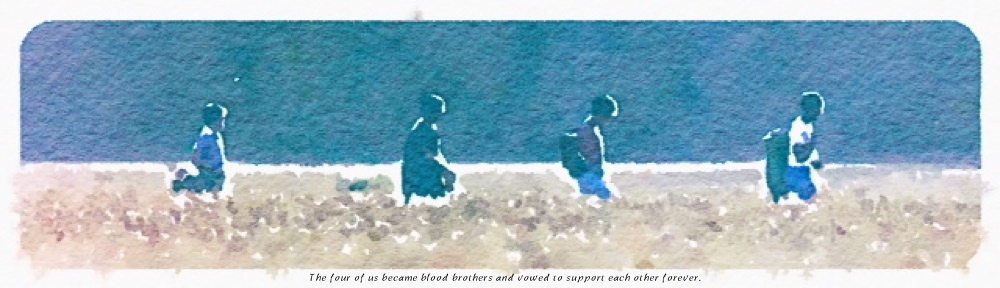
“That’s where Malcolm insisted we become blood brothers,” Dondi remembered.
“Blood Brothers of the Cayadutta,” Woody added.
“We took a blood oath to have each other’s back forever,” I said.
With that, we fastened our seatbelts and rode an adrenaline high across the Atlantic, sharing stories from when we were last all together as kids. The plane was our time capsule, leaving contrails of toxic leather mills, leukemia, astrological curses, migraine headaches, and anti-anxiety medications hanging in the skies behind us as we hurtled ahead through the pure black air toward dawn.
 Searching for Malcolm
Wow, it would be great if it did happen that way. Bring tears to my eyes.
LikeLike
Malcolm is my cousin and we have lost touch. Would love to reconnect with him. If you can put me in touch with him, I’d appreciate it. He would know me as Sally Richmond.
LikeLike