Kong

Q: If Paper covers Rock, Scissors cut Paper, and switchbladeRock breaks Scissors, what defeats a Switchblade pulled on you by the school bully?

A: A Slush Puppie.

“Hit me, hit me,” Dukey screamed as he raced down court.

Arm cocked, I froze at the sight of Royal Eaton pawing through my gym bag at the far end of the Briggs Street court.

Royal had been held back so many grades no one knew his real age. He went by the name of Kong, probably because it sounded way tougher than Royal—and more flattering than the one that kids uttered behind his back. When teachers called “Eaton” during roll call, some of the braver boys whispered, “Turds.”

Kong pulled something out of my gym bag, held it up over his head, and shouted, “Hey, Parker, ya think you’re some hot shit or something?” As I got closer, I realized he was holding up an Ace bandage rolled up, the brand name Ace neatly framed between the two metal tabs securing it.

“Just give it back, Kong,” I said, hoping to distract him from my fourteen-dollar fortune. He hadn’t yet noticed the wallet among the sweatshirt, candy wrappers, dirty socks, and peanut butter sandwich.

“What, ya think you’re such a hot shit, you write Ace on your stuff?” Kong asked.

What an idiot this guy is, I thought. “That’s the brand name, Kong. Hey, if you’re going to keep my gym bag, at least give me my dirty socks out of it.”

“I’m not interested in no dirty socks,” Kong snarled as he slammed the bag into my chest, knocking the wind out of me. “But I’m keeping this — Ace,” holding up the rolled bandage as his prize.

Locating my wallet in the bag, I fished out the remainder of my sandwich as a decoy, and stuffed half of it into my mouth. Kong stared at me while I chewed. He held out his hand and said, “Let’s see what else ya got in the bag, Ace.”

I calmly walked away, grabbed my basketball, stuffed it in the bag, and zipped it shut. As I picked up my bike, Kong bellowed, “Hey, I’m talkin’ to you, Ace!”

Without saying a word, Dondi nonchalantly jaywalked, positioning himself in a way that blocked Kong from me. I took several quick strides, jumped on my bike and pedaled off. “I’d love to stick around, Kong, but I have to go,” I called back over my shoulder, standing up on my pedals to accelerate.

Kong made his move to the left of Dondi. As he did, Dondi maneuvered to block his path. When Kong reversed course to veer around behind him, Dondi moved again. By then, I was safely out of reach.

Kong glared at Dondi through the thick lenses of his black-framed glasses. Standing there with his jaw jutting out, he looked a lot like one of the Marquis Chimps on The Ed Sullivan Show. They put the same glasses on some of them to make them look more human. “You know, Kong, there’s no name for that,” Dondi said.

“The hell you talking about?” Kong asked, backing off slightly from his attack-mode pose.

“It’s like when you meet someone in the hall in school and you block each others’ paths. One guy jogs one way, but the other guy accidentally goes the same way, so they’re still blocked. There’s no name for that maneuver,” Dondi replied.

“Yeah, right, like you didn’t do that on purpose, so your faggot friend could get away.”

“There’s no name for this, either,” Dondi rambled on, pointing with his forefinger to the spot between his nose and upper lip.

“You’re a real dipshit, you know that?” Kong leaned forward and placed his finger in the cleft above Dondi’s lip and twisted it back and forth, like his finger was a cigarette he was grinding out. “And it has a name. It’s called your mustache!” With that he jabbed him so savagely he snapped Dondi’s head back, drawing a faint line of blood with his fingernail.

Dondi interpreted Kong’s threat as permission to leave. He grabbed his bike and pedaled out Briggs Street, across The Arterial Highway to the Dairy Queen, where we always went after playing hoops. I sat on one of the picnic tables on the side of the building in the shade. Dondi walked out of the Dairy Queen carrying two drinks and joined me.

“Here, this one’s for you,” he said, handing me one of the cups.slush

I took it and stared at its bright-blue contents. “What is it?”

“It’s a Slush Puppie. It’s new. Just don’t drink it too fast,” he warned.

“Sorry to leave you hanging back there,” I said, noticing the red mark above Dondi’s lip. “Thanks for covering my escape.”

“That dumb ape…” Dondi started to say and then stopped. I followed his gaze to the other side of the parking lot. Locked in on us like a heat-seeking missile, Kong walked straight up to me with murder in his eyes. “Give me the gym bag,” he demanded.

I went as icy-cold as my drink when I noticed the unopened switchblade in his hand. I raised my cup to him in a friendly, toast-like gesture. “Hey, Kong,” I said in a voice that even to me sounded far away, like someone else had said the words.

“I’ll take this first,” Kong said, as he reached out slowly and took the slush from my hand. He looked at me accusingly. “Dirty socks, my ass. Let’s see what else ya got in the bag.”

Instinctively I closed my hand on the loop handles of the bag sitting next to me, never taking my eyes off of Kong.

“We’ll give it to you without a fight on one condition,” Dondi said.

“One condition? That’s a laugh,” Kong said. He flicked the switchblade open.

Even though I thought the blade was mainly for show, I dug my elbows into my knees to stop my legs from shaking. Kong flashed a crazy smile, drunk on his powers of intimidation.

“If you can down that Slush Puppie in under a minute,” Dondi said, “we’ll give you the gym bag and everything in it.”

I shot Dondi a skeptical look.

Kong straightened up, puffed out his chest and smirked. “I can suck down a beer in ten seconds. Why would this candy-ass little drink take me a minute?”

“It’s not as easy as you think,” Dondi warned him.

Kong slowed down, thinking hard. “Tell you what,” he said. “Throw in a dollar with the bag if I win, and you’re on.”

Dondi fished a dollar bill out of the front pocket of his jeans and placed it under my gym bag. “Okay, you win the bag and a buck if you can down that slush in sixty seconds or less. But if you can’t do it, we have to get something in return.”

Kong looked at Dondi warily. “Yeah, what’s that?”.

“If you lose, we get to call you by your other nickname — the one you don’t like,” Dondi said. “And you can’t get pissed at us when we do,” he added.

Kong inhaled noisily through flared nostrils, glaring first at Dondi, then me. “Okay. That’s fair, especially since I get to call you assholes whatever I want all the time.”

Dondi studied his watch, waiting for the second hand to come around. “You ready then? Five, four, three, two, one, go.”

Kong leered at us, scribing small circles in the air with his switchblade and paying no attention to the drink in his other hand.

Dondi counted down the seconds. With twenty seconds remaining, Kong tilted his head back and dumped half the contents of the cup into his gaping mouth. His Adam’s apple danced up and down like the bobber on a fish line when a little sunny hits the hook and struggles to pull the bobber under. Swallowing that first huge gulp, he poured the remainder of the drink into his upturned mouth.

Dondi watched Kong intently, glanced down at his watch and softly said, “Ten seconds left, Turd.”

That’s exactly when Kong emitted a thunderous, enraged bellow. I raised my arms instinctively, to protect myself. Instead, Kong sank to his knees, lowered his forehead to the ground, and let out a deep, vibrating moan. I turned back to Dondi looking baffled. He smiled at me, shrugged, and said, “Brain freeze — I tried to warn him.” I picked up my gym bag and Dondi pocketed his dollar bill and we rode away on our bikes before Turd’s brain thawed out.

Hoeppner’s Candy and Radio Repair

images-1

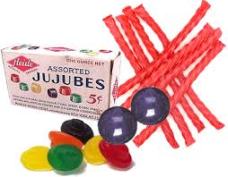
No adults ever suspected that Old Lady Hoeppner dealt drugs to elementary and junior high school kids out of her store on the corner of Maple and Cady Street. The drug of choice was sugar, dispensed in the form of Atomic Fireballs, malted milk balls, grape jawbreakers, Red-Hot Dollars, licorice laces and other odd-named penny candies.

Many of these candies had the same rubbery consistency and no taste other than a mucky sweetness. But the taste didn’t matter all that much; it was all about the sugar buzz.

The penny candies were unwrapped and protected from shoplifting fingers in a walnut and glass display case that looked like it might have previously been used to display bodies in a funeral home.

Dealing sugar wasn’t the only commerce that took place in Hoeppner’s. Mrs. Hoeppner’s adult son, Aldo, ran a radio repair business somewhere in the back part of the building. I doubted many radios were repaired there, at least judging by how often Aldo wandered out into the candy store to check in on his mother’s customers.

Mrs. Hoeppner glared at us one at a time through her old-world glasses – the ones that were just glass, with no rims – and with a slight nod of her head said, “What’s yours.” It wasn’t a question; it was a demand. Her gray hair was pulled into a bun at the back, and she moved angrily about the little shop draped in a floral print housedress, stomping on the oily, blackened wooden floor with her lace-up heeled shoes.

Her oddness intimidated us into an inoffensive form of politeness – not unlike the phony kind practiced by Eddie Haskell on Leave it to Beaver. Dondi especially would say things like, “Hello, Mrs. Hoeppner, it is so good to see you today. Those new Chunky candy bars for only ten cents certainly look like a terrific value.” The fact was Chunky was the worst deal in the store, maybe in the entire world of candy.

But when Aldo walked into the store, we didn’t mess around. He looked to be in his early-forties and wore a buzz cut, even though he was balding (Woody called it his “buzzard cut”). Tufts of back and chest hair sprouted out around the neckline of his white T-shirt. He carried his arms out away from his body, as if holding invisible suitcases in each hand.

I often wondered about the radio repair business supposedly squirreled away out back somewhere. I pictured racks of vacuum tubes of all different sizes that had been purchased as part of the Radio Repair Correspondence Course. Of course, transistors had become such a big deal that vacuum tubes were pretty much obsolete. But our real fear was that what Aldo really had hidden out back was a big chest freezer, with children stacked up in it like cordwood.

While the penny candies provided us with sugar on the go, for instant injections we perched on the round swivel stools and osodafountainrdered from the soda fountain. Gleaming silver hand pumps, lined up like toy soldiers behind the counter, squirted thick, sweet syrups in all flavors — Coca-Cola, 7-Up, Pepsi, root beer, cherry, chocolate, strawberry, vanilla, and grape. We were forever experimenting with new flavor combinations. For several weeks Malcolm tried to convince us that Chocolate 7-Up would soon sweep the country. I told him it tasted like dirt.
“When I become famous and you’re bragging to everyone that you knew the bloke who invented it, I won’t give you the time of day,” he said.

Woody worked with cherry as a base flavor and hit on something decent with Cherry 7-Up. My signature drink was Vanilla Coke. But Dondi never ordered the same thing twice. When he ordered a Pepsi-Cokesy, the name sounded so cool we all knew he was onto something. But Old Lady Hoeppner scowled and shook her jowls, refusing to mix it. It was so unlike her to turn down a dime, we figured that Pepsi and Coke probably had a law against mingling the brands.

Shortly after graduating from the sixth grade, we streamed into Hoeppner’s all sweaty from a game of basketball on the courts across the street. When it came my turn, Mrs. Hoeppner nodded at me. “What’s yours.”

“May I please have a glass of water to start, Mrs. Hoeppner? I’m awfully thirsty.”

Magnified through her glasses, her eyes blinked owl-like several times before looking down to locate a glass. She filled the glass from the tap and clanked it down in front of me on the marble counter. As she turned to fill Woody’s Cherry 7-Up with cold seltzer, I dug a foil packet of Fizzies out of my jeans and dropped the two strawberry-flavored tablets into my glass of water. Fizzies were flavored sparkling tablets, from the same folks who brought us Bromo Seltzer. They didn’t really taste that great. But if you put them in your mouth they would foam up and you could run around pretending to be a dog with rabies or a crazy man. Of course, parents hated seeing their kids being so good at that kind of thing. So they started a rumor that if you swallowed a Fizzie whole, your stomach would burst.

fizziesWoody, who was watching me attentively, suddenly cried out, “It’s Fizzling!” He said it in the same excited voice as the dopey kid in the Fizzies commercials. That got Old Lady Hoeppner’s attention in a hurry. She whirled around faster than I’d ever seen her move, locked her eyes on my glass of water fizzing away, and latched onto my glass with both hands.

We played a back and forth tug of war that looked like two lumberjacks working a bucksaw. For an old lady she was pretty strong. So I pulled harder, and surprised her with my strength, pulling her up on her tiptoes. Then she dropped her big butt for leverage, hauling me halfway across the counter. I was just fighting for my Fizzie. But she was fighting something much bigger — a dangerous, new-fangled trend.

Malcolm, Woody, and Dondi were cheering wildly, like it was a TV game show. I gritted my teeth and searched Mrs. Hoeppner’s face for some sign of weakness. That’s when I noticed Aldo in the doorway, looming behind his mother. He walked quickly over and squeezed both of my wrists, forcing me to release my grip.

“What are you a tough guy?” he said, trapping both my wrists in one of his mitts. “Fighting with a woman? The hell’s wrong with ya?”

“She was trying to take my drink away,” I said.

“He no pay,” said Mrs. Hoeppner, wagging her boney finger in my face. I jerked my head back startled by her sharp, yellow fingernail. Aldo held my wrists tighter.

He put his face uncomfortably close to mine, exhaling sour coffee breath. “You didn’t pay?” Clearly this was a worse sin than arm-wrestling with his elderly mother.

“It was just a glass of water,” I said, hoping my voice didn’t sound as whiney to my buddies as it did to me.

“He no pay,” Mrs. Hoeppner said again.

“Get the hell out of here and don’t come back,” Aldo said, leading me to the door. He opened the door for me, which I thought was quite polite of him until he flung me to the sidewalk. As he stood over me, I noticed a brief look of concern in his eyes. Perhaps he worried that he had been too rough. But then he said, “And don’t come back for two weeks.” That’s when I knew his real fear was the lost revenue if he banned me for life.

Occasionally Hoeppner’s attempted to branch out of the candy and soda business into other merchandise. Experimental racks of yo-yo’s, rocket-shaped crystal radios, or cap guns would mysteriously appear. We always inspected the stuff just in case there was something interesting, but never bought anything. If we could get the same item for a nickel less, we would ride our bikes downtown to get it at Gould’s or Newberry’s. Besides, Hoeppner’s never had anything new and different — at least until the day we stood staring at a display of peashooters.

We walked out of the place armed and in search of targets. Malcolm took aim at the white Ford Falcon parked across the street. Ping! He raised his fist triumphantly and shouted, “Bulls-eye.”

Dondi rolled eyes. “It’s a car for Christ sakes. Let’s see you hit that stop sign.”

Malcolm, Woody, and I all fired at once. Ping! Ping! Ping! We immediately went back into Hoeppner’s and bought more ammo.

We wandered over to Knox Field and parked ourselves on the bank behind the tennis courts. The two men in front of us were running around under the hot sun, diving for shots on the hard court.

“What d’ya think the odds are of me shooting a pea clean through that chain link fence?” Woody asked.

The guy on the court in front of us was bouncing the ball, preparing to serve. I gave Woody a skeptical look.

“You know,” Woody said, “kind of like a science experiment.”

When Woody fired, the guy duffed his serve into the net, double-faulting. He turned and glared at us. I wasn’t sure if the sound from the peashooter had distracted him or if he had been hit. The man walked across the court, meeting his opponent at the net, suggesting to us that their match was over.

“I thought that clot was going to come after you,” Malcolm said to Woody.

“Think again,” Woody said, pointing across the court. The man had exited the gate on the far side, and was circling around the court toward us. His opponent joined in, heading in the opposite direction to catch us in a pincer attack.

The Chase was what we both hoped for and feared. In the same way that the Swamp Fox on Walt Disney made the British look foolish, and Zorro outwitted Sergeant Garcia, every eleven-year-old boy secretly believes that through superior wit and guile he can outsmart and outrun the enemy. We knew every secret shortcut, path, and hiding place at Knox Field. So, as terrifying as it was to have two grown men with tennis rackets in their hands closing in on us from two different directions, we knew we held the advantage.

Surveying the angle of attack of our pursuers, we sprinted down the stone-dust path paralleling First Avenue. The guy coming at us clockwise believed he had us trapped. “I’ve got you, you little shitheads,” he screamed, waving his racket overhead as he closed in on us. There was no exit in the high, spiked wrought-iron fence in the direction we were headed. But what we knew and he didn’t was that there was one bar in the fence that had been bent when a garbage truck backed into it. The gap had been widened just enough for us to squeeze through.

We piled up at our exit spot like subway commuters at a turnstile. We pushed Malcolm through first, and then Woody and I slipped through behind him. The closest pursuer was closing in fast on Dondi as he squatted down to angle his head through the widest part of the opening. Believing he was about to catch one of us, the man bellowed, “Come to papa, you little bastard!”

Dondi jammed his head through the bars, bending his ears back in the process, and lunged forward, just as the man dove. It may have been our volley of peas shot at point blank range that made the guy flinch and miss grabbing Dondi’s legs.

Dondi bounced to his feet and stood just beyond range of the man’s outstretched arms. “You are not my papa,” Dondi said in a calm voice that was spooky, especially considering that the guy’s hands were so close to reaching Dondi’s neck.

We raced down First Avenue toward the junior high school building. But Dondi stopped short, as if he had forgotten something, and turned back toward the man at the fence.

“What the heck are you doing?” I asked. “Let’s get out of here.”

Dondi stared back at the man. “If that was my father, he would have caught me,” he said.

I grabbed his arm, and we both turned to catch up with Woody and Malcolm. The number of cars parked around the school suggested an event inside, so we raced across the front lawn and ducked in the main entrance on Perry Street. Inside, we heard muffled, discordant sounds emanating from the bowels of the school, as if the building had indigestion. The high school spring band and chorus concert was in full swing.

Fearing that our pursuers were close behind, we hid out in the projection booth above the balcony. Far below, Mrs. Gates was conducting the chorus in a sappy rendition of “Sleep Kentucky Babe.” We peered through the portholes normally used for the lights and projectors. The chorus was singing, “Skeeters am a hummin…” when Woody fired a salvo of peas out his porthole. Mrs. Gates was stretching her arms outward, directing the singers. Her right hand suddenly snapped to the back of her neck as if slapping at a mosquito.

“Hey, did you see that?” Woody whispered. He studied the peashooter in his hand, and then us. “We couldn’t really have the range from up here, could we?”

So we all joined in. At first nothing happened. We put more into our shots, arching our backs, and then snapping forward as we fired. Members of the chorus started flinching and swatting. Excited that we were on target, we rained destruction down on the performance below. It wasn’t easy because we were laughing so hard.

“Awck. I think I inhaled a pea,” Malcolm said. He held his throat with both hands as if choking.

That’s when the door to the projection room burst inward. A silhouette of a huge man swung crazily from side to side in the doorway, apparently trying to peer through the darkness. “Who is it and what are you doing up here?” the form asked. I realized it was Mr. Gates, the teacher the high school kids called Norman, as in Norman Bates from the movie Psycho. He was a tall, severe-looking man…and the husband of the embattled woman trying to conduct down below.

I was about to say we weren’t doing anything when I heard Dondi say, “We’re working the lights for the concert. Mr. Rhodes asked us to.”

One lone spotlight at the far porthole bathed the stage below in light. It certainly didn’t take four of us to work it, especially since it hadn’t moved. And it wouldn’t take much for Mr. Gates to ask the band instructor Mr. Rhodes if Dondi’s claim was true.

“Then concentrate on your work and stop making so much noise.” With that, he quietly shut the door.

We stood motionless for a good five minutes, listening. Malcolm finally said, “Let’s get the F out of here.”

“Get the F out of here?” Woody repeated. “What the fuck’s that supposed to mean?”

“It’s code in case he’s out there laying for us,” Malcolm whispered.

“Right. Like wrecking his wife’s concert is okay, but swearing would be the final straw,” Woody said.

“Why don’t we go one at a time and make a rendezvous, like in The Great Escape,” I suggested.

Dondi offered to go first. “If he’s out there, I’ll just say I’m going to the bathroom. If I don’t come back in five minutes, you’ll know it’s safe.”

So we snuck out one at a time and regrouped two blocks away on Malcolm’s front porch. In The Great Escape — in our opinion the best movie ever made — we had watched in disbelief as the escapees were recaptured one by one, and about fifty of them were machine-gunned by the Germans. In the movie, only Danny, Willie, and Sedgwick made it to freedom. Yet we all escaped our peashooter caper unscathed, further reinforcing our belief that we were invincible.

Blood Brothers of the Cayadutta

When I was in the sixth grade our school dreamed up a new way to save us from Russian missiles — a go-home air raid drill. We webloodcropre sent home with instructions to hide in our basements all afternoon. My friends and I were like, “Yeah, right.” Instead, we biked straight out of town to our secret Indian village on the banks of the Cayadutta.
Those who never smelled the Cayadutta probably found the name noble sounding — in a Native American sort of way. But in our hometown, the stream that carried sewage, chemicals, flesh and hair from the tanning mills, only inspired insults. Kids who lived along the Cayadutta were sewer rats. One classmate was so slovenly he became known simply as Cayadutta. It was about the lowest name you could call anyone.

Flushed out by side streams, the Cayadutta flowed a bit more cleanly by the time it reached Sammonsville. It was near there that Malcolm had first spotted a high bluff above the stream and insisted that’s where he would live if he were an Indian. We all agreed he was right. We pictured a Cayadutta full of trout, deer in the forests, and gardens on the bluff providing corn, beans, and squash for our tribe.

On the afternoon of our go-home drill, we gathered firewood and built a teepee-style campfire at our secret spot. I produced a package of Oscar Mayer hot dogs I had hocked from my parents’ freezer and we roasted them on sticks. There was no bread, mustard, or ketchup – just water from our canvas-covered army canteens.

Malcolm washed down his second wiener with a big swig, and let loose a throaty belch, followed immediately by, “No Slugs! P.A.A.!”

“Slugs,” I shouted, too late. Malcolm had repelled my knuckle punch by calling No Slugs first.

“Eagle Claws,” Dondi countered, lunging for Malcolm’s belly with fingers flexed like talons.

“I called P.A.A.” Malcolm said, sidestepping and straight-arming Dondi’s attack.

“Yeah, what’s that supposed to mean?” Dondi asked.

“Protection Against Anything,” Malcolm said, sticking his chin out, challenging him.

“That’s brilliant,” said Woody, who was never all that much into this game anyway.

“What if I just call N.P.A.A.?” Dondi asked. He looked unsettled by Malcolm’s game-changer.

“N.P.A.A.?” Malcolm asked.

“NO Protection Against Anything,” Dondi said.

“It’s Protection Against Anything. That means anything.” For emphasis, Malcolm rolled up the sleeve of his favorite gold football jersey. He’d gotten it at the knitting mill and had cut off the sleeves at the elbow, right below the purple and white stripes. He showed us the bruises on his upper arm, and looked at Dondi accusingly, daring him to argue.

Dondi held up his hands in protest. I couldn’t tell if he was declaring his innocence — or surrendering.

“Hey, let’s find us some Arty-Facts,” Woody said, redirecting us back to the real purpose of our expedition.

The four of us scoured the village, picking up any sharp rock that might pass for an arrowhead. Larger pieces were spears and tomahawks. Flat, square-edged stones were fragments of pottery. Too soon, the length of our shadows on the ground told us it was time to head home.

After gathering our things and peeing on the fire, Malcolm proposed we become Indian blood brothers. Producing a drop of blood doesn’t sound like a big deal — until you try to do it with the point of a jackknife. Woody lit a match to sterilize the blade. Malcolm went first and carried on like a big baby, but it was only for show, to get the rest of us laughing while nervously waiting our turns.

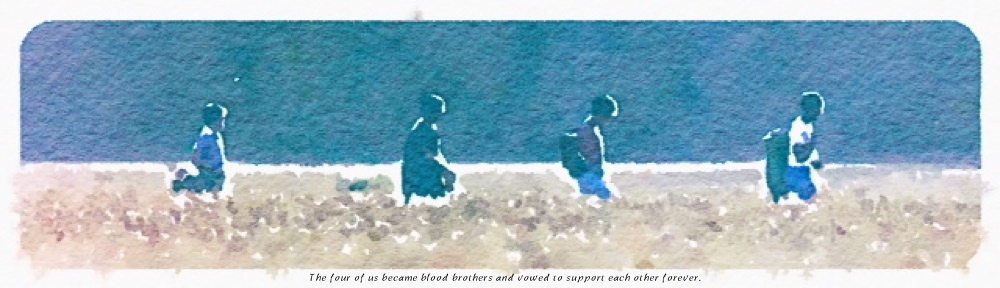
I went last, with Dondi, Woody, and Malcolm chanting “Hurry! Hurry!” as they tried to keep their blood fresh, by squeezing more out of their fingers. Egged on, I sliced too deeply. With that, Dondi, who had the most theatrical flair, raised his finger up high, and said, “In the spirit of the Great Iroquois Nation, I hereby pronounce that we are now blood brothers of the Cayadutta Clan…bound to support and defend each other forever.”

No one could top that, so we looked each other in the eye and nodded our agreement. The smoke from the dying fire hung in the air, on our clothes and in our hair. Only I could reach Dondi’s bloody finger comfortably. Malcolm and Woody stood on their tiptoes and craned their bodies and necks upward, like baby birds reaching for food. Then we put our fingers together, and solemnly mixed our blood.

When you’re eleven years old, competing to collect the best Indian artifacts, it’s easy to get carried away. Each of us carried at least fifteen extra pounds in our knapsacks, and it was a five-mile bike ride back to town, even going the shorter way home on the highway.

After dinner that evening, I cleared all the books off my bedroom shelves, and neatly arranged displays of arrowheads, spearheads, tomahawk heads, and pottery pieces – just the way they did at Johnson Hall. I didn’t have any cool stuff like musket balls or scalps to display, but that didn’t stop me for weeks from charging five cents admission from neighborhood kids to see my collection. I would also take baseball cards in trade from those who didn’t have a nickel.

Returning home from school one day, I discovered my entire Indian arrowhead display replaced by a lame store-bought rock collection, with samples neatly labeled and glued inside a cardboard box. Eventually, Woody’s, Dondi’s, and Malcolm’s arrowheads met the same fate, tossed in the garbage, and all buried together in Johnstown’s landfill.

Many years after our discovery and plundering of the site, historians verified the location of an ancient Iroquois Village on the east bank of the Cayadutta, about a mile upstream from Sammonsville — at the exact spot where we became blood brothers. The public is now restricted from visiting this area for fear that the archeological purity will be violated.

No doubt, several hundred years in the future, when the remnants of our arrowhead collections are unearthed beneath tons of household garbage and tannery wastes, future historians will locate another Iroquois Village below the site of the old, 20th century Johnstown Landfill.

The Statue of Liberty Play

The west eFullSizeRendernd kids always beat us in sandlot football except for one time — thanks to this truly miraculous, admittedly crappy trick play.

Our south end team played our home games on the front lawn of the old Knox Gelatin Factory on Chestnut Street. The side boundaries were enforced by a high curb and asphalt driveway on one side, and a stretch of woods on the other.

The prior year, one of our players, Charlie “Clunk” Knolls, who later in life had a try out with the Baltimore Colts, sustained a compound spiral fracture of his right femur when he was gang tackled onto the asphalt. I had stood over Clunk urging him to shake it off, until Malcolm came over and pointed out that Clunk’s foot was on backwards. The doctors put a bolt through his cast and slung his leg up in the air with cables until Thanksgiving. Sixth-grade fractions, multiplication tables and world geography passed him by forever. But Clunk was back on the field this year as we warmed up in our flimsy helmets and shoulder pads from Woolworth’s.

We heard the pack of west end kids whooping and hollering before they even turned the corner onto Chestnut Street. As they approached, they were in constant motion, as if they had already started the game. Their quarterback, who was called Beanie, launched long, flat spirals to Weasel, Tuna, Sandman, and Tombstone. We tried not to stare. Malcolm sent me out for a pass and twice waved me deeper. The ball wobbled end over end and fell at least ten yards shy. One of the west end kids they called Junior slapped his thighs with both hands and, pointing in the direction of the pass, said, “What do ya call that? A wounded duck?” Another kid they called Soda started making quacking noises.

“What’s that Mambo kid doing here?” Dondi whispered to me.

I stole a glance at the other team. “Is that Dom Schialdone?” I asked.

“Yeah, it’s Mambo,” Dondi repeated. “They’ve never brought him along before.”

“Maybe he’s their manager or something,” I suggested. He carried a black metal lunch box with adhesive tape crosses at each end, suggesting it contained their first aid kit. “He doesn’t even have a helmet,” I noted.

Mambo had arrived from Italy two years earlier. With his thick glasses and white short-sleeved dress shirts, he normally looked like a portly middle-aged man. But on this day, stripped of his glasses and dressed in a gold jersey, he looked as solid as a bowling ball, outweighing any of us by at least fifty pounds.

After the third play from scrimmage, Malcolm pointed at the bright red strawberry on the inside of his forearm. “That Mambo fella is a bit testosteroney. He has whiskers like sandpaper,” he said.

When Mambo carried the ball, it took three or four of us to ride him to the ground.

At halftime, Mambo lifted his first aid kit for me to see as he brushed past me. “For emergency use only,” he said with a grin. I peered over his shoulder as he knelt down and unhinged the top of the box to reveal a pack of unfiltered Camels and a can of Budweiser.

While our team retreated to the shade of the trees to plan our second half strategy, the west end kids never stopped moving. They ran pass patterns and made leaping catches. Only Mambo paused long enough to lounge on the grass, enjoying his beer and smokes.

Miraculously, toward the end of the game, our team trailed the west end by less than a touchdown, thanks largely to Mambo leaving early to go work at his uncle’s liquor store and to a totally unlikely touchdown pass in the third quarter. Malcolm called for a deep pass to me down the right sideline along the trees. Seeing that I had slipped behind the defense, Malcolm uncorked a pass that was well beyond his range. The extra effort produced an unnatural hook in his throwing motion that caused the ball to veer unexpectedly to the left instead, hitting Clunk mid-stride for a touchdown as he streaked down the left sideline.

Malcolm walked up to Junior, the kid who had laughed at his warm-up passes, and asked, “How do you like that wounded duck?”

“Yeah, right! Ya wasn’t even throwin’ to him,” Junior said, bumping Malcolm with his chest.

“Right on the numbers, ya scruffy knobhead!”

Sensing from Malcolm’s tone that he had just been insulted, Junior bumped Malcolm again. “Your ass. You were looking at your other receiver the whole time.”

“Does Johnny Unitas look to Raymond Berry the whole time?” Malcolm shot back. “He looks to Jimmy Orr, then hits Ray Berry for the TD.”

The argument might have evolved into a fight if the west end players hadn’t been so anxious to get the ball back to pad their small lead. Several teammates grabbed Junior and dragged him to their side of the field. The two teams traded the ball back and forth several times without scoring. Then, with one-minute left, Woody, whose usual role was distracting opponents with his sarcasm, pounced on a fumble near our end zone.

In the huddle Malcolm said, “Don’t look now mates, but we’ve got some admirers from the Future Cheerleaders of America.” He loved creating odd spin-offs like that of real clubs like The Future Farmers of America. He nodded his helmet up toward Chestnut Street where half a dozen girls stood in a tight circle, feigning disinterest in our game.

Normally Malcolm called for either a running play up the middle with Dondi taking the hand-off or a pass to me. But at this moment, with time running out, Malcolm called for our ultra-secret, often discussed but never practiced, end-around Statue of Liberty play. At the snap, Malcolm would drop back to pass and pump-fake to Clunk, who was going deep on the left side along the driveway. Then he would transfer the ball to his non-throwing hand and I would snatch it from him as I ran around behind him.

I lined up next to Clunk, forcing the defense to shift to that side. The pump-fake froze the defense long enough for me to circle around behind Malcolm, take the handoff and sprint around the right end toward the trees. I was within ten yards of the goal line when the kid they called Tombstone knocked my legs out from under me with a cross-body tackle. Diving forward for extra yardage, I landed on my belly and slid into the woods.

“Lawn sausage,” Tombstone screamed as he back-pedaled away from the scene, frantically checking his clothes. All the west end kids in the vicinity hopped on one foot, then the other, inspecting the bottoms of their sneakers. As I scrambled to my feet, the one called Tuna pointed at me, then threw his head back and barked. Soon the entire west end team joined in, laughing and howling like a pack of wild dogs. The air was thick with a smell way worse than the Cayadutta. I glanced down at my jersey and jeans and gagged. I had belly-flopped on a dog pile and slid through it.

Meanwhile Clunk’s older brother Billy, who was officiating, had marked the ball on the two-yard line. My teammates were jumping up and down, screaming for me to hurry back to the huddle. The west end kids stopped barking and starting complaining, “Come on ref! Time’s up!” Billy studied his watch and shook his head no. There was still time.

Malcolm called what would surely be the last play of the game. “Dondi through the middle on two,” he whispered hoarsely. It’s not that he needed to whisper; the west end team would surely be keying on Dondi anyway.

When we broke from the huddle I stepped between my team and the line of scrimmage and said, “Same call, but let me run the ball.” When Malcolm protested, I spread my arms and took a step toward him. Malcolm’s eyes opened wide with alarm before flashing a look of understanding. “Brilliant,” he said, “Lucas through the middle on two.”

I nearly fumbled the handoff when Malcolm tossed the ball in the air to avoid any contact with my fouled jersey. The west end defenders allowed me to waltz into the end zone untouched. Almost immediately after the winning score, Billy called time. Our south end team had won our first game ever against the west end kids.

Despite their aloofness, the Future Cheerleaders of America had to have noticed who had scored the winning touchdown, but it had come at a price. As Dondi, Woody, and Malcolm walked back up Maple Avenue with some of the girls — I straggled along at least a half block behind the group, earning a totally undeserved but no less fatal reputation for being shy when it came to girls.

Blue Collar Cotillion


cotillionphotoWhen I was in the seventh grade I switched churches for an Indian Princess, only to have true love spoiled by a freak accident in the men’s room at the Rollerama. 

Thirty or so adolescent couples shuffled around the mahogany raised-panel room, counting out the steps to the foxtrot on the parquet floor of the old Treadwell Inn’s Colonial Ballroom. The red letters on the bass drum grandly promoted the tuxedoed trio of musicians crammed into the corner of the room as The Johnny Lanier Orchestra. The boys’ heads rhythmically bobbed up and down as they alternately studied their feet, then looked up to avoid collisions. I did my best to steer Missy Grazinski, who was actually cute in a perky, Brenda Lee sort of way. In fact, she was a local singer of some notoriety, having sung Brenda Lee’s hit song, “I’m Sorry” on the local TV variety show, Teenage Barn. The only problem with Missy was that I was at least a foot taller than her. I stepped forward trying to lead, but her backward step was too short for my long legs. My knee slid against the silky fabric of her dress and nudged a soft part of her body. I prayed it was just her leg.

“Ahh, sorry,” I mumbled, uncertain if I should acknowledge the contact or not.

Missy’s upturned face glistened under the ceiling lights of the old ballroom. “That’s okay Lucas,” she said with a big smile.

Although other seventh-grade boys might have taken her response as encouragement, I backed my legs away from Missy to avoid any further contact. After all, this was cotillion — where we were expected to learn etiquette, social graces, and ballroom dancing.

“No, no, no, no.” The excited voice from the middle of the room instantly made all the boys jumpy. I felt Mrs. Cicotti’s hand ease my outstretched butt back toward Missy. Everyone else stopped to watch.

“Are you afraid to get close to your partner?” she asked as she manipulated me into a more upright position as if I were a Gumby toy. “Here, let me demonstrate.” She took my right hand and placed it well around her own back. “The male’s right hand should be in the small of the woman’s back,” she said to everyone in the room.

I didn’t feel any smallness in the dance instructor’s back. She continued to hold my hand on her back to keep me from backing away. Her ample bosom pressed into my collarbone.

“You are bobbing your head up and down like one of those toy birds that sips out of a glass of water.” She rocked her head up and down, drawing a few nervous laughs from the crowd. “You do not have to check on your feet,” she announced, staring down to demonstrate. “Because they are not going anywhere.” I felt her swell with pride at the effect her punch line had on everyone else. But as I took in the roomful of laughing faces, I knew their laughter was mostly relief that they weren’t in my shoes.

“You should look at your partner,” she said, now smiling at me. “And carry on polite conversation.”

Her hair was pulled back tightly away from her face, exposing a row of grey roots at her scalp line. I tried not to stare at her faint mustache. At this range I could see all the fine lines in her face she had powdered over.

“I think I have it now,” I said, hoping that would be enough for her to release me.

“Yes, like this,” she said, standing up straight. “Not like this.” She bent at the waist sticking out her bum, mocking me. All the boys and even some of the girls in the class laughed.

The drummer popped his snare drum emphatically to signify it was the end of the song and time for their break. The band retired upstairs to the bar while the boys in the class retreated to the punch bowl.

“Man, she had you in her death grip,” Dondi said to me.

“You’re lucky you didn’t get your eye put out with one of her knockers,” Woody said.

Mrs. Cicotti clapped her hands together rapidly to hurry us up. “Boys, boys, you’re supposed to be offering refreshments to your partners.” She gestured to the girls sitting patiently in their fluffy dresses on metal folding chairs on the opposite side of the room. “And don’t forget the stimulating conversation,” she whispered.

Dutifully, I made my way across the room toward Missy. “Here, I brought you some punch and cookies,” I said, holding them out to her.

“Thanks, Lucas.” She beamed her usual, upbeat smile.

“Sorry I got us singled out,” I apologized. “That was pretty embarrassing, huh?”

“Don’t worry about it, Lucas.”

The seats on either side of her were taken, so I continued standing. I wondered if I should drop down on one knee to be at her level, but shook that idea out of my head. “Well, I better get going,” I said tilting my head back in the direction of the punch bowl.

“Okay, see you later.”

“Yeah, see you later.”

Terry Webb was seated next to the punch bowl with at least a dozen empty glasses scattered in front of him. He was a big kid with droopy, basset hound eyes. He always put on a terrific show of pretending to get drunk on the punch. He claimed he perfected this act by watching his dad — who owned a big leather mill in town — drink Manhattans every night at home.

“How many is he up to?” I asked as I sidled up to Malcolm.

“He’s at twenty-two cups and acting totally bladdered,” Malcolm replied.

Terry was closing in on his record of twenty-seven cups when Mrs. Cicotti called for everyone’s attention.

“We have a special surprise tonight.” She tapped Johnny Lanier’s big silver microphone. Doink, doink, doink. The amplified noise startled her, causing her to step back into one of the Grunert twins, nearly taking her out.

Dondi leaned close to me and imitating Mrs. Cicotti’s baritone voice, whispered, “Tonight we’ll practice proper introductions.”

Mrs. Cicotti composed herself and spoke into the microphone. “For a special treat tonight, Cammie and Connie will sing several of their beautiful harmonies for us.”

I groaned to myself. The previous month I had been matched up with one of the Grunert twins as a dance partner. I never did figure out if it was Cammie or Connie, which probably didn’t help. All she wanted to talk about was The City, where her cousins lived. I tried to shift the conversation to Roger Maris who, after all, played baseball in The City. But she put on a bored expression and said she could care less about whether Roger Maris broke Babe Ruth’s home run record.

When I told this story to my friends, I said, “And then she peeled off her latex mask to reveal her true identity as one of the Twin Lizard Women from the planet Reptalia. Hypnotizing me with her flicking tongue, she forced me to listen and nod with interest as she told me how enrapturing it was to see the Flower Drum Song in The City.”

“Let me introduce Cammie and Connie — the Grunert twins — singing a cappella,” Mrs. Cicotti continued.

“Singing a what?” Malcolm whispered.

“A cappella. It means they’re going to sing without any clothes on,” Woody replied.

“Without any instruments,” Dondi corrected.

“It would be more entertaining without clothes,” Woody said.

The twins were big on peace and brotherhood songs. First they sang “Cruel War” in a sappy harmony, as if they were the ones marching off to war. Then they got everyone clapping by singing “Sloop John B.”

“We come on the sloop John B

My grandfather an’ me

Around Nassau town we did roam

Drinkin’ all night”

Terry Webb joined in that last line with the twins, belting it out. A severe look from Mrs. Cicotti cut him off.

The band finally returned from the bar red-faced and with their ties undone. As Johnny Lanier queued up “In the Mood” with a wave of his arm, Dondi said, “and a one and a two and a three,” imitating Lawrence Welk. He said it was the only other place you could hear music that corny. But we always got into the swing on that number because it was the one song all evening when we were allowed to do the jitterbug.

Cotillion must have fallen on hard times because, prior to one lesson, Mrs. Webb — who was Terry’s mom — sat everyone down to ask for names of potential new recruits. She said that if we couldn’t expand our membership, everything — the dance instruction, the polite conversation, Mrs. Cicotti, the punch, the Grunert twins — all of it would be over. It was the most thrilling win-win prospect I could imagine. Shutting down cotillion sounded pretty good; recruiting girls who were not aliens sounded even better.

Terry was the first to raise his hand.

His mom peered over her reading glasses and asked, “Terrance, would you like to nominate someone?”

“Yes, mother. Abigail Russo.”

All of us turned our attention from Terry, to his mom, just like in a tennis match. We all knew that Terry loved Abby Russo, but I couldn’t imagine her joining cotillion, even if Mrs. Webb got down on her knees and begged her.

Mrs. Webb’s pen stopped in mid-air never reaching the small spiral notebook in her hand. “Address?” she commanded, in a flat tone.

We all looked back at Terry.

“Cayadutta Street.”

Two-dozen heads swiveled back to watch Mrs. Webb’s reaction.

“Street number?” She asked.

Back to Terry.

“I don’t know the street number.” He raised his chin defiantly. “Just write it down, Mom. It’ll get there without a street number.”

Mrs. Webb pursed her lips. Most of the time she was almost attractive — at least for a mom. But the hard look she had on her face right then made her lips and jowls look like crinkled paper. She held her head up with her nose in the air as if she had detected a bad odor. It seemed like just the mention of the word Cayadutta, the creek that carried all the sewage through town, including industrial wastes and chemicals from her husband’s tannery, was enough to bring the smell of the stream right into the room.

“I’m not sure we want anyone from that part of town in cotillion,” she said. Then her jaw and neck relaxed, as if the smell had suddenly gone away, and she cheerfully asked, “What other names would you children like to nominate?”

Several others offered names. Mrs. Webb controlled the entries, not even pretending to write down the ones she deemed unworthy. Trying to sound as blasé as possible, I suggested Bethany Larson. But it came out like a question, as if I was unsure a girl by that name even existed. Truthfully, I thought she was the most beautiful girl in my entire class. She had the most perfect, unblemished skin, without a mole or freckle anywhere. When she came back to school in September each year, her legs were so tan you could see perfect white stripes on her feet where her sandals had covered the skin. In contrast, I was so pale my cousins called me “Whitey” when we got together at Lake George every summer. By the end of the summer, my skin would take on a peculiar orange hue from a distance. But at closer range, my summer color revealed itself as nothing more than a solid nebula of freckles.

I knew that everyone had something they obsessed over. Kids with acne wished their pimples would go away. Short kids wished they were taller. The skinny ones wished they were heavier, and the fat ones wished they were thin. The plain ones wished they were attractive. But I couldn’t imagine what Bethany Larson might wish for; there wasn’t anything about her I would change.

When signs went up around town for a Friday night record hop at the local YMCA, I figured this might be my big chance with Bethany Larson.

“Real girls,” Dondi said. “And real music.”

“Maybe I’ll sneak Joan Novenas down into the showers and get all soapy with her,” Woody confided.

“I’m about to bite me arm off,” Malcolm said, which was just his way of saying he was excited.

Yet when the big night arrived, we all wasted most of the evening Indian wrestling, singing along with the records, and reenacting personal sports heroics. As the evening was ebbing to a close, the disc jockey finally put on “Wonderland by Night” — the most romantic, sensuous slow song of the era. I screwed up my courage and headed straight for Bethany Larson. The gaggle of girls surrounding her separated as I approached. Several twittered when I offered my hand and led her out onto the dance floor.

With conversational skills honed from hours of cotillion training, I began, “What’d you do this summer? You look really tan.”

“Oh this,” she said looking down at her arms as if noticing them for the first time in her life. “I went to the Cape with my family for the last two weeks in August. What did you do?”

I shrugged my shoulders. “I just hung around. Dondi, Woody, Malcolm and I discovered an old Indian village over near Sammonsville.”

“Really?” she asked. I could not tell if she was astonished, skeptical, or ridiculing me. “How did you know it was an Indian village?” she asked.

“Oh, we collected tons of arrowheads and pottery pieces and stuff. I have a pretty cool collection. I normally charge kids to see it, but I’ll show it to you for free.”

Other couples were already out on the floor, slow dancing around us, and here we were just talking. I had no idea how to make the switch to dancing. I considered holding out my arms as an invitation, but what if she didn’t pick up on it? Then I would look like an idiot, as if I were standing in front of her with an invisible partner. So I tried flattery.

“You know, you’re so tan, you could probably pass for an Indian.” I smiled and wondered if it were possible to pay someone a better compliment. Bethany scrunched up her nose, making me wonder if her opinion of Indians differed from my own.

I needed the remainder of “Wonderland by Night” to fast talk my way out of that one. I wasn’t sure if my rambling, incoherent explanation made any more sense to her than it did to me, but I was pretty sure it contained the words Indian and Princess in the same sentence, and that may have been what kept her out on the dance floor talking to me. When the DJ announced the next song would be “The Twist” and that the night would close with a Twist contest, the place started buzzing. Here was a dance that required absolutely no skill or footwork — all you needed was athletic energy. Mrs. Webb and Mrs. Cicotti had banned the twist at cotillion, which automatically cemented it as our favorite.

The DJ announced the judge for the contest and Stanley Saco stepped onto the dance floor. Stanley was the fitness director at the Y. He reminded me of an elephant, with folds of saggy skin covering his muscular frame. Stanley told us stories of traveling the vaudeville circuit as a young man. He taught us cool things like juggling and acrobatics. His best trick was balancing kids in their bare feet on top of his bald head.

On this particular night, Stanley twisted all around the dance floor, demonstrating the proper technique to everyone. He twisted from couple to couple, holding his hand over the couples being eliminated, until only Bethany and I and one other couple remained for the final twist off. The rest of the banned dancers surrounded us, clapping in beat to the music.

I felt myself following my partner’s more practiced movements. She looked like the snake charmer and I felt like the snake. When she urged me on with the words, “Go Lucas, go!” I tried so hard it felt like I might corkscrew myself through the floor. Stanley threw feints from the other couple to us, as if changing his mind on who to eliminate. I knew it was a just routine he had picked up from the TV show To Tell the Truth. The contestants would try to fake out the audience by pretending to stand up, when Bud Collyer the host would call out, “Would the real Percy Hoskins please stand up?” Stanley may have kept everyone else in suspense with his theatrics, but he didn’t fool me.

In the end, it was a magical evening. As we walked home, Dondi and Woody went on and on about how much they’d “gotten off of” Judy Fiorelli and Joan Novenas, slow dancing to the song “Wonderland by Night.” Dondi said that Judy had melted in his arms, but that was to be expected because he always felt he was irresistible to girls. Malcolm had successfully “chummed the waters in Dondi’s wake,” as he put it, and had an equally satisfying slow dance with one of the cast-offs.

I had never even touched my dance partner. But through my skillful conversation, she came away thinking I considered her as beautiful as an Indian princess, and together we had come in second place in the Twist contest. Walking home that evening, I felt an unfamiliar, not unpleasant nervous feeling in my belly that promised to blossom into something sweet and spectacular. The feeling lasted several more weeks. But unfortunately, that evening proved to be the high point of my relationship with Bethany Larson. With all the best intentions, somehow all future encounters would prove to be disastrous.

Soon after that evening, I switched churches for Bethany Larson. After baptizing me in the Methodist Church, my parents washed their hands of any further religious training, figuring they had done their part. They never noticed, or at least never asked, when I began getting up early on Sundays well before them, and walking six blocks to the First Presbyterian Church. If pressed, what would I have told them? I liked the sermons better? Nicer stain glass windows? I certainly wouldn’t have told them the truth. The Presbyterian Church had much cuter girls (one in particular) and they had field trips that involved long bus rides with these girls. I certainly did not tell them that I had signed up for one of these bus rides to go roller-skating several hours away.

Bethany Larson was looking out the window as I made my way down the aisle of the bus. Betsy Suttliff, who was sitting next to Bethany, gave me a knowing smile as I passed. I sat in the back of the bus daydreaming about skating hand in hand under the lit crescent moon. As I laced on my skates at the Rollerama, Betsy rolled unsteadily up to me and bent over, placing her hands on her knees for support. “She’d kill me if she knew I told you, but Beth really wants to sit with you on the ride home,” she said.

I felt the blood rushing to my face. “If I don’t kill myself on these things first,” I said, pointing to my tan and burgundy skates that looked like high-top bowling shoes on wheels.

Before going out on the rink, I found the men’s room. I balanced with the fingertips of my left hand on the wall in front of me and tried to relax. Just as my stream reached full force, some kid rolled unsteadily into the room and, when he windmilled out of control, clipped one of my skates from behind. By the time I regained my balance, I had managed to pee all over the front of my wide wale corduroys. Panic set in as I hid in a toilet stall, unsuccessfully blotting and fanning the stain. The only solution was to tie my jacket around my waist backwards. When I finally emerged from the men’s room, I cringed when I saw Bethany Larson’s reaction to this unlikely fashion statement. She looked confused, then quickly looked away in embarrassment. Every time the electric “couples only” moon lit up, I veered back into the men’s room to wait it out.

I wondered if through sheer will power I could give myself a seizure, thinking I had heard somewhere that people wet their pants when they had seizures. It might even elicit sympathy, but I decided it would be the fatal kind. So instead, I pretended I was coming down with the flu, which was exactly the way I felt anyway. I sat alone in the front of the bus during the long ride home just in case I had to get out to puke. No one wanted to sit near someone with the flu anyway.