Fancy Nancy

—How a Mail Order Scam Nearly Turned Me into a
Peeping Tom in the 7th Grade.

I charged into my bedroom after school, and stopped at the sight of a small brown package propped on my pillow. I ripped open the package and a box labeled Amazing Illusory X-Ray Spex dropped into my lap.

The illustration of the man leering at a woman through his X-Ray Spex made this moment worth the six week wait. The man’s eyes bugged out, and the caption promised, “See thru clothing…blushingly funny!”

I rattled the box, which felt strangely light in weight. I pried open one end and removed an unconvincing pair of glasses with cardboard frames. I put them on and held out my hands. A blurred double edge appeared around my hands and arms. I walked around my room examining everything. If those were bones I was seeing in my fingers and arms, then my Y.A. Tittle football, my Yankees baseball, and even my arrowheads had bones inside them too.

I carefully folded up my glasses, tucked them into the back pocket of my jeans, and biked over to Knox Field. Perhaps they worked better in broad daylight. If they had looked more like real glasses, I might have watched the high school girls bouncing around on the tennis court. Instead, I parked myself out of the way on one of the benches at the top of the hill overlooking the football field.

Eventually a girl approached on the cinder path that snaked along the top of the hill. She was a ninth-grader everyone called Jacki, and she clutched a stack of books to her chest with one arm and carried a field hockey stick in her free hand. Strictly in the pursuit of scientific research, I popped on my X-Ray Spex after she passed. Daylight did nothing to improve the double image of one slightly less-heavy girl walking in lockstep, inside the real one. I took off the glasses and in a moment of spite briefly considered ripping them up. Remembering they cost me a full month’s allowance, I stowed them back in my hip pocket instead.

I forgot all about the glasses until the next day during recess. I was standing under the big pine tree off to the side of the playground when Kevin Knight snuck up behind me and pulled the glasses out of my pocket.

“Cool. 3-D glasses. Where’d you get these?” Kevin asked as he started to put them on.

“They’re not 3-D, they’re x-ray glasses,” I said, snatching them back.

“Hey, come on. Let me try ‘em.” Kevin said, reaching to get them back.

“Tell you what. I’ll sell them to you for a dollar,” I suggested, knowing he always had money from his paper route.

He took a step back, and held out his hand. “Let me try them first. If they really work I’ll pay up.”

I put on the glasses and held my hand up in front of my face. “Of course they work. I can see the bones in my hand.”

Kevin fished a dorky blue plastic change purse out of his front jeans pocket, squeezed it open and pulled out a dollar bill. “I’ll pay you if you let me try them first.”

“Yeah, right. You’ll probably take a long look at those girls over there,” I said redirecting my gaze through the glasses at the nearest circle of girls. I raised my eyebrows and opened my mouth in an attempt to mimic the leering man in the ad.

“You can’t see through their clothes,” Kevin said, shaking his head.

“It’s blushingly funny,” I laughed, stealing the line that had hooked me.

“Lucas,” Kevin whispered urgently. “Let me try them on and I’ll tell you an amazing secret.”

“Why are you whispering?” I whispered back.

“It’s about Mrs. Delancey,” he said even more softly.

I removed the X-Ray glasses and stared at him. Nancy Delancey, the divorcee who lived at the top of my street, was a legend in the neighborhood. Some referred to her as Fancy Nancy because of her revealing short shorts and halter tops. The gossipers claimed she sunbathed nude. The only proof seemed to be that she had an eight-foot high fence around her backyard. I sometimes overheard snippets of conversation from mothers in the neighborhood.

The joke was that on the sunniest weekend days, Mrs. Delancey’s male neighbors became uncharacteristically industrious, climbing ladders to clean gutters, wash windows, and fiddle with the roof shingles on their houses.

I leaned toward Kevin so our faces were close and asked, “Okay, what’s your secret?”

“Promise you’ll let me try your glasses if I tell you?”

“Promise.”

“And you won’t tell anyone?”

“Okay, okay. What’s the big deal?”

He inhaled and puffed out his cheeks as he held his breath, and then exhaled. “Okay, get this.” He took a step closer to me. “You know how I have a paper route, right?”

“Yeah, I know.”

“Well, Mrs. Delancey is on my route,” he continued.

“So?”

“So last week when I went to collect, I think I kind of surprised her when I came to her door.”

“Surprised her how?”

“Well I rang the doorbell and nobody answered. So I was standing there playing “Mary Had a Little Lamb” on the buzzer. I figured no one was home.”

“Okay, okay, what happened?”

“I was about to leave, when suddenly the door opened and there was Mrs. Delancey standing in her full glory, if you know what I mean.”

I stared at him wide-eyed. “You mean…?”

Kevin urgently nodded his head yes, as if afraid to say it out loud.

“She wasn’t wearing anything?” I studied him for some sign of agreement.

Kevin kept the same solemn expression on his face, but changed his up and down head motions, to side-to-side ones.

If any other kid shared such a story, I would not have believed it. But Kevin Knight did not have it in him to make up something this fantastic. He wanted to be an Eagle Scout and spent all his free time tying knots and memorizing the states in alphabetical order.

“Do you swear on Scout’s Honor that this is really true?”

Kevin held up his right hand, made the Boy Scout sign and said, “Scout’s Honor.”

I grabbed him by his shoulders and looked directly into his eyes. “You must have been right at her chest level.”

“I wasn’t going to look there,” he said, recoiling, and pulling out of my grasp.

“You mean to tell me you were face to face with the most famous knockers in town, and you didn’t even look?”

“I couldn’t just stand there and gawk,” he protested.

“When do you go back to collect for your paper route again?” I asked.

“Next Thursday,” he replied hesitantly. He took a step back. “Why?”

“Let me collect for you next week.”

“No way,” he said, crossing his arms. “I never should have told you.” He turned to walk away.

But I grabbed his arm. “Wait, take them. I held out my X-Ray Spex as a peace offering. “A deal is a deal.”

Kevin donned the x-ray glasses and studied his hands.

“Say, about what time will you be at her house to collect again?” I asked. I wondered if he didn’t hear me, or didn’t want to answer.

Kevin looked up at me through the glasses. They were so dopey-looking, I was glad I had given them away. “Why do you want to know?” he asked.

“I could just hide in the bushes across the street before you get there,” I said. Kevin’s eyebrows pulled together so tightly I thought he was going to cry. “Come on,” I said, “No one will even know I’m there.”

Ultimately, I did reveal the plan to Woody, because he was the one friend who talked about wanting to see girls naked more than anyone. But I made him promise not to tell anyone. We figured the two of us could keep ourselves hidden as well as one.

The following Thursday while walking with me along a sunny section of Colonial Avenue, Woody rolled back his sleeve and held out his hand, as if checking for rain. “It feels like a perfect day for sunbathing to me.” Then he stretched his arms over his head and faked an exaggerated yawn. “Someone could get awfully drowsy out in sunshine like this.” He sauntered ahead of me, rolling his hips from side to side, and said, “So drowsy it’d be easy to forget to put on your clothes when you went to answer the door.”

Colonial Avenue normally saw little traffic, but on this particular afternoon, every time we approached our intended hiding spot, cars appeared. We slowed our pace to try to let the cars pass, but then the drivers slowed down even more to watch us.

Woody whispered, “It’s like we’re wearing signs that say we’re Peeping Toms!”

A nervous, guilty feeling nearly paralyzed me when we finally dove into the bushes across the street from Mrs. Delancey’s house. I parted the bushes slightly to open up a good view. We were more than a half hour early. Within a couple minutes we heard footsteps coming up the sidewalk from the direction of Knox Field. I held my breath as Abs Calhoun walked by so close I could have reached out and touched him.

Like many nicknames, most kids had long forgotten the origin of this one and associated Abs with his stomach muscles, which he always showed off. But his name had originally come about because of the abscesses in his teeth. Before his dentures, he used his tongue to hide his bad front teeth when he smiled, which had the unfortunate effect of making him look crazy and mocking, when he was trying his hardest to be friendly. This led to many arguments and fights, launching Abs’ current reputation as a tough guy and a bully.

After Abs passed by, I whispered to Woody, “What’s he doing here? He never comes to this part of town.”

Before Woody could answer, Abs spun around, and headed back our way. Nearing our hiding place, he looked up and down the street several times, put his head down with his forearms protecting his face, and charged like a fullback into the hedge, landing right next to Woody.

“Am I too late?” Abs asked.

“Too late for what?” Woody asked.

“For the peep show. This is the place, right?”

Soon, three more kids approached with so little stealth I hoped they were just passing through, but they joined us in the bushes. Within fifteen minutes the bushes were swaying with boys jostling for position. When Kevin scurried up Melrose Street looking nervous, his mouth dropped when he took in the scene of at least a dozen of us overflowing the bushes.

He shook his head, as if planning to abort the mission, but a chorus of pleas bleated out from across the street, “Do it…ring the doorbell!”

Slowly, he turned to look at the house, put his finger to his lips and walked up the steps and rang the bell. This instantly silenced the crowd as everyone strained for the best view. No one inhaled until the door opened, just a crack.

Someone inside appeared to be talking to Kevin, through the barest of openings in the door. Kevin handed the bill through the opening. All eyes strained to see; it appeared to be a woman’s hand. The hand withdrew back into the house, and Kevin surveyed the ceiling of the porch as he waited.

“You think she’s going to get her pocketbook?” I whispered to Woody.

“She’ll have to open the door wider to pay him,” Woody said.

“Hey, shut the fuck up down there. Ya gonna ruin it,” came a hoarse whisper from further along in the bushes.

Suddenly someone was back at the door. The collective yearnings of a dozen junior high school boys willed Kevin to back away, so we could see inside. Magically, he stepped back and the door opened wider, revealing Mrs. Delancey in a polka-dotted mini skirt with a revealing matching halter-top. She handed Kevin her payment for the newspaper. Then, as Kevin descended the front steps, Mrs. Delancey looked across the street, and blew a kiss. Then she spun around, causing her skirt to flare out just like Marilyn Monroe’s, stepped back into the house, and softly shut the door.
The Putty Story

Two lessons learned from being caught white-handed on my first day of 6th grade at Pleasant Avenue Elementary, 1960.

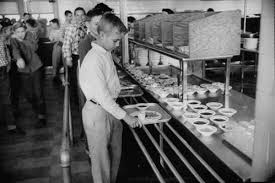
When we became the big kids at Pleasant Avenue Elementary, entering the sixth grade — we figured we knew the ropes. For example, we knew never to stray anywhere near Hank Riley and Walter Munson, especially in the cafeteria.

Hank was a sadistic fireplug of a kid with strawberry blonde hair and freckles. He held the school record for the softball toss. Then Walter Munson arrived at Pleasant Ave by way of reform school and smashed Hank’s record by forty feet. Walter’s advantage may have been hormonal; he was the only kid in the sixth grade sporting a goatee.

On our first day of school, we sat together at lunchtime making juicy noises by sucking up Jell-O through our straws. Malcolm laughed so hard milk ran out of his nose — the highest score on our humor barometer. I watched a nervous fourth-grader an aisle over, scanning the cafeteria for a friendly face. Hank Riley smiled up at the kid as he walked by. “Have a nice trip,” Hank said.

“Huh?” the kid asked, quickening his pace, just as Hank stuck out his leg. As Walter Munson shoved the kid he called after him, “See you next fall.”

Like the delay between the puff of smoke shooting out of the starter’s pistol at Knox Field and the crack of sound, I pointed and then the plates and silverware crashed across the linoleum. The place exploded with cheers and whistles — mostly expressions of relief it wasn’t one of us sprawled on the floor all covered with Sloppy Joe sauce.

Some kids took advantage of the mayhem by catapulting spoonfuls of Jell-O across the room. Our principal, Mr. Jewell, grabbed the big, silver microphone parked next to the stage. “Settle down,” he boomed over the PA system. The noise level fell as Mr. Jewell watched and waited. An errant spoon sailed end over end from the far side of the cafeteria and pinged across the floor. Mr. Jewell intoned into the microphone in a deathly monotone, “I am now taking names.” His threat sucked all the noise out of the cafeteria, except for the ticking of the big clock on the wall.

I counted seventeen ticks before Mr. Jewell finally announced, “Homeroom B-4 can now line up for recess.”

The girls huddled together on the playground, mainly for protection from the packs of howling boys darting everywhere like wolves on the hunt. Dondi, Malcolm, Woody, and I clung to a sliver of shade along the edge of the cool brick school building, rehashing the recent melee in the cafeteria.

“That kid flew in perfect Superman pose, with his lunch tray straight out in front of him,” Malcolm said.

“If he was Superman, then Walter Munson is Lex Luthor,” I said, referring to Superman’s evil archenemy.

“I heard Walter got sent up the river for knifing some guy,” Dondi said.

“His stepfather,” Woody corrected him.

“Say, do you think Superman needs to have his arms out in front of him to fly?” Malcolm asked, extending his arms overhead to demonstrate.

“That’s just for less wind resistance,” Dondi said, sounding exasperated for having to point out something so obvious.

“So could he fly in a sitting position if he wanted to?” Malcolm asked.

“Yeah, but that would just look stupid,” Woody said.

Bowing out of the discussion, I leaned back against the big plate glass classroom window behind me and my elbows sank deeply into something very soft and sticky. Startled, I turned around and discovered a thick line of fresh putty.

I scooped out a small handful of the pliable, white material, and passed it around to my friends. Its earthy smell and oily consistency must have cast a spell over us, because we were soon racing from one set of classroom windows to the next, mining out virgin strips. Within minutes, each of us held shot put sized putty balls.

By the time the warning bell rang, signaling three minutes until the end of recess, every window along the entire length of the school had inch-deep gouges scooped out of the frames. We couldn’t bring the evidence back into school. So we sprinted across the playground to heave it out into the neighboring field.

Walter Munson and Hank Riley appeared out of nowhere, blocking our path.

“What’ve you peckerheads got there?” Walter asked, raising his head and pointing his wispy-haired chin at us.

We held out our merchandise for him and Hank to see. “We’re going to see who can throw them the farthest,” I said.

Walter slowly reached out and took mine from my hand, as if daring me to pull it away from him. He raised it to his nose and sniffed. “What is this shit?”

“It’s cookie dough,” Dondi said.

Walter turned his head toward Dondi and smiled, revealing little crescents of decay between his front teeth. “What are you, some kind of wise ass, Duquette?”

I held my breath. The last hot bugs off in the distance buzzed a mournful reminder that summer vacation really was over. I wanted to be anywhere else, rather than staring down these two.

“These lunkers are probably too heavy to throw very far anyway,” Dondi said, offering his to Walter.

That was all Hank and Walter needed.

We stepped back to watch what was certain to be the world’s first putty-ball heaving contest. I figured it might even qualify for the Guinness Book of Records, right alongside the man with The World’s Longest Fingernails (they touched the ground when he was standing), or my favorite, The Metal-Eating Man who had eaten 18 bicycles.

As it turned out, Dondi was right; even the best softball throwers in school couldn’t throw fat putty balls far enough to make them disappear. They sat in the field like four lonesome snowballs that would never melt. But at least they were out of our hands and as the final bell rang we ducked back into the dark, cool halls of the school.

I forgot all about our putty episode until Mr. Jewell appeared in the doorway of my social studies classroom later that afternoon. He conferred with my teacher Mr. Robinson, who bore a disturbing, perhaps cultivated resemblance to Abraham Lincoln. Mr. Robinson strode across the classroom to my desk and solemnly stared down at me. He paused dramatically as if preparing to deliver the Gettysburg Address.

“Mr. Jewell would like to meet with you in the hall,” he said. Thirty-two sets of eyes followed me as I made my way to the door. I placed one foot mechanically in front of the other, as if relearning how to walk.

It didn’t surprise me to find Woody, Dondi, and Malcolm already out in the hallway. What surprised me was the way they were holding their hands out in front of them, as if waiting to be cuffed. Their heads were bowed prayer-like, which suddenly seemed like a good idea to me. Mr. Jewell was holding his hands behind his back.

“Lucas, show me your hands,” he said.

When I held out my hands, I noticed fine lines of whiteness packed into every crevice around my fingernails.

“Do you boys know anything about these,” asked Mr. Jewell, as he produced four filthy, weed-encrusted balls of putty from behind his back.

The four of us stood silently.

“Did you boys dig this putty out of the school’s windows and throw these into the field?”

I was surprised to hear Dondi say, “No, we didn’t, sir.”

I supposed this was technically true. We hadn’t collected the putty and thrown it away.

“Well, who did throw these out into the field at recess, then?”

Again somewhat telling the truth, Dondi replied, “Hank Riley and Walter Munson did, sir.”

“If that’s the case, then why do you boys have putty all over your hands?”

I didn’t see any way around this question. But Dondi was on a roll so I let him keep going.

“They bet us they could throw those farther than we could. But we knew we couldn’t out throw those guys, sir,” Dondi said.

I noticed that the first part of his answer was an outright lie, followed quickly by a statement with which no one in school could argue.

Mr. Jewell stared at each of us for a long time, as if waiting for a better explanation. Finally he said, “Okay then. I am going to have a talk with Mr. Riley and Mr. Munson to see what they have to say about this. You boys can go back to your classes. I will follow up with you later.”

For the next week we traveled everywhere together, carrying Woody’s BB gun pistol in a gym bag for protection from Walter and Hank. But we gave up on that idea when Woody accidentally shot Malcolm in the belly at point blank range. Malcolm immediately called out, “bagsies” — which was just his British way of claiming the right to shoot Woody to even the score. Neither of them even flinched.

In the end the whole thing just blew over and we wasted a lot of time worrying about nothing. That was my first inkling into the meaning of a Mark Twain quote that later in my life would emerge as a favorite. When he was quite old, Twain said, “I’ve had a lot of worries in my life, most of which never happened.”

That episode was also the first time it occurred to me that Dondi’s ability to sidestep trouble wasn’t just beginner’s luck. It was survival skill honed from living in the same house with his father.

Ringo

I may be crazy, but my 50th high school reunion is calling me back. Mostly I  just want to see Woody again. He should be in rare form, given that for a long time he never expected to reach this milestone, with his diagnosis and all. Even before that, we shared enough dumbass stunts to preclude any notions of ever toasting such escapades in our old age.


Like the time on spring break when we tried to walk from Daytona Beach to Ft.Lauderdale, wearing only flip-flops, t-shirts, and our bathing trunks. No hats, no sun block, no underwear, and certainly no cell phones.

If we had consulted a map—free at any gas station back then—we might have realized there is no contiguous beach from Daytona to Ft. Lauderdale. We might have also learned we were biting off a two hundred mile walk.

After less than ten miles the beach simply ended. Backtracking would have been sensible, but instead we chose to battle westward through fields of saw grass and mangrove swamps until we came to a road and stuck out our thumbs. By then the heels of our flip-flops had completely worn away, forcing us to walk ballerina-style on the balls of our feet, which may have explained the difficulty we had in getting rides. So we accepted any ride, regardless of the length or the direction, taking a long, rambling inland loop through alligator swamps and dry landscapes crawling with armadillos.

“Race riots,” was all one driver said when he dropped us off in a section of Jacksonville up in flames. To be fair, we had told him he could drop us anywhere, so it may have been his idea of a joke. Forty-eight sleepless hours later we landed right back in Daytona Beach where we started.

Boredom drove us to Newton’s Auction House, with Woody brazenly bidding up items of jewelry at three and four thousand dollars a clip. Neither of us had the slightest idea of how auctions worked.

“Hey,” I whispered to Woody. “What happens if you win one of these bids?”

“Relax. I’m just playing these guys,” Woody assured me.

“Them?” I asked, inclining my head toward the Mafioso-looking guards in the back of the room in their black muscle shirts.

There were two auctioneers. One rallied up the bids while the other quietly showed upcoming items to the high bidders in the audience. The guy working the crowd introduced himself to us as George and said he had an “exquisite” man’s gold ring coming up, with diamond and tear-drop ruby insets. Woody tried it on and said he had to have it.

They started the bidding for Woody’s ring at one hundred dollars. The lead auctioneer called out in nasally, machine gun bursts, “Bid’s at a hunert, do I hear a hunert ‘n ten, a hunert ‘n ten, who’ll bid a hunert ‘n ten?” At this point George leaned over to Woody and whispered, “Say one-hundred-ten and leave the rest to me.”

Woody raised his hand and called out, “One hundred and ten.” His bid felt completely safe—given that this ring, like the ones before it, would surely sell for thousands more.

The auctioneer at the front of the room was just revving up his sermon about the value of the ring and how it had been owned by Dean Martin…or at the very least Dean Martin owned the matching “twin” to this ring.

Just when the head auctioneer was reaching the climax of his pitch, George interrupted him and said, “Tony, the gentleman back here has tried on this ring. He really admires the design. I say we let him have it for a hundred and ten bucks.”

Tony argued that the ring was worth fifty times that amount, but eventually relented — too quickly, in my opinion — and slammed down the gavel, shouting, “Sold to the young man in the back of the room, for a hunert ‘n ten dollars!”

The auction house required a twenty percent deposit on winning bids, but they called it square at eighteen dollars and a handful of change when that was all Woody and I could scrape together. Woody carefully tucked the receipt in his wallet.

Later that night Woody stepped under a light next to the door of a seaside condo to pull a cactus spine from his finger. He was lucky it was only his finger. After we had downed several beers, Woody had stepped into an abandoned lot filled with cactus to take a leak.

If we hadn’t been such cactus virgins, I might have known better than to break off a pad and toss it toward my friend to check out, and Woody definitely would not have tried to catch it.

As he leaned against the door of the condo trying to get in the best light to examine his wound, the door suddenly opened, pitching Woody into the arms of a stunning blonde. Our luck seemed to be turning when she and her two girlfriends invited us in for dinner. Woody poured gin and tonics, and attempted to charm the pants off the shortest, dark-haired girl.

“So Rosie, are you a riveter?” he asked her.

I had no idea what that meant, and I don’t think Rosie did either. But like a lot of Woody’s banter, it felt flirtatiously suggestive and seemed to be working.

“What would you like me to rivet?” she asked him.

I took the helpful, serious approach, stirring the risotto, while Shelly leaned lightly against me, streaming sauvignon blanc into the rice and mushroom mixture.

But the evening’s promise was shattered when Audra — the blonde — revealed that her boyfriend George would be arriving as soon as he got off work at the local auction house. That news threw Woody into a theatrical frenzy, claiming he had a score to settle with that “bastard,” which promptly cost us our dinner invitation.

That was the last time Woody and I traveled together for many years. Shortly after our return from Florida, everything changed. Woody’s girlfriend announced she was pregnant, he married her, dropped out of college, and went to work shaving skins for the next seven years, snorting leather dust by day and blowing dark, stringy mucous into his handkerchief at night.

I moved out of the area and Woody and I saw each other less and less. But whenever we did get together, Woody always produced the dog-eared receipt for his ring from his wallet. He spoke with regret of his failure to claim the ring — as though the ring was a talisman and by forswearing it he had somehow altered the trajectory of his life.

I finally lost contact with Woody altogether, hearing rumors that he had moved to Florida. When he reconnected with me ten years later with news of his diagnosis, he joked that he had caught the disease — an aggressive form of leukemia — while vacationing in Mexico.

He shrugged off my suggestion that his illness may have had more to do with the skins he had once shaved.

“Don’t even go there,” he said, waving me off. “The doctors say I have a defective Philadelphia chromosome.”

“Right, I said, “but those skins were soaked in benzene and benzene is known to cause DNA strand breaks like those detected in your form of leukemia.

Woody just shook his head, rejecting my theory.

“As Yogi Berra said, ‘you can look it up,’” I added.

In fact, I had looked it up. Benzene was first reported to induce cancer in humans as far back as the 1920’s. But the chemical, leather, and rubber industries denied any link to cancer until 1979. By then, Woody had already fled the leather mills before they got the best of him (or so he thought). Maybe his brain somehow detected the chromosomal breaks in his body and silently whispered to him, “I can’t tell you why, but you must leave this place…leave your wife… leave your five year old daughter…leave now before it’s too late.”

Luckily Woody had enough time left for me to shanghai him for one final trip — to England to find our old childhood mate, Malcolm. It was a raucous, happy, and at times tearful farewell tour.

More than fifteen years have now passed since that epic “last” trip. Since then — after abandoning all medications out of sheer stubbornness due to the extortion of the pharmaceutical companies, and to the total puzzlement of his doctors — Woody’s leukemia simply disappeared.

So, I look forward to toasting memories with Woody at our 50th high school reunion — a milestone neither of us expected him to reach. I am certain he still carries the receipt for his ring. I hope to touch it, caress its feathered edges, and absorb its good karma through my fingertips.

Duck and Cover Drills

Back in the early 60’s my boogeyunnamedman didn’t come tap dancing out of the shadows of some past lifetime trauma; he threatened me from the future. I knew he would surprise me with a light tap on my shoulder. Turning to see who was there, my eyeballs would melt out of my skull by the flash of a thermonuclear blast.

Call me paranoid, but who could escape the signs? There was Nikita Khrushchev on the evening news, taking his shoe off at the U.N., pounding it on his desk and screaming, “We will bury you!” To me he looked and acted a lot like Curly on The Three Stooges, which was not reassuring.

At school, sirens regularly sent us ducking under our desks. We knelt there on the gritty linoleum floor as if praying — and I suspect some kids were. Our sixth-grade teacher walked around our classroom demanding silence, and instructing us to cover the backs of our necks with our hands—as if that might bump up our odds of survival.

The part I never understood was why we had to be quiet if we were about to be incinerated anyway. Wouldn’t this be the best possible time to crack a joke that everyone could savor for eternity?

As our teacher patrolled the far side of the classroom, Woody whispered to me, “Bend over and kiss your ass goodbye.”

I’d have rather kissed Bethany Larson’s ass goodbye, but saved that line for when I thought the world really might be ending.

During one hallway drill, when we were sent out of the classroom to lean our heads against our lockers, Malcolm celebrated his last few seconds on earth by unleashing what he liked to call in his weird British parlance, a Drifter.

“More tea, vicar?” he whispered to me, which was his way of claiming ownership.

A wave of throat-clearing retching sounds rippled down the hallway. Sensing unruliness in the face of nuclear attack, our principal Mr. Thompson race-walked our way.

“Quiet!” he commanded in a hoarse whisper, trying not to alert any enemy aircraft roaming the skies. Little did he suspect that the real enemy bomber was working from inside the school. When he got within the Circle of Doom (as Malcolm proudly called it later) Mr. Thompson executed a perfect about-face, and marched back as if he had forgotten something.

We spent several hours hanging out on Malcolm’s front porch after school that day, hoping Malcolm could summon the urge to drop another Drifter into an empty Skippy peanut butter jar. He clammed up with a rare case of stage fright, and we walked home disappointed in the failure of our science project.

But Malcolm brought the Skippy jar to school in his lunchbox the next day with reports of success. We agreed to unleash the doom jar in the cafeteria at lunchtime.

We should have simply opened it and walked away. Instead, we tossed it around, as if it were a hot potato. Dondi held it up to the light and claimed it had a purple tinge to it, which got us all laughing.

“What’s in the jar, boys?” Mr. Thompson asked, appearing out of nowhere.

“Nothing sir,” Dondi said, holding up the jar to prove his point.

“Well I don’t see why an empty jar should create this much interest then,” Mr. Thompson said, taking the jar from Dondi’s hand. He too held the jar up to the overhead fluorescent lights, and peered inside while rolling it around in his hand.

“Who brought this to school?” he asked.

“I did,” Malcolm admitted.

“And for what purpose?” Mr. Thompson asked.

“Ah, it was for a science experiment,” Malcolm said.

“And did this science experiment involve smuggling alcohol into school?” Mr. Thompson asked, sounding like Perry Mason when he pops the surprise question that makes the defendant crack on the witness stand.

“Whaa—aat?” Malcolm stuttered. He sounded guilty even to me.

“If you are lying to me I will know,” Mr. Thompson said. He moved one hand to the lid of the jar, as if to open it.

“Don’t do that,” Malcolm blurted out — loudly enough to hush the entire cafeteria.

“Oh really?” Mr. Thompson said as he made a big show of doing just the opposite, unscrewing the lid, and plunging his nose into the jar.

In my memory, what happened next was remarkably uneventful. Thompson backed his face away from the jar and screwed the lid back on in one quick motion. Then he said, “That’s some bad peanut butter,” and slid the jar back across the table to Malcolm.

In retelling the story forty years later, when I kidnapped Woody (after his leukemia diagnosis) and cajoled Dondi into joining us on a quest to England to find Malcolm, Dondi retold the story of Principal Thompson opening the peanut butter jar much differently…

*           *        *

“A great magenta cloud swirled out of the jar and filled the cafeteria,” Dondi recalled, raising his arms and looking skyward in a Charlton Heston, Moses kind of pose.

“I’m not remembering this part,” Malcolm said.

“Don’t you remember?” Dondi persisted. “Kids trampled each other, running for the exits and Thompson fell face-first onto the floor?”

I knew Dondi was exaggerating mostly for effect. Still, the insistence in his voice suggested to me that regardless of the history we shared, memories mutate in our brains until after four decades all that’s left is the enjoyment of arriving at a new version of the truth.

Clearly not buying Dondi’s story, Malcolm shrugged and said, “Must have been me pre-curry phase.”


Melcher Street Hill

Anticipating what’s ahead in 2017 has me feeling a bit waterlogue-2017-01-01-11-31-52like I’m eight years old again, staring down Melcher Street hill in my Radio Flyer Wagon…

I knelt in my old red wagon, with one foot anchored to the ground, weighing my odds. The wagon’s D-shaped handle had broken off years prior, leaving the sharp, jagged metal digging into my chest.

So instead of sitting, I placed one foot in the wagon, then the other, and began coasting downhill standing up. The stockade fence flashing by on the left reminded me of the words in the song “Hot Rod Lincoln:”

“Now the boys all thought I’d lost my sense.
And telephone poles all looked like a picket fence.”

The muscular roots of the giant elms lining the street had pitched the sections of concrete sidewalk at crazy angles. The bump — pause — bump cadence slowly increased as the front, then the back wheels hit the cracks.

“They said, Slow down! I see spots!
The lines on the road just look like dots.”

By the time I reached Dead Man’s Tree, the bumpbump of the wheels rattled a constant staccato sound with no pause in between. The tempo increased as I shot down the sidewalk, faster than I ever traveled on a sled. As my eyes darted around searching for a soft landing spot, the wagon went airborne, launching off one of the sidewalk slabs angled upward like a ski jump.

“My fenders was clickin’ the guardrail posts.
The guy beside me was white as a ghost.”

For a split-second I imagined I could land on my feet in the wagon and keep right on going. But when the wagon hit the sidewalk, the front wheels violently jerked to the side at nearly a ninety-degree angle. The wagon pitched onto its side, catapulting me in a long, clawing arch through the air until I landed and bounced on the concrete. I lay in a stunned heap, the final lines of the song, which my friends and I always shouted out in unison when the song played on the radio, running through my brain:

“Son, you’re gonna drive me to drinkin.
If you don’t stop driving that Hot Rod Lincoln!”

The next morning I awoke to discover that overnight my New York Giants pajama bottoms had stuck and dried to the gigantic raspberry covering my right buttock. It hurt way too much to pull the fabric away from the wound. So, I pulled my jeans on over my pajamas and walked the three blocks to school with portraits of Alex Webster, Frank Gifford, Rosey Grier, and Sam Huff hidden underneath. I felt bogged down by the extra weight and heat of the flannel during recess. Walking back into class, I caught a cluster of girls stealing glances at me, and whispering to each other. That was unusual enough to prompt me to glance down to check my fly. What I saw was even worse. My pajama bottoms were hanging out well below the cuffs of my jeans.

After school, in the privacy of my bedroom, I examined the damage. The flannel was so thoroughly embedded in my skin it sounded like plywood when I rapped on it with my knuckles. I snipped away the fabric around the perimeter of the wound, leaving behind a portion of Y.A. Tittle’s face. But without his helmet or the other players around him, the bald quarterback wasn’t even recognizable. He just looked like a wizened old man — a creepy thing for a kid to be walking around with on his butt.

The next day I sensed doom. Our gym teacher, Mr. Collins, brought the class outside for a monster tug-of-war contest over the little stream that ran behind the school. Both sides of the stream were slick with wet clay. Normally I loved this kind of free-for-all, but Mr. Collins would surely patrol the locker room, enforcing showers after this mud bath. After hauling the other team slipping and sliding through the mud, I pretended to celebrate with my teammates.

“Okay, everyone hit the showers,” Mr. Collins shouted causing thirty-two mud-covered boys to scream like monkeys as we ran for the locker room. I sprinted to the front of the pack, stripped down to my jockey shorts, wrapped a towel around my waist, and headed toward the showers ahead of everyone else. At the stainless basin sink I stepped on the pedal to turn on the water and dunked my head under the stream. By the time I got back to my locker and was toweling my hair, the other boys were just heading toward the showers.

I had seen far too many kids branded forever with unfortunate nicknames to risk baring my behind in this crowd. Alex Snyder, who was plagued by allergies in the first-grade, was still Snot Rag Snyder. A kid with asthma was renamed Wheezer. The one born with a harelip became Mumbles. Kenny Deerfield who lived one block up the street from me was simply Moan. His mistake in life was being born to parents who were Christian Scientists. When Kenny tried to do the pole vault in his backyard and the bamboo pole snapped, his parents believed that God would relieve their son’s back pain. All these names were ingenious in their simplicity and cruelty. I even had a pretty good idea what my new name would be if my secret were discovered — I would be forever known as Butt-Face.

I could sense Mr. Collin’s presence as I went through the motions of drying off.

“Showered already, Lucas?” he asked.

I turned to look at him. “Yes sir, I already washed up,” I said, which wasn’t entirely a lie.

“Looks like you missed a few spots,” Mr. Collins said, pointing at my leg.

I looked down at the mud smeared from one thigh to my ankle.

“You better get back in there and use soap this time.”

I shrugged and began walking back in the direction of the showers.

“What, are you going to shower in your jockey shorts?” Mr. Collins called after me.

I walked back to my locker and stalled, hoping he would leave.

“Well, what are you waiting for?”

I looked up at the man, took a deep breath, and said, “I’ve got a cut I’m not supposed to get wet, so how about if I just towel off at the sink?”

“Son, there’s nothing to be embarrassed about. If you want to play sports you better get used to showering with a bunch of guys.”

“It’s not that, honest.” I stared down at my feet for a long time before mumbling, “I’ve got this cut that I can’t get wet.”

Mr. Collins inhaled deeply and looked up at the ceiling. He looked back down at me impatiently. “Look, I don’t like getting the run around, Parker. Unless you have a note from home about this so-called wound, get in there and shower up like everyone else.”

I heard the voices of several boys heading back into the locker room and knew I didn’t have much time. “Okay, I’ll prove it to you.” I turned my right butt cheek toward him, and hiked down my shorts on that side for a quick look. I turned back to Mr. Collins, and stared up at him stone-faced, awaiting his reaction.

His eyes conveyed a bewildered, almost frightened look. “Is that a tattoo?” he asked, clearly trying to make some sense of what he had just witnessed.

“No, it’s my pajamas,” I said.

“Your pajamas,” Mr. Collins repeated blankly.

“Yeah, my New York Giants pajamas — what’s left of them. Y.A. Tittle stuck to the giant strawberry I got when I skidded on the sidewalk.”

Four kids noisily rounded the corner and immediately stopped talking when they saw Mr. Collins standing over me.

Mr. Collins looked at the boys, then back at me. His face changed from anger to confusion, and then seemed to soften just a little.

“What are you guys waiting for? Dry off and get yourselves dressed,” Mr. Collins said to the group of boys. “And you, Mr. Parker,” he said, turning back to me. “You don’t have time to shower up again. Just take your towel and go back to the sink and wash that mud off your leg.”

Kong

Q: If Paper covers Rock, Scissors cut Paper, and switchbladeRock breaks Scissors, what defeats a Switchblade pulled on you by the school bully?

A: A Slush Puppie.

“Hit me, hit me,” Dukey screamed as he raced down court.

Arm cocked, I froze at the sight of Royal Eaton pawing through my gym bag at the far end of the Briggs Street court.

Royal had been held back so many grades no one knew his real age. He went by the name of Kong, probably because it sounded way tougher than Royal—and more flattering than the one that kids uttered behind his back. When teachers called “Eaton” during roll call, some of the braver boys whispered, “Turds.”

Kong pulled something out of my gym bag, held it up over his head, and shouted, “Hey, Parker, ya think you’re some hot shit or something?” As I got closer, I realized he was holding up an Ace bandage rolled up, the brand name Ace neatly framed between the two metal tabs securing it.

“Just give it back, Kong,” I said, hoping to distract him from my fourteen-dollar fortune. He hadn’t yet noticed the wallet among the sweatshirt, candy wrappers, dirty socks, and peanut butter sandwich.

“What, ya think you’re such a hot shit, you write Ace on your stuff?” Kong asked.

What an idiot this guy is, I thought. “That’s the brand name, Kong. Hey, if you’re going to keep my gym bag, at least give me my dirty socks out of it.”

“I’m not interested in no dirty socks,” Kong snarled as he slammed the bag into my chest, knocking the wind out of me. “But I’m keeping this — Ace,” holding up the rolled bandage as his prize.

Locating my wallet in the bag, I fished out the remainder of my sandwich as a decoy, and stuffed half of it into my mouth. Kong stared at me while I chewed. He held out his hand and said, “Let’s see what else ya got in the bag, Ace.”

I calmly walked away, grabbed my basketball, stuffed it in the bag, and zipped it shut. As I picked up my bike, Kong bellowed, “Hey, I’m talkin’ to you, Ace!”

Without saying a word, Dondi nonchalantly jaywalked, positioning himself in a way that blocked Kong from me. I took several quick strides, jumped on my bike and pedaled off. “I’d love to stick around, Kong, but I have to go,” I called back over my shoulder, standing up on my pedals to accelerate.

Kong made his move to the left of Dondi. As he did, Dondi maneuvered to block his path. When Kong reversed course to veer around behind him, Dondi moved again. By then, I was safely out of reach.

Kong glared at Dondi through the thick lenses of his black-framed glasses. Standing there with his jaw jutting out, he looked a lot like one of the Marquis Chimps on The Ed Sullivan Show. They put the same glasses on some of them to make them look more human. “You know, Kong, there’s no name for that,” Dondi said.

“The hell you talking about?” Kong asked, backing off slightly from his attack-mode pose.

“It’s like when you meet someone in the hall in school and you block each others’ paths. One guy jogs one way, but the other guy accidentally goes the same way, so they’re still blocked. There’s no name for that maneuver,” Dondi replied.

“Yeah, right, like you didn’t do that on purpose, so your faggot friend could get away.”

“There’s no name for this, either,” Dondi rambled on, pointing with his forefinger to the spot between his nose and upper lip.

“You’re a real dipshit, you know that?” Kong leaned forward and placed his finger in the cleft above Dondi’s lip and twisted it back and forth, like his finger was a cigarette he was grinding out. “And it has a name. It’s called your mustache!” With that he jabbed him so savagely he snapped Dondi’s head back, drawing a faint line of blood with his fingernail.

Dondi interpreted Kong’s threat as permission to leave. He grabbed his bike and pedaled out Briggs Street, across The Arterial Highway to the Dairy Queen, where we always went after playing hoops. I sat on one of the picnic tables on the side of the building in the shade. Dondi walked out of the Dairy Queen carrying two drinks and joined me.

“Here, this one’s for you,” he said, handing me one of the cups.slush

I took it and stared at its bright-blue contents. “What is it?”

“It’s a Slush Puppie. It’s new. Just don’t drink it too fast,” he warned.

“Sorry to leave you hanging back there,” I said, noticing the red mark above Dondi’s lip. “Thanks for covering my escape.”

“That dumb ape…” Dondi started to say and then stopped. I followed his gaze to the other side of the parking lot. Locked in on us like a heat-seeking missile, Kong walked straight up to me with murder in his eyes. “Give me the gym bag,” he demanded.

I went as icy-cold as my drink when I noticed the unopened switchblade in his hand. I raised my cup to him in a friendly, toast-like gesture. “Hey, Kong,” I said in a voice that even to me sounded far away, like someone else had said the words.

“I’ll take this first,” Kong said, as he reached out slowly and took the slush from my hand. He looked at me accusingly. “Dirty socks, my ass. Let’s see what else ya got in the bag.”

Instinctively I closed my hand on the loop handles of the bag sitting next to me, never taking my eyes off of Kong.

“We’ll give it to you without a fight on one condition,” Dondi said.

“One condition? That’s a laugh,” Kong said. He flicked the switchblade open.

Even though I thought the blade was mainly for show, I dug my elbows into my knees to stop my legs from shaking. Kong flashed a crazy smile, drunk on his powers of intimidation.

“If you can down that Slush Puppie in under a minute,” Dondi said, “we’ll give you the gym bag and everything in it.”

I shot Dondi a skeptical look.

Kong straightened up, puffed out his chest and smirked. “I can suck down a beer in ten seconds. Why would this candy-ass little drink take me a minute?”

“It’s not as easy as you think,” Dondi warned him.

Kong slowed down, thinking hard. “Tell you what,” he said. “Throw in a dollar with the bag if I win, and you’re on.”

Dondi fished a dollar bill out of the front pocket of his jeans and placed it under my gym bag. “Okay, you win the bag and a buck if you can down that slush in sixty seconds or less. But if you can’t do it, we have to get something in return.”

Kong looked at Dondi warily. “Yeah, what’s that?”.

“If you lose, we get to call you by your other nickname — the one you don’t like,” Dondi said. “And you can’t get pissed at us when we do,” he added.

Kong inhaled noisily through flared nostrils, glaring first at Dondi, then me. “Okay. That’s fair, especially since I get to call you assholes whatever I want all the time.”

Dondi studied his watch, waiting for the second hand to come around. “You ready then? Five, four, three, two, one, go.”

Kong leered at us, scribing small circles in the air with his switchblade and paying no attention to the drink in his other hand.

Dondi counted down the seconds. With twenty seconds remaining, Kong tilted his head back and dumped half the contents of the cup into his gaping mouth. His Adam’s apple danced up and down like the bobber on a fish line when a little sunny hits the hook and struggles to pull the bobber under. Swallowing that first huge gulp, he poured the remainder of the drink into his upturned mouth.

Dondi watched Kong intently, glanced down at his watch and softly said, “Ten seconds left, Turd.”

That’s exactly when Kong emitted a thunderous, enraged bellow. I raised my arms instinctively, to protect myself. Instead, Kong sank to his knees, lowered his forehead to the ground, and let out a deep, vibrating moan. I turned back to Dondi looking baffled. He smiled at me, shrugged, and said, “Brain freeze — I tried to warn him.” I picked up my gym bag and Dondi pocketed his dollar bill and we rode away on our bikes before Turd’s brain thawed out.

Jockstraps and Flying Machines (or how in the 7th grade I almost invented hang gliding)

When JFK announced his Presidential Physical Fitness Awards, I Presidential_Physical_Fitness_Awardunfortunately sucked at chin-ups. Four or five honest pull-ups were my limit, with one more leg-pumping, neck-stretching cheater thrown in at the end. But my salvation was the 600-yard run.
For this event I secretly perfected a new running technique that involved two normal length steps, followed by a bounding, energy-saving stride. I got the idea by watching antelopes on Mutual of Omaha’s Wild Kingdom. While evading cheetahs, the antelopes occasionally catapulted themselves into the air where they hung suspended for an unnatural length of time. I figured that was their rest step.

When my technique made me famous, I would call it the Antelope Running Technique, or ART for short (which I particularly liked with its double meaning and all). As I trained, running circles in my backyard, I could hear the sports announcers on ABC’s Wide World of Sports narrating my race:

“Leading down the final backstretch in the 800-meter finals is New Zealand’s Peter Snell. Closing quickly from the back of the pack is Lucas Parker, from the United States, employing his unique Antelope Running Technique. It may not look like ART, but that’s what they call it and that’s the result! Parker is gobbling up the track, passing Snell for the lead. The new Olympic 800-meter gold medal winner is Lucas Parker — The Antelope — from the USA!”

On the first day of gym class I was ready to unveil my new running style. But instead of taking us out on the track, our gym teacher — we all called him “Prof” — sat us down for a lecture about the importance of jockstraps. Our assignment for the following week was to purchase one. “Prof” specifically mentioned Bike as a reputable brand.

Purchasing a jockstrap at Ahearn’s Pharmacy was socially risky, because packs of girls frequented the record section, milling through the latest Chubby Checkers and Bobby Rydell releases.

I wandered up and down the aisles for so long that a matronly female clerk finally cornered me. “Can I help you, young man?” She studied me intently through her rhinestone-studded eyeglasses.

“I’m just looking, thanks,” I said, pretending to study the laxative labels in front of me.

She frowned, but didn’t move away. So I drifted around the store, pausing at denture adhesives, then wart removers. Finally, the male pharmacist behind the counter was free.

“Do you have any Bike Supporters?” I whispered.

He looked up at me and scrunched his mouth to one side, thinking. He held a yellow, Ticonderoga number two pencil between his fingers like he was holding a cigarette, and bounced its eraser on the counter. “I think we’ve put those away for the season.”

This caught me totally off guard because I didn’t know there was a season for jockstraps. He surprised me even more when he shouted over to the rhinestone eyeglass lady, “Charlene, would you go down in the basement and see if you can find one of those Bike Supporters for this young man? Look in the back corner, next to the inflatables.”

I felt my face burn as several people turned to check out the jockstrap shopper.

“Hey Lucas, what are you doing here?”

My heart stopped. It was Bethany Larson, and as usual she looked perfect.

“Oh hey, Bethany, are you buying something?”

She held up a single 45-rpm record of Chubby Checker’s Limbo Rock. “I just love this song,” she said. “Are you in line?” she asked, motioning toward the counter and the cash register.

“No, they didn’t have what I needed.”

But before I could escape, I heard the sales lady with the eyeglasses say, “I hope you really want this young man, because it took some digging.”

Bethany cocked her head to the side with a puzzled look as she stared at the woman. I spun around. In the woman’s hand was a bicycle kickstand. Naturally I purchased it on the spot (carefully circling back several days later to exchange it for a Bike Brand Athletic Supporter).

The following week, “Prof” lined us up for the start of the 600-yard run and started his stopwatch. I settled into my Antelope stride-stride-bound rhythm on the Knox Field track. I settled into third place, waiting for the two in front of me to tire from their orthodox, energy wasting gaits.

As I went by him after the first lap, “Prof” glowered at me and barked, “Parker, what the hell are you doing?”

Startled, I began sprinting conventional-style, passing both of the guys in front of me. Though I secretly attributed my blazing finish to how much energy I had saved doing the Antelope up until that point, I never dared display my new running technique in public again.

Rather than improve on running, which humans had been doing for thousands of years, I decided it might be easier to invent an entirely new sport. That’s when my thoughts drifted toward figuring out a new way to fly.

I showed up at Dondi’s back door one night with a twenty by forty-foot sheet of plastic bundled under one arm and my Woolworth’s football helmet under the other. The wind was blasting so hard it tore the aluminum storm door out of my hands, slamming it into the aluminum siding where the handle left a sizeable dent.

“What’s with the tarp?” Dondi asked.

“It’s not a tarp,” I said. “It’s a flying machine.”

“Your ass. Who’s going to fly it?”

“We are,” I said. “Grab your helmet.”

We stood at the top of the bank at Knox Field, each holding two corners of the giant plastic sheet. The sail yanked and pulled us, making great snapping sounds, as if it were an enraged beast. We ran down the bank, holding the sail high over our heads.

Instead of lifting us up, the wind catapulted us down the bank, forcing us to run at twice our normal speed. Our maiden flight ended in a twisting fall entangled in plastic, before thudding and sliding across the cinder running track below.

That night my dreams took me over Knox Field, suspended by a harness from something above that I could not see. There was no risk of falling, so it was beautiful just watching the twinkling lights below.

The next day in school I shared my dream with Dondi.

“What were we thinking?” he asked. “Trying to fly.”

“The problem is the plastic sheet,” I argued. “We need something that will hold the air better.”

“What do you mean we, Kemo Sabe?” he asked, distancing himself from future flights.

The limitations of plastic led me months later to Vrooman’s Army Surplus in Fultonville. Vrooman’s was full of so much cool military stuff it was easy to imagine you might discover an old bazooka in a dusty corner—or at the very least a live hand grenade.

I did find a silk parachute, with the lines still attached. It was a steal for three bucks. And the big wind I wanted arrived one Sunday afternoon in January. The snow on the ground at Knox Field had been thickly glazed over with ice. Sitting on a flying saucer in the northern end zone of the football field, with the silk parachute tucked under my butt, I carefully tied the chute’s lead lines to the belt loops on the front and sides of my jeans. Then, I unfurled the chute, casting it in front of me. At first nothing happened. My theory was that the wind would fill the chute, and with so little friction between the icy surface and the flying saucer, I would hit flight speed by the time I reached the spot where the football field terraced down ten or twelve feet to the level of the baseball field. If everything went according to plan, at this instant I would become airborne.

A gust snapped the chute open with a resonant “thunk” and the acceleration nearly flipped me backwards off the saucer. I hadn’t accounted for steering though, which was of increasing concern as I rocketed toward one of the steel light towers on the east side of the field. Dragging my hands and leaning my body had no effect on my direction. I could have reached out to touch the tower as I blew by.

When I dropped off the terrace to the baseball outfield I did become airborne —just long enough to lose my flying saucer. I slid toward the infield in Superman position, with the chute taut in the wind and the lead lines tied to my pants. I slammed headfirst into the chain link fence backstop behind home plate, producing a bright red checkerboard of lines on my face.

That officially ended my attempts to fly. Not that I stopped thinking about it. The same peaceful image of floating over our town kept coming to me in my dreams. It was always nighttime, the air was cool and fresh, and the twinkling lights of the town below were beautiful and reassuring. Eventually the lights grew smaller and smaller as I drifted away until everything below turned black.


Knox Field

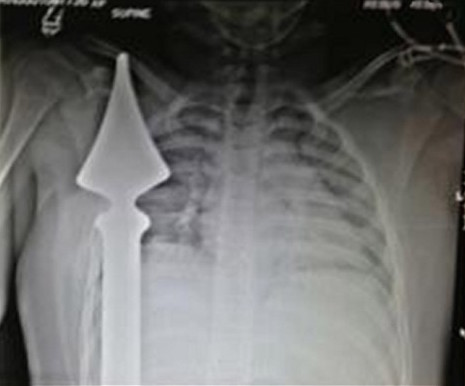
The x-ray photo in Life magazine of the big ghostly silIMG_0355ver spike inside the kid’s chest convinced us to never risk climbing over the spiked wrought iron fence surrounding Knox Field again. From then on, we snuck into games by going under it…

I dragged my knuckles along the iron bars of the fence as I walked alongside it, straining to hear the loudspeaker announcements over the buzz of the crowd.

The steel towers above us lit the night sky brilliantly as we bucked the current of fans making their way to the main entrance. Shafts of blue smoke wafted upward, drawn to the lights. Cigar and cigarette odors mingled exotically with aromas of pizza and popcorn from the vendors lining Perry Street.

“Welcome ladies and gentlemen to beautiful Knox Field for the Sir Bill’s lid-lifter against the Blue Streaks from Saratoga. Our sponsors tonight are Teens and Tots and Dandy Landry.”

“Pssst.” I pointed with my thumb toward the inside of the fence. “Let’s hurry up. They’re already naming the sponsors.”

“So, if you want to get taken to the cleaners,” Dondi said. “Go to Dandy.” He always made the same joke, and we always laughed at it, pretending we were cool and calm.

Woody, Dondi, Malcolm, and I reached the corner of the fence where it jogged east toward the junior high school.

“Not yet,” I said to my companions. “Just keep going straight.”

In less than twenty yards, walking in slow motion away from the field, the announcer’s voice crackled over the loudspeakers.

“Everyone please rise for our national anthem.”

We stopped walking and listened attentively.

“Oh-oh say can you see…”

That was our cue that all the patrolmen inside would be standing at attention, facing the flag down on the field, with their backs to the fence. We had a minute and a half to break in. The four of us bolted back in the direction we had come, to the deepest shadows near the school, to a depression in the ground under the fence. Woody wriggled under in seconds and dissolved into the crowd. Dondi went next and waited to help pull Malcolm through.

“Hurry up,” I said to Malcolm, as I pushed from the outside.

“I can’t. I’m caught somewhere.”

“Where, here?” Dondi asked.

I could feel Malcolm spasming with laughter.

“Or here?” Dondi repeated.

“Come on, hurry,” I hissed. “Stop tickling him and help.”

Already, the raspy recording over the P.A. system was building to its closing crescendo and I was still on the outside…

“O’er the land of the freeeeeee….”

Frantically running my hands underneath each iron post, I found the belt loop of Malcolm’s jeans that was snagged. “Okay, you’re free,” I said, unhooking him. “Go. Go.”

I squirted under, just as the closing line began that I knew would send the crowd into a frenzy.

“…and the home…of the… braaaave!”

With that final note, an officer not fifty feet away turned to scan the fence line behind him, pointed at me with his finger like he was aiming a gun, and shouted, “You, right there. Freeze!”

I did freeze — but for just for a split-second — as I weighed my odds. Then, when the cop took one step toward me, I sprinted a wide arc around him. He immediately brought both hands together and went into a half-crouch, as if getting ready to shoot. He continued tracking me with his make-believe gun as I disappeared into the crowd at the top of the bank.

I burrowed into the crowd, stripped off my green plaid jacket, turned it inside out, and put it back on with its reversible khaki side out. When I emerged out of the crowd at our rendezvous spot near the grandstands, I watched the cop as he scanned the crowd.

I shielded myself behind three men with stogies clenched in their teeth. They were taking hits off a bottle wrapped in a brown paper bag.

“Thing of beauty,” the guy with the really big gut said, shaking his head in wonder. His black leather coat was unzipped to give his belly some air. I looked up at him and followed his gaze down to the emerald playing field below. He handed the paper bag to one of the men standing next to him.

“We ought to give Leo and Bob undefeated jackets whenever the team gets ‘em,” the bald man said. He was wearing a deerskin jacket that was cut to look like a shirt. He took a swig from the bottle.

I knew they were talking about Leo Davis and his sidekick, Bob “Boomer” Bennet, the groundskeepers. Leo and Boomer manicured the field with matching walk-behind Locke Reel Mowers – the same model used to mow the Yankee Stadium field, the White House lawn and the grass at the Kremlin.

“Shit,” the third man said, exhaling a blue cloud of smoke. “We gave Coach Jehlinek a goddam, gold Caddie for producing back-to-back undefeated seasons.”

“Should’ve been undefeated and unscored-upon,” the bald man corrected him. “Except for one piece-of-crap defensive play by that Keszey kid.” He shook his head sadly.

“And the school board made Jehlinek principal,” the big gut guy pointed out, waving his cigar like he was conducting an orchestra.

I stared at the field with them. It really was beautiful, but I wasn’t the fan of Leo and Boomer that these guys were. Whenever we gathered to play pickup games, Leo would come storming out of his maintenance shed shouting, “Goddamn it! Get the hell off that field!”

Then he and Boomer would come racing up in their motorized cart. Boomer was a tall, rangy man who looked a lot like Chuck Connors on The Rifleman. But instead of a rifle, he carried a pitchfork.

For revenge, one day after school Dondi and I dragged a box of old 78-rpm records from my parent’s basement to the top of the bank overlooking the field and whipped them off into space. They almost disappeared as a thin edge, and then suddenly reappeared as they flashed broadside, twisting and turning, before knifing into the pampered turf below. We had been so mesmerized watching them soar, we had failed to notice Leo and Boomer tearing up in their little motorized wagon until it was almost too late.

The loudspeaker on the tree over my head boomed, “Ladies and gentlemen, Johnstown High School now presents the Sir Bills.” Two thousand heads — almost a fifth of the town’s population — swiveled to the left to watch their team lined up at the top of the bank above the north end of the field.

“You made it.”

I turned around to see Dondi, with Malcolm and Woody. They were all smiling.

Leaving my hands in my jacket pockets, I shrugged and opened my jacket enough to reveal the plaid side. “Works every time,” I said.

The fact that the cops never caught on to our reversible jacket trick only reinforced our belief that we were way smarter than they were.

Smalley’s Theater

Giddy with the anticipation of summer vacation, we walkElvised home from Smalley’s Theater after watching Elvis punch his way to glory in Kid Galahad.
Dondi careened into Malcolm harder than he needed to. In his best Elvis voice Malcolm said, “Watch it Willie. I may be a grease monkey, but I don’t slide so easy.”

Dondi wrapped his arm around Malcolm’s neck and pulled him close. “I don’t slide so easy,” he said, drawling the word “slide.” “Elvis is from Memphis, not Manchester.”

“All right, all right,” Malcolm said, squirming out from underneath Dondi’s headlock. “Lucas, do the Hamburger Haven one again. You do that one the best.”

I looked over at Dondi who just shrugged. “Aw Willie,” I began, in what I felt was the best Elvis impersonation of our group. “You have got a dirty mind, haven’t you Willie? I’ll tell you what I did to your sister. I’ll tell you right to your face. We went to the Hamburger Haven and held hands on top of the table for half an hour — is that so bad, is it Willie?”

Dondi cut in, “I’ll tell you another thing Willie. I’m getting out of this fight game as soon as I can.” Dondi veered into Woody and asked, “You know why Willie?”

“I dunno,” Woody said, refusing to play along.

Dondi cut the opposite way, crashing into Malcolm. “You know why, Willie?”

Already laughing as he anticipated the punch line, Malcolm barely spit out, “No, why?”

“I’ll tell you why, Willie,” Dondi said, leaning over with his face up close to Malcolm’s. “Because it stinks.” Except he said it like Elvis, so the word came out as “Stinsh.”

High above us the black branches of the doomed elm trees reached toward each other from opposite sides of the street. No streetlights lit this stretch, making it a dreaded section after horror movies. The big colonial houses on both sides of the street loomed out of the darkness. Flickering silver light from black and white TVs danced in the windows of some of the houses. As Dondi completed his Elvis delivery, a motion on Miss Myron’s front porch caught my eye. A silhouette rocked silently, taking in the cool night air.

Ethel Myron was our spinster school librarian. You would think that someone who was forever telling us to stop talking would be less of a town gossip. I imagined her telling her neighbors over coffee, “They sounded like southerners, shouting and picking fights with each other. One accused the other of doing Lord knows what with the other one’s sister!”

Fortunately, we were well past Miss Myron’s house when Woody brought up the kissing scenes in the movie. “They were sucking tongues like there was no tomorrow,” he said.

“It was disgusting,” Malcolm said. He made a face and drooled a long hank of spit onto the sidewalk. “Swapping spit with a girl.”

“I’d do it in a minute,” Dondi said.

“Me too,” said Woody.

That’s when Malcolm divulged the amazing anatomical secret that girls have nuts in their breasts. His only proof was Sally Schultz’s reaction to getting drilled in the chest with a hardball during a neighborhood baseball game.

“Remember? She was doubled over just like she’d been kicked in the goolies,” he said. He grabbed his right breast and staggered as if he’d been shot. “Except she got hit right in the baps.”

“What’s that prove? Sally Schultz doesn’t even have boobs, anyway,” Woody said.

Whatever Malcolm lacked in scientific discovery was more than made up by the fact that he had an older sister who was in high school. That was enough credibility to cement this biological fact about girls in our minds. We walked together in silence for a full block, digesting our new knowledge.

As we ambled up the William Street hill, Malcolm finally broke the silence. “You know that Sawyer girl?”

Of course we all knew the red headed girl who was two years younger than us and lived next door to Malcolm. She always jumped rope and played hopscotch on the sidewalk. Sometimes we would find her on Malcolm’s front steps, talking to Malcolm and the other neighborhood kids.

“What about her?” Dondi asked.

“I can’t stand her,” Malcolm said.

I looked at Malcolm skeptically. “What do you have against her? She seems nice enough.”

Malcolm sighed deeply as if his list of complaints was too long to consider. “Well, for one thing, she’s as flat as a board.”

We stopped walking and stared at Malcolm.

“What the heck are you talking about? She’s only like ten years old,” Dondi said.

We were at the corner of William and First Avenue where we always split up to go our separate ways home. Woody parroted back Malcolm’s words, “I can’t stand her…she’s as flat as a board.”

Malcolm said, “Hey Dondi, do the Hamburger Haven routine one more time.”

“Aww, Willie,” Dondi began. Then he stopped.

Malcolm had walked away, in the direction of his house. He called back over his shoulder, “You have got a dirty mind, haven’t you Willie?”

That’s when we all knew the truth — that Malcolm liked the Sawyer girl.

We walked the seven blocks to Smalley’s Theater every Friday night, unless there was a night football game. When the theater jacked up their admission price from twenty-five to thirty-five cents, Malcolm declared it the biggest gyp joint in town. His boycott gained support from the rest of us for six days. But when the following Friday rolled around, our resolve crumbled. Smalley’s was just too magical to resist.

The theater looked tiny from the outside, but it was cavernous inside with hundreds of plush, red velvet seats. Originally built for the vaudeville circuit, its art deco fixtures were as exotic and far-fetched as the images flickering on the big screen, from movies like The Blob and The Time Machine.

The usher, a high school kid we called Paper Thin for his hair-do that was greased into a sharpened wing overhanging his forehead, patrolled the big balcony to keep kids out. More than anything, Woody wanted to sneak up there with a container of cooked oatmeal, make loud, retching noises, and dump the whole mess onto the crowd below.

“My cousin’s friend did it in the town where he lives,” Woody said as we walked home after seeing Voyage to the Bottom of the Sea.

Dondi skeptically raised one eyebrow but didn’t say anything.

“What, you don’t believe me?” Woody said. “You can call my cousin up. He’ll tell you.”

But of course Woody couldn’t produce a phone number. And even if he did, it was long distance, and we weren’t allowed to make long distance calls. So, it became part of our code that we accepted each other’s stories about far away cousins.

The most famous of these friend-of-cousin legends involved a high school girl who constructed the perfect beehive hairdo. To preserve it, she slept with her head elevated and never washed her hair. She just kept coating it with hair spray until it was entombed in a solid shellac-like coating. Eventually maggots ate through the protective coating into her brain. Here the legend mutated into two different versions, depending on whether your cousin was from upstate or downstate New York. In the upstate version, the girl tragically died from the maggots eating into her brain. In the downstate version, she became a living vegetable. Lots of famous people, who were supposed to be officially dead, like James Dean and Marilyn Monroe, were rumored to be living vegetables during this period.

The candy counter in Smalley’s Theater glowed in the darkened lobby like it was the control board of a space ship. It contained wonderfully weird stuff you couldn’t find anywhere else. There were flavored wax lips, which were a three-in-one candy. You could wear them for a while, chew the flavor out of them, and then chuck the remaining wad of wax at other kids in the theater. Or, for five cents, you could get a whole six-pack of little wax bottles, filled with colored, sugar water. Those were good for chewing and throwing too.

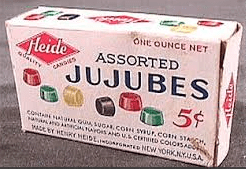
The best projectile candy hands-down was Jujubes. They tasted oddly like jujubessoap, so you only kept them in your mouth long enough to soften up the outside. Then they would stick to almost anything they hit. These candies, which looked like the prehistoric drops of amber that trapped insects, would suck the fillings out of your teeth if you bit down on them.

Adults normally avoided Smalley’s as if it were a war zone, which on most Friday nights it was. That’s why Malcolm, Dondi, Woody, and I felt as if we were trapped behind enemy lines, as grown-ups mysteriously surrounded us before one show.

“What’s playing anyway?“ I whispered as we sat waiting in the darkened theater.

“I don’t know, but if they’re showing Children of the Damned again, these people are sure going to be disappointed,” Woody said.

WaxLipsAs Gershwin’s Porgy and Bess lit up our faces, the woman sitting two seats to our right stared at us wearing our oversized wax lips. “You boys should be ashamed of yourselves, mocking these Negroes like that.” Dondi and Woody immediately ditched their wax lips onto the floor.

Malcolm dropped his into his shirt pocket where his mom discovered them weeks later as she ironed. Malcolm continued to wear the shirt despite what looked like a bloodstain over his heart. “I could keep me matches in here and they’d never get wet,” he always bragged as he’d peel the pocket open.

I kept wearing my lips. I couldn’t see what all the fuss was about, especially since our chorus teacher had staged a minstrel show for the winter concert that year, painting all our faces black and having us sing songs like “Mama’s Little Baby Loves Short’nin Bread.” I felt especially bad for Anthony Jefferson. Mrs. Lippiello chose not to paint Anthony’s face black, which was embarrassing enough because it made his milk chocolate face really stand out in our sea of licorice ones. What was even worse was when Joey Kavarvic got up there on stage in blackface, and sang the lead solo to an audience of adoring white faces. All of us kids knew that Anthony had a way better voice than Joey, so it was kind of unfair that Joey got the lead solo. Still, I was thankful Mrs. Lippiello at least had enough sense not to make Anthony sing the lyrics:

“I’s a little pickaninny,

blacker den a crow.

But I’s as sweet as lasses candy,

Mammy told me so.”

Imitating the falsetto voice of the lady on the screen, Dondi softly cried out “Crawdads, craw-da-uds.”

A long, drawn out shhhhh hissed ominously from the woman directly in front of Malcolm. She flung one end of her fur wrap over her shoulder as an angry exclamation point. The wrap was the type that had an animal head attached to it. The head landed pointing backwards, staring directly at Malcolm with its beady black eyes.

Up on the screen, Porgy was singing, “Bess, you is my woman now, you is, you is! An’ you mus’ laugh an’ sing an’ dance for two instead of one.”

“What is it?” Malcolm whispered to Dondi, as he pointed at the animal head.

Dondi leaned close to Malcolm and whispered in his ear, “It’s a rabid squirrel, and if you don’t shut up, it’s going to attack your nuts.”

Malcolm gagged on his coke as he tried not to make any noise. At that moment, Paper Thin in his gold-trimmed, burgundy usher’s suit, that made him look like an escapee from the circus, appeared behind Dondi and bonked him on the head with his flashlight. Little squeaks escaped from Malcolm as he held his breath. But the laughter had to go somewhere, and like a pressure relief valve, coke exploded out of his nose, sending a mist in the direction of the fur stole lady. Her husband whirled around in his seat, pointed at us and growled at Paper Thin, “Either they go, or we go.”

As we walked home, chewing the flavoring out of our wax bottles, Woody said, “The movie wasn’t even half over. They should have at least given us twenty cents back.”

“We’re regulars. We’re the ones butterin’ their bread,” Malcolm added. “Then some squirrel-infested lady comes in one time to see some lame musical, and gets us thrown out?”

Then Dondi called out “crawdads” again, sounding like the lady in the movie, and we all doubled over in laughter.

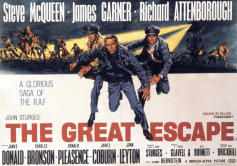
On the night we saw the movie, Sink the Bismarck, we marched home in Bismarckunison discordantly belting out the theme song.
“We’ll find that German battleship that’s makin’ such a fuss,

We gotta sink the Bismarck ‘cause the world depends on us.

Hit the decks a-runnin’ boys and spin those guns around,

When we find the Bismarck we gotta cut her down.”

To us, World War II was more than a lifetime in the past. It seemed even more distant to us because our fathers who had served in the war never discussed it. Snooping through the U.S. Army pins and ribbons in my dad’s desk one day, I discovered an amazing piece of war booty — a large dagger with a carved wooden handle. On the handle there was a silver eagle with spread wings and talons sunk into a round emblem below it. I rubbed my finger over the tiny embossed metal swastika in the middle of the emblem. Removing the decorated metal scabbard revealed a sinister, foot-long blade, oily and sharp on both edges. Engraved on one side of the blade in fancy script letters were the words, “Alles fur Deutschland.”

In the bottom of the desk drawer I found a plain manila envelope, stuffed full of photographs. Some of the photos showed railroad boxcars piled high with human bodies. The bodies appeared to be slathered with mud. In other photos, rows and rows of hundreds, maybe thousands of naked bodies lay face-up on the ground, with their eyes and mouths wide open. Their arms and legs were so thin and their ribs were sticking out so far, at first I thought they were skeletons. I returned to that drawer many times, studying each face with a magnifying glass, searching for any expression that might provide a clue of what had happened to these people. The despair captured on each face haunted me. On the outside of the envelope was the one word, “Dachau.” It was decades before I learned that my father had been one of the first into the death camp when it was liberated, which explained a lot about my dad.

As kids — perhaps because the topic was so squelched — we craved information on the war. Judging from the nearly empty theater, Sink the Bismarck’s raw, semi-documentary style with grainy, black and white footage of actual naval battles probably repelled most adults. But for us, it was mesmerizing. It traced the story of the flagship of the German Navy, which had guns with a range of over nine miles, well beyond the range of Britain’s ships. We watched in disbelief as the Bismarck sank the HMS Hood in the Battle of the Denmark Strait. The Hood was the pride of the Royal Navy. She carried 1,415 crewmen. Most of those who made it off the ship before it sank were machine-gunned in the water by German U-boats. Out of the entire crew, only three survived. In the dark, Malcolm whispered to us that his father had known some of the guys who died on the Hood.

When Winston Churchill issued the order in the film to “sink the Bismarck at all costs” we were ready to volunteer on the spot. The movie then wasted a lot of time with the British Navy cruising around, trying to locate the Bismarck, which we all agreed was the most boring part of the whole movie. But when the Brits finally located her and damaged the ship’s rudder with torpedoes dropped from airplanes, we started screaming and hollering and slapping each other on the back. When the Bismarck finally went under, we fell silent.

GreatEscapeWhen The Great Escape arrived at Smalley’s Theater, we all agreed it was the best movie ever made. We didn’t goof around and throw Jujubes on this night. We stared silently, mouths agape, as Steve McQueen, James Garner, James Coburn, Charles Bronson, and David McCullum outwitted the Germans at every turn. The captive soldiers dug a secret tunnel, with the goal of freeing several hundred prisoners.
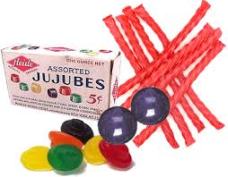
For weeks after The Great Escape, we were obsessed with digging a tunnel somewhere, anywhere. We eventually settled on tunneling out from under the lattice-enclosed front porch of my house. We chose a spot at the farthest end of the porch from the access door, figuring this would be the least likely place to be discovered. We planned to dig down vertically, take a ninety-degree turn, and then head toward my side yard. There we would excavate out an area for an underground clubhouse.

Whenever my parents left to play golf, I called Dondi, Malcolm, and Woody to come over to work on the tunnel. We developed a system using one person to dig the hole and another to load up my red Radio Flyer wagon. A third person dragged the wagon over to the access door with a rope. In the movie, the prisoners filled their pockets with dirt, and dumped it, one pocketful at a time, in the prison courtyard. At first, Malcolm insisted we deposit the dirt in my mother’s perennial garden next to our garage in the same manner.

“It’s too slow. Besides, I’ve always got dirt in my pockets,” Woody said.

“Steve McQueen never complained about that,” Malcolm said. “What’s the point of doing this if we don’t stay true to the movie?”

“Then why don’t we string up some barbed wire around my backyard while we’re at it?” I said. “That’d be more realistic, too.”

“And we could bring in some guards with Tommy guns,” Dondi added.

“If you guys just want it to be easy, why don’t we just hire a backhoe?” Malcolm said, throwing his shovel down in disgust.

“The difference is the guys in the movie had months to work and we’ve just got the time it takes Lucas’ parents to play nine holes,” Woody pointed out.

Finally we decided to shortcut the principles of the movie on this one technicality, and roll full wagonloads of dirt around to the back of the garage and dump it there. We dug a three-foot diameter hole six feet down, using a stepladder to get into it. We began striking out horizontally, but only got a few feet before losing interest in the project forever.

Years later when our tunnel was long forgotten, my father came into the house one Saturday morning, looking pale and agitated. He had been stowing some lumber under the porch when he ventured into the deepest bowels of the space and discovered the remains of our Great Escape diggings.

Now, if a thousand fathers made such a discovery, it’s unlikely that any would jump to the conclusion that their son and his friends had been trying to tunnel out from underneath the front porch. Some, like my father, might fear foul play.

As much as I wanted to ease my dad’s worries, I couldn’t help thinking that if I told him the truth he might get even more worried — about me. So, instead of confessing, I watched with interest as two of Johnstown’s finest arrived, and after cordoning off the crime scene, duck-walked under the porch. They came back out with their dark blue uniforms and glossy black shoes covered with a dust the consistency and color of chocolate cake mix. They announced with authority that the digging under the porch was a test hole dating back to when the house was built, over sixty years prior. This news was a relief to my father, who reasoned that a body buried under his front porch would put a real damper on the resale value of the house.

Hoeppner’s Candy and Radio Repair

images-1

No adults ever suspected that Old Lady Hoeppner dealt drugs to elementary and junior high school kids out of her store on the corner of Maple and Cady Street. The drug of choice was sugar, dispensed in the form of Atomic Fireballs, malted milk balls, grape jawbreakers, Red-Hot Dollars, licorice laces and other odd-named penny candies.

Many of these candies had the same rubbery consistency and no taste other than a mucky sweetness. But the taste didn’t matter all that much; it was all about the sugar buzz.

The penny candies were unwrapped and protected from shoplifting fingers in a walnut and glass display case that looked like it might have previously been used to display bodies in a funeral home.

Dealing sugar wasn’t the only commerce that took place in Hoeppner’s. Mrs. Hoeppner’s adult son, Aldo, ran a radio repair business somewhere in the back part of the building. I doubted many radios were repaired there, at least judging by how often Aldo wandered out into the candy store to check in on his mother’s customers.

Mrs. Hoeppner glared at us one at a time through her old-world glasses – the ones that were just glass, with no rims – and with a slight nod of her head said, “What’s yours.” It wasn’t a question; it was a demand. Her gray hair was pulled into a bun at the back, and she moved angrily about the little shop draped in a floral print housedress, stomping on the oily, blackened wooden floor with her lace-up heeled shoes.

Her oddness intimidated us into an inoffensive form of politeness – not unlike the phony kind practiced by Eddie Haskell on Leave it to Beaver. Dondi especially would say things like, “Hello, Mrs. Hoeppner, it is so good to see you today. Those new Chunky candy bars for only ten cents certainly look like a terrific value.” The fact was Chunky was the worst deal in the store, maybe in the entire world of candy.

But when Aldo walked into the store, we didn’t mess around. He looked to be in his early-forties and wore a buzz cut, even though he was balding (Woody called it his “buzzard cut”). Tufts of back and chest hair sprouted out around the neckline of his white T-shirt. He carried his arms out away from his body, as if holding invisible suitcases in each hand.

I often wondered about the radio repair business supposedly squirreled away out back somewhere. I pictured racks of vacuum tubes of all different sizes that had been purchased as part of the Radio Repair Correspondence Course. Of course, transistors had become such a big deal that vacuum tubes were pretty much obsolete. But our real fear was that what Aldo really had hidden out back was a big chest freezer, with children stacked up in it like cordwood.

While the penny candies provided us with sugar on the go, for instant injections we perched on the round swivel stools and osodafountainrdered from the soda fountain. Gleaming silver hand pumps, lined up like toy soldiers behind the counter, squirted thick, sweet syrups in all flavors — Coca-Cola, 7-Up, Pepsi, root beer, cherry, chocolate, strawberry, vanilla, and grape. We were forever experimenting with new flavor combinations. For several weeks Malcolm tried to convince us that Chocolate 7-Up would soon sweep the country. I told him it tasted like dirt.
“When I become famous and you’re bragging to everyone that you knew the bloke who invented it, I won’t give you the time of day,” he said.

Woody worked with cherry as a base flavor and hit on something decent with Cherry 7-Up. My signature drink was Vanilla Coke. But Dondi never ordered the same thing twice. When he ordered a Pepsi-Cokesy, the name sounded so cool we all knew he was onto something. But Old Lady Hoeppner scowled and shook her jowls, refusing to mix it. It was so unlike her to turn down a dime, we figured that Pepsi and Coke probably had a law against mingling the brands.

Shortly after graduating from the sixth grade, we streamed into Hoeppner’s all sweaty from a game of basketball on the courts across the street. When it came my turn, Mrs. Hoeppner nodded at me. “What’s yours.”

“May I please have a glass of water to start, Mrs. Hoeppner? I’m awfully thirsty.”

Magnified through her glasses, her eyes blinked owl-like several times before looking down to locate a glass. She filled the glass from the tap and clanked it down in front of me on the marble counter. As she turned to fill Woody’s Cherry 7-Up with cold seltzer, I dug a foil packet of Fizzies out of my jeans and dropped the two strawberry-flavored tablets into my glass of water. Fizzies were flavored sparkling tablets, from the same folks who brought us Bromo Seltzer. They didn’t really taste that great. But if you put them in your mouth they would foam up and you could run around pretending to be a dog with rabies or a crazy man. Of course, parents hated seeing their kids being so good at that kind of thing. So they started a rumor that if you swallowed a Fizzie whole, your stomach would burst.

fizziesWoody, who was watching me attentively, suddenly cried out, “It’s Fizzling!” He said it in the same excited voice as the dopey kid in the Fizzies commercials. That got Old Lady Hoeppner’s attention in a hurry. She whirled around faster than I’d ever seen her move, locked her eyes on my glass of water fizzing away, and latched onto my glass with both hands.

We played a back and forth tug of war that looked like two lumberjacks working a bucksaw. For an old lady she was pretty strong. So I pulled harder, and surprised her with my strength, pulling her up on her tiptoes. Then she dropped her big butt for leverage, hauling me halfway across the counter. I was just fighting for my Fizzie. But she was fighting something much bigger — a dangerous, new-fangled trend.

Malcolm, Woody, and Dondi were cheering wildly, like it was a TV game show. I gritted my teeth and searched Mrs. Hoeppner’s face for some sign of weakness. That’s when I noticed Aldo in the doorway, looming behind his mother. He walked quickly over and squeezed both of my wrists, forcing me to release my grip.

“What are you a tough guy?” he said, trapping both my wrists in one of his mitts. “Fighting with a woman? The hell’s wrong with ya?”

“She was trying to take my drink away,” I said.

“He no pay,” said Mrs. Hoeppner, wagging her boney finger in my face. I jerked my head back startled by her sharp, yellow fingernail. Aldo held my wrists tighter.

He put his face uncomfortably close to mine, exhaling sour coffee breath. “You didn’t pay?” Clearly this was a worse sin than arm-wrestling with his elderly mother.

“It was just a glass of water,” I said, hoping my voice didn’t sound as whiney to my buddies as it did to me.

“He no pay,” Mrs. Hoeppner said again.

“Get the hell out of here and don’t come back,” Aldo said, leading me to the door. He opened the door for me, which I thought was quite polite of him until he flung me to the sidewalk. As he stood over me, I noticed a brief look of concern in his eyes. Perhaps he worried that he had been too rough. But then he said, “And don’t come back for two weeks.” That’s when I knew his real fear was the lost revenue if he banned me for life.

Occasionally Hoeppner’s attempted to branch out of the candy and soda business into other merchandise. Experimental racks of yo-yo’s, rocket-shaped crystal radios, or cap guns would mysteriously appear. We always inspected the stuff just in case there was something interesting, but never bought anything. If we could get the same item for a nickel less, we would ride our bikes downtown to get it at Gould’s or Newberry’s. Besides, Hoeppner’s never had anything new and different — at least until the day we stood staring at a display of peashooters.

We walked out of the place armed and in search of targets. Malcolm took aim at the white Ford Falcon parked across the street. Ping! He raised his fist triumphantly and shouted, “Bulls-eye.”

Dondi rolled eyes. “It’s a car for Christ sakes. Let’s see you hit that stop sign.”

Malcolm, Woody, and I all fired at once. Ping! Ping! Ping! We immediately went back into Hoeppner’s and bought more ammo.

We wandered over to Knox Field and parked ourselves on the bank behind the tennis courts. The two men in front of us were running around under the hot sun, diving for shots on the hard court.

“What d’ya think the odds are of me shooting a pea clean through that chain link fence?” Woody asked.

The guy on the court in front of us was bouncing the ball, preparing to serve. I gave Woody a skeptical look.

“You know,” Woody said, “kind of like a science experiment.”

When Woody fired, the guy duffed his serve into the net, double-faulting. He turned and glared at us. I wasn’t sure if the sound from the peashooter had distracted him or if he had been hit. The man walked across the court, meeting his opponent at the net, suggesting to us that their match was over.

“I thought that clot was going to come after you,” Malcolm said to Woody.

“Think again,” Woody said, pointing across the court. The man had exited the gate on the far side, and was circling around the court toward us. His opponent joined in, heading in the opposite direction to catch us in a pincer attack.

The Chase was what we both hoped for and feared. In the same way that the Swamp Fox on Walt Disney made the British look foolish, and Zorro outwitted Sergeant Garcia, every eleven-year-old boy secretly believes that through superior wit and guile he can outsmart and outrun the enemy. We knew every secret shortcut, path, and hiding place at Knox Field. So, as terrifying as it was to have two grown men with tennis rackets in their hands closing in on us from two different directions, we knew we held the advantage.

Surveying the angle of attack of our pursuers, we sprinted down the stone-dust path paralleling First Avenue. The guy coming at us clockwise believed he had us trapped. “I’ve got you, you little shitheads,” he screamed, waving his racket overhead as he closed in on us. There was no exit in the high, spiked wrought-iron fence in the direction we were headed. But what we knew and he didn’t was that there was one bar in the fence that had been bent when a garbage truck backed into it. The gap had been widened just enough for us to squeeze through.

We piled up at our exit spot like subway commuters at a turnstile. We pushed Malcolm through first, and then Woody and I slipped through behind him. The closest pursuer was closing in fast on Dondi as he squatted down to angle his head through the widest part of the opening. Believing he was about to catch one of us, the man bellowed, “Come to papa, you little bastard!”

Dondi jammed his head through the bars, bending his ears back in the process, and lunged forward, just as the man dove. It may have been our volley of peas shot at point blank range that made the guy flinch and miss grabbing Dondi’s legs.

Dondi bounced to his feet and stood just beyond range of the man’s outstretched arms. “You are not my papa,” Dondi said in a calm voice that was spooky, especially considering that the guy’s hands were so close to reaching Dondi’s neck.

We raced down First Avenue toward the junior high school building. But Dondi stopped short, as if he had forgotten something, and turned back toward the man at the fence.

“What the heck are you doing?” I asked. “Let’s get out of here.”

Dondi stared back at the man. “If that was my father, he would have caught me,” he said.

I grabbed his arm, and we both turned to catch up with Woody and Malcolm. The number of cars parked around the school suggested an event inside, so we raced across the front lawn and ducked in the main entrance on Perry Street. Inside, we heard muffled, discordant sounds emanating from the bowels of the school, as if the building had indigestion. The high school spring band and chorus concert was in full swing.

Fearing that our pursuers were close behind, we hid out in the projection booth above the balcony. Far below, Mrs. Gates was conducting the chorus in a sappy rendition of “Sleep Kentucky Babe.” We peered through the portholes normally used for the lights and projectors. The chorus was singing, “Skeeters am a hummin…” when Woody fired a salvo of peas out his porthole. Mrs. Gates was stretching her arms outward, directing the singers. Her right hand suddenly snapped to the back of her neck as if slapping at a mosquito.

“Hey, did you see that?” Woody whispered. He studied the peashooter in his hand, and then us. “We couldn’t really have the range from up here, could we?”

So we all joined in. At first nothing happened. We put more into our shots, arching our backs, and then snapping forward as we fired. Members of the chorus started flinching and swatting. Excited that we were on target, we rained destruction down on the performance below. It wasn’t easy because we were laughing so hard.

“Awck. I think I inhaled a pea,” Malcolm said. He held his throat with both hands as if choking.

That’s when the door to the projection room burst inward. A silhouette of a huge man swung crazily from side to side in the doorway, apparently trying to peer through the darkness. “Who is it and what are you doing up here?” the form asked. I realized it was Mr. Gates, the teacher the high school kids called Norman, as in Norman Bates from the movie Psycho. He was a tall, severe-looking man…and the husband of the embattled woman trying to conduct down below.

I was about to say we weren’t doing anything when I heard Dondi say, “We’re working the lights for the concert. Mr. Rhodes asked us to.”

One lone spotlight at the far porthole bathed the stage below in light. It certainly didn’t take four of us to work it, especially since it hadn’t moved. And it wouldn’t take much for Mr. Gates to ask the band instructor Mr. Rhodes if Dondi’s claim was true.

“Then concentrate on your work and stop making so much noise.” With that, he quietly shut the door.

We stood motionless for a good five minutes, listening. Malcolm finally said, “Let’s get the F out of here.”

“Get the F out of here?” Woody repeated. “What the fuck’s that supposed to mean?”

“It’s code in case he’s out there laying for us,” Malcolm whispered.

“Right. Like wrecking his wife’s concert is okay, but swearing would be the final straw,” Woody said.

“Why don’t we go one at a time and make a rendezvous, like in The Great Escape,” I suggested.

Dondi offered to go first. “If he’s out there, I’ll just say I’m going to the bathroom. If I don’t come back in five minutes, you’ll know it’s safe.”

So we snuck out one at a time and regrouped two blocks away on Malcolm’s front porch. In The Great Escape — in our opinion the best movie ever made — we had watched in disbelief as the escapees were recaptured one by one, and about fifty of them were machine-gunned by the Germans. In the movie, only Danny, Willie, and Sedgwick made it to freedom. Yet we all escaped our peashooter caper unscathed, further reinforcing our belief that we were invincible.

Blood Brothers of the Cayadutta

When I was in the sixth grade our school dreamed up a new way to save us from Russian missiles — a go-home air raid drill. We webloodcropre sent home with instructions to hide in our basements all afternoon. My friends and I were like, “Yeah, right.” Instead, we biked straight out of town to our secret Indian village on the banks of the Cayadutta.
Those who never smelled the Cayadutta probably found the name noble sounding — in a Native American sort of way. But in our hometown, the stream that carried sewage, chemicals, flesh and hair from the tanning mills, only inspired insults. Kids who lived along the Cayadutta were sewer rats. One classmate was so slovenly he became known simply as Cayadutta. It was about the lowest name you could call anyone.

Flushed out by side streams, the Cayadutta flowed a bit more cleanly by the time it reached Sammonsville. It was near there that Malcolm had first spotted a high bluff above the stream and insisted that’s where he would live if he were an Indian. We all agreed he was right. We pictured a Cayadutta full of trout, deer in the forests, and gardens on the bluff providing corn, beans, and squash for our tribe.

On the afternoon of our go-home drill, we gathered firewood and built a teepee-style campfire at our secret spot. I produced a package of Oscar Mayer hot dogs I had hocked from my parents’ freezer and we roasted them on sticks. There was no bread, mustard, or ketchup – just water from our canvas-covered army canteens.

Malcolm washed down his second wiener with a big swig, and let loose a throaty belch, followed immediately by, “No Slugs! P.A.A.!”

“Slugs,” I shouted, too late. Malcolm had repelled my knuckle punch by calling No Slugs first.

“Eagle Claws,” Dondi countered, lunging for Malcolm’s belly with fingers flexed like talons.

“I called P.A.A.” Malcolm said, sidestepping and straight-arming Dondi’s attack.

“Yeah, what’s that supposed to mean?” Dondi asked.

“Protection Against Anything,” Malcolm said, sticking his chin out, challenging him.

“That’s brilliant,” said Woody, who was never all that much into this game anyway.

“What if I just call N.P.A.A.?” Dondi asked. He looked unsettled by Malcolm’s game-changer.

“N.P.A.A.?” Malcolm asked.

“NO Protection Against Anything,” Dondi said.

“It’s Protection Against Anything. That means anything.” For emphasis, Malcolm rolled up the sleeve of his favorite gold football jersey. He’d gotten it at the knitting mill and had cut off the sleeves at the elbow, right below the purple and white stripes. He showed us the bruises on his upper arm, and looked at Dondi accusingly, daring him to argue.

Dondi held up his hands in protest. I couldn’t tell if he was declaring his innocence — or surrendering.

“Hey, let’s find us some Arty-Facts,” Woody said, redirecting us back to the real purpose of our expedition.

The four of us scoured the village, picking up any sharp rock that might pass for an arrowhead. Larger pieces were spears and tomahawks. Flat, square-edged stones were fragments of pottery. Too soon, the length of our shadows on the ground told us it was time to head home.

After gathering our things and peeing on the fire, Malcolm proposed we become Indian blood brothers. Producing a drop of blood doesn’t sound like a big deal — until you try to do it with the point of a jackknife. Woody lit a match to sterilize the blade. Malcolm went first and carried on like a big baby, but it was only for show, to get the rest of us laughing while nervously waiting our turns.

I went last, with Dondi, Woody, and Malcolm chanting “Hurry! Hurry!” as they tried to keep their blood fresh, by squeezing more out of their fingers. Egged on, I sliced too deeply. With that, Dondi, who had the most theatrical flair, raised his finger up high, and said, “In the spirit of the Great Iroquois Nation, I hereby pronounce that we are now blood brothers of the Cayadutta Clan…bound to support and defend each other forever.”

No one could top that, so we looked each other in the eye and nodded our agreement. The smoke from the dying fire hung in the air, on our clothes and in our hair. Only I could reach Dondi’s bloody finger comfortably. Malcolm and Woody stood on their tiptoes and craned their bodies and necks upward, like baby birds reaching for food. Then we put our fingers together, and solemnly mixed our blood.

When you’re eleven years old, competing to collect the best Indian artifacts, it’s easy to get carried away. Each of us carried at least fifteen extra pounds in our knapsacks, and it was a five-mile bike ride back to town, even going the shorter way home on the highway.

After dinner that evening, I cleared all the books off my bedroom shelves, and neatly arranged displays of arrowheads, spearheads, tomahawk heads, and pottery pieces – just the way they did at Johnson Hall. I didn’t have any cool stuff like musket balls or scalps to display, but that didn’t stop me for weeks from charging five cents admission from neighborhood kids to see my collection. I would also take baseball cards in trade from those who didn’t have a nickel.

Returning home from school one day, I discovered my entire Indian arrowhead display replaced by a lame store-bought rock collection, with samples neatly labeled and glued inside a cardboard box. Eventually, Woody’s, Dondi’s, and Malcolm’s arrowheads met the same fate, tossed in the garbage, and all buried together in Johnstown’s landfill.

Many years after our discovery and plundering of the site, historians verified the location of an ancient Iroquois Village on the east bank of the Cayadutta, about a mile upstream from Sammonsville — at the exact spot where we became blood brothers. The public is now restricted from visiting this area for fear that the archeological purity will be violated.

No doubt, several hundred years in the future, when the remnants of our arrowhead collections are unearthed beneath tons of household garbage and tannery wastes, future historians will locate another Iroquois Village below the site of the old, 20th century Johnstown Landfill.

The Statue of Liberty Play

The west eFullSizeRendernd kids always beat us in sandlot football except for one time — thanks to this truly miraculous, admittedly crappy trick play.
Our south end team played our home games on the front lawn of the old Knox Gelatin Factory on Chestnut Street. The side boundaries were enforced by a high curb and asphalt driveway on one side, and a stretch of woods on the other.

The prior year, one of our players, Charlie “Clunk” Knolls, who later in life had a try out with the Baltimore Colts, sustained a compound spiral fracture of his right femur when he was gang tackled onto the asphalt. I had stood over Clunk urging him to shake it off, until Malcolm came over and pointed out that Clunk’s foot was on backwards. The doctors put a bolt through his cast and slung his leg up in the air with cables until Thanksgiving. Sixth-grade fractions, multiplication tables and world geography passed him by forever. But Clunk was back on the field this year as we warmed up in our flimsy helmets and shoulder pads from Woolworth’s.

We heard the pack of west end kids whooping and hollering before they even turned the corner onto Chestnut Street. As they approached, they were in constant motion, as if they had already started the game. Their quarterback, who was called Beanie, launched long, flat spirals to Weasel, Tuna, Sandman, and Tombstone. We tried not to stare. Malcolm sent me out for a pass and twice waved me deeper. The ball wobbled end over end and fell at least ten yards shy. One of the west end kids they called Junior slapped his thighs with both hands and, pointing in the direction of the pass, said, “What do ya call that? A wounded duck?” Another kid they called Soda started making quacking noises.

“What’s that Mambo kid doing here?” Dondi whispered to me.

I stole a glance at the other team. “Is that Dom Schialdone?” I asked.

“Yeah, it’s Mambo,” Dondi repeated. “They’ve never brought him along before.”

“Maybe he’s their manager or something,” I suggested. He carried a black metal lunch box with adhesive tape crosses at each end, suggesting it contained their first aid kit. “He doesn’t even have a helmet,” I noted.

Mambo had arrived from Italy two years earlier. With his thick glasses and white short-sleeved dress shirts, he normally looked like a portly middle-aged man. But on this day, stripped of his glasses and dressed in a gold jersey, he looked as solid as a bowling ball, outweighing any of us by at least fifty pounds.

After the third play from scrimmage, Malcolm pointed at the bright red strawberry on the inside of his forearm. “That Mambo fella is a bit testosteroney. He has whiskers like sandpaper,” he said.

When Mambo carried the ball, it took three or four of us to ride him to the ground.

At halftime, Mambo lifted his first aid kit for me to see as he brushed past me. “For emergency use only,” he said with a grin. I peered over his shoulder as he knelt down and unhinged the top of the box to reveal a pack of unfiltered Camels and a can of Budweiser.

While our team retreated to the shade of the trees to plan our second half strategy, the west end kids never stopped moving. They ran pass patterns and made leaping catches. Only Mambo paused long enough to lounge on the grass, enjoying his beer and smokes.

Miraculously, toward the end of the game, our team trailed the west end by less than a touchdown, thanks largely to Mambo leaving early to go work at his uncle’s liquor store and to a totally unlikely touchdown pass in the third quarter. Malcolm called for a deep pass to me down the right sideline along the trees. Seeing that I had slipped behind the defense, Malcolm uncorked a pass that was well beyond his range. The extra effort produced an unnatural hook in his throwing motion that caused the ball to veer unexpectedly to the left instead, hitting Clunk mid-stride for a touchdown as he streaked down the left sideline.

Malcolm walked up to Junior, the kid who had laughed at his warm-up passes, and asked, “How do you like that wounded duck?”

“Yeah, right! Ya wasn’t even throwin’ to him,” Junior said, bumping Malcolm with his chest.

“Right on the numbers, ya scruffy knobhead!”

Sensing from Malcolm’s tone that he had just been insulted, Junior bumped Malcolm again. “Your ass. You were looking at your other receiver the whole time.”

“Does Johnny Unitas look to Raymond Berry the whole time?” Malcolm shot back. “He looks to Jimmy Orr, then hits Ray Berry for the TD.”

The argument might have evolved into a fight if the west end players hadn’t been so anxious to get the ball back to pad their small lead. Several teammates grabbed Junior and dragged him to their side of the field. The two teams traded the ball back and forth several times without scoring. Then, with one-minute left, Woody, whose usual role was distracting opponents with his sarcasm, pounced on a fumble near our end zone.

In the huddle Malcolm said, “Don’t look now mates, but we’ve got some admirers from the Future Cheerleaders of America.” He loved creating odd spin-offs like that of real clubs like The Future Farmers of America. He nodded his helmet up toward Chestnut Street where half a dozen girls stood in a tight circle, feigning disinterest in our game.

Normally Malcolm called for either a running play up the middle with Dondi taking the hand-off or a pass to me. But at this moment, with time running out, Malcolm called for our ultra-secret, often discussed but never practiced, end-around Statue of Liberty play. At the snap, Malcolm would drop back to pass and pump-fake to Clunk, who was going deep on the left side along the driveway. Then he would transfer the ball to his non-throwing hand and I would snatch it from him as I ran around behind him.

I lined up next to Clunk, forcing the defense to shift to that side. The pump-fake froze the defense long enough for me to circle around behind Malcolm, take the handoff and sprint around the right end toward the trees. I was within ten yards of the goal line when the kid they called Tombstone knocked my legs out from under me with a cross-body tackle. Diving forward for extra yardage, I landed on my belly and slid into the woods.

“Lawn sausage,” Tombstone screamed as he back-pedaled away from the scene, frantically checking his clothes. All the west end kids in the vicinity hopped on one foot, then the other, inspecting the bottoms of their sneakers. As I scrambled to my feet, the one called Tuna pointed at me, then threw his head back and barked. Soon the entire west end team joined in, laughing and howling like a pack of wild dogs. The air was thick with a smell way worse than the Cayadutta. I glanced down at my jersey and jeans and gagged. I had belly-flopped on a dog pile and slid through it.

Meanwhile Clunk’s older brother Billy, who was officiating, had marked the ball on the two-yard line. My teammates were jumping up and down, screaming for me to hurry back to the huddle. The west end kids stopped barking and starting complaining, “Come on ref! Time’s up!” Billy studied his watch and shook his head no. There was still time.

Malcolm called what would surely be the last play of the game. “Dondi through the middle on two,” he whispered hoarsely. It’s not that he needed to whisper; the west end team would surely be keying on Dondi anyway.

When we broke from the huddle I stepped between my team and the line of scrimmage and said, “Same call, but let me run the ball.” When Malcolm protested, I spread my arms and took a step toward him. Malcolm’s eyes opened wide with alarm before flashing a look of understanding. “Brilliant,” he said, “Lucas through the middle on two.”

I nearly fumbled the handoff when Malcolm tossed the ball in the air to avoid any contact with my fouled jersey. The west end defenders allowed me to waltz into the end zone untouched. Almost immediately after the winning score, Billy called time. Our south end team had won our first game ever against the west end kids.

Despite their aloofness, the Future Cheerleaders of America had to have noticed who had scored the winning touchdown, but it had come at a price. As Dondi, Woody, and Malcolm walked back up Maple Avenue with some of the girls — I straggled along at least a half block behind the group, earning a totally undeserved but no less fatal reputation for being shy when it came to girls.

Blue Collar Cotillion


cotillionphotoWhen I was in the seventh grade I switched churches for an Indian Princess, only to have true love spoiled by a freak accident in the men’s room at the Rollerama. 
Thirty or so adolescent couples shuffled around the mahogany raised-panel room, counting out the steps to the foxtrot on the parquet floor of the old Treadwell Inn’s Colonial Ballroom. The red letters on the bass drum grandly promoted the tuxedoed trio of musicians crammed into the corner of the room as The Johnny Lanier Orchestra. The boys’ heads rhythmically bobbed up and down as they alternately studied their feet, then looked up to avoid collisions. I did my best to steer Missy Grazinski, who was actually cute in a perky, Brenda Lee sort of way. In fact, she was a local singer of some notoriety, having sung Brenda Lee’s hit song, “I’m Sorry” on the local TV variety show, Teenage Barn. The only problem with Missy was that I was at least a foot taller than her. I stepped forward trying to lead, but her backward step was too short for my long legs. My knee slid against the silky fabric of her dress and nudged a soft part of her body. I prayed it was just her leg.

“Ahh, sorry,” I mumbled, uncertain if I should acknowledge the contact or not.

Missy’s upturned face glistened under the ceiling lights of the old ballroom. “That’s okay Lucas,” she said with a big smile.

Although other seventh-grade boys might have taken her response as encouragement, I backed my legs away from Missy to avoid any further contact. After all, this was cotillion — where we were expected to learn etiquette, social graces, and ballroom dancing.

“No, no, no, no.” The excited voice from the middle of the room instantly made all the boys jumpy. I felt Mrs. Cicotti’s hand ease my outstretched butt back toward Missy. Everyone else stopped to watch.

“Are you afraid to get close to your partner?” she asked as she manipulated me into a more upright position as if I were a Gumby toy. “Here, let me demonstrate.” She took my right hand and placed it well around her own back. “The male’s right hand should be in the small of the woman’s back,” she said to everyone in the room.

I didn’t feel any smallness in the dance instructor’s back. She continued to hold my hand on her back to keep me from backing away. Her ample bosom pressed into my collarbone.

“You are bobbing your head up and down like one of those toy birds that sips out of a glass of water.” She rocked her head up and down, drawing a few nervous laughs from the crowd. “You do not have to check on your feet,” she announced, staring down to demonstrate. “Because they are not going anywhere.” I felt her swell with pride at the effect her punch line had on everyone else. But as I took in the roomful of laughing faces, I knew their laughter was mostly relief that they weren’t in my shoes.

“You should look at your partner,” she said, now smiling at me. “And carry on polite conversation.”

Her hair was pulled back tightly away from her face, exposing a row of grey roots at her scalp line. I tried not to stare at her faint mustache. At this range I could see all the fine lines in her face she had powdered over.

“I think I have it now,” I said, hoping that would be enough for her to release me.

“Yes, like this,” she said, standing up straight. “Not like this.” She bent at the waist sticking out her bum, mocking me. All the boys and even some of the girls in the class laughed.

The drummer popped his snare drum emphatically to signify it was the end of the song and time for their break. The band retired upstairs to the bar while the boys in the class retreated to the punch bowl.

“Man, she had you in her death grip,” Dondi said to me.

“You’re lucky you didn’t get your eye put out with one of her knockers,” Woody said.

Mrs. Cicotti clapped her hands together rapidly to hurry us up. “Boys, boys, you’re supposed to be offering refreshments to your partners.” She gestured to the girls sitting patiently in their fluffy dresses on metal folding chairs on the opposite side of the room. “And don’t forget the stimulating conversation,” she whispered.

Dutifully, I made my way across the room toward Missy. “Here, I brought you some punch and cookies,” I said, holding them out to her.

“Thanks, Lucas.” She beamed her usual, upbeat smile.

“Sorry I got us singled out,” I apologized. “That was pretty embarrassing, huh?”

“Don’t worry about it, Lucas.”

The seats on either side of her were taken, so I continued standing. I wondered if I should drop down on one knee to be at her level, but shook that idea out of my head. “Well, I better get going,” I said tilting my head back in the direction of the punch bowl.

“Okay, see you later.”

“Yeah, see you later.”

Terry Webb was seated next to the punch bowl with at least a dozen empty glasses scattered in front of him. He was a big kid with droopy, basset hound eyes. He always put on a terrific show of pretending to get drunk on the punch. He claimed he perfected this act by watching his dad — who owned a big leather mill in town — drink Manhattans every night at home.

“How many is he up to?” I asked as I sidled up to Malcolm.

“He’s at twenty-two cups and acting totally bladdered,” Malcolm replied.

Terry was closing in on his record of twenty-seven cups when Mrs. Cicotti called for everyone’s attention.

“We have a special surprise tonight.” She tapped Johnny Lanier’s big silver microphone. Doink, doink, doink. The amplified noise startled her, causing her to step back into one of the Grunert twins, nearly taking her out.

Dondi leaned close to me and imitating Mrs. Cicotti’s baritone voice, whispered, “Tonight we’ll practice proper introductions.”

Mrs. Cicotti composed herself and spoke into the microphone. “For a special treat tonight, Cammie and Connie will sing several of their beautiful harmonies for us.”

I groaned to myself. The previous month I had been matched up with one of the Grunert twins as a dance partner. I never did figure out if it was Cammie or Connie, which probably didn’t help. All she wanted to talk about was The City, where her cousins lived. I tried to shift the conversation to Roger Maris who, after all, played baseball in The City. But she put on a bored expression and said she could care less about whether Roger Maris broke Babe Ruth’s home run record.

When I told this story to my friends, I said, “And then she peeled off her latex mask to reveal her true identity as one of the Twin Lizard Women from the planet Reptalia. Hypnotizing me with her flicking tongue, she forced me to listen and nod with interest as she told me how enrapturing it was to see the Flower Drum Song in The City.”

“Let me introduce Cammie and Connie — the Grunert twins — singing a cappella,” Mrs. Cicotti continued.

“Singing a what?” Malcolm whispered.

“A cappella. It means they’re going to sing without any clothes on,” Woody replied.

“Without any instruments,” Dondi corrected.

“It would be more entertaining without clothes,” Woody said.

The twins were big on peace and brotherhood songs. First they sang “Cruel War” in a sappy harmony, as if they were the ones marching off to war. Then they got everyone clapping by singing “Sloop John B.”

“We come on the sloop John B

My grandfather an’ me

Around Nassau town we did roam

Drinkin’ all night”

Terry Webb joined in that last line with the twins, belting it out. A severe look from Mrs. Cicotti cut him off.

The band finally returned from the bar red-faced and with their ties undone. As Johnny Lanier queued up “In the Mood” with a wave of his arm, Dondi said, “and a one and a two and a three,” imitating Lawrence Welk. He said it was the only other place you could hear music that corny. But we always got into the swing on that number because it was the one song all evening when we were allowed to do the jitterbug.

Cotillion must have fallen on hard times because, prior to one lesson, Mrs. Webb — who was Terry’s mom — sat everyone down to ask for names of potential new recruits. She said that if we couldn’t expand our membership, everything — the dance instruction, the polite conversation, Mrs. Cicotti, the punch, the Grunert twins — all of it would be over. It was the most thrilling win-win prospect I could imagine. Shutting down cotillion sounded pretty good; recruiting girls who were not aliens sounded even better.

Terry was the first to raise his hand.

His mom peered over her reading glasses and asked, “Terrance, would you like to nominate someone?”

“Yes, mother. Abigail Russo.”

All of us turned our attention from Terry, to his mom, just like in a tennis match. We all knew that Terry loved Abby Russo, but I couldn’t imagine her joining cotillion, even if Mrs. Webb got down on her knees and begged her.

Mrs. Webb’s pen stopped in mid-air never reaching the small spiral notebook in her hand. “Address?” she commanded, in a flat tone.

We all looked back at Terry.

“Cayadutta Street.”

Two-dozen heads swiveled back to watch Mrs. Webb’s reaction.

“Street number?” She asked.

Back to Terry.

“I don’t know the street number.” He raised his chin defiantly. “Just write it down, Mom. It’ll get there without a street number.”

Mrs. Webb pursed her lips. Most of the time she was almost attractive — at least for a mom. But the hard look she had on her face right then made her lips and jowls look like crinkled paper. She held her head up with her nose in the air as if she had detected a bad odor. It seemed like just the mention of the word Cayadutta, the creek that carried all the sewage through town, including industrial wastes and chemicals from her husband’s tannery, was enough to bring the smell of the stream right into the room.

“I’m not sure we want anyone from that part of town in cotillion,” she said. Then her jaw and neck relaxed, as if the smell had suddenly gone away, and she cheerfully asked, “What other names would you children like to nominate?”

Several others offered names. Mrs. Webb controlled the entries, not even pretending to write down the ones she deemed unworthy. Trying to sound as blasé as possible, I suggested Bethany Larson. But it came out like a question, as if I was unsure a girl by that name even existed. Truthfully, I thought she was the most beautiful girl in my entire class. She had the most perfect, unblemished skin, without a mole or freckle anywhere. When she came back to school in September each year, her legs were so tan you could see perfect white stripes on her feet where her sandals had covered the skin. In contrast, I was so pale my cousins called me “Whitey” when we got together at Lake George every summer. By the end of the summer, my skin would take on a peculiar orange hue from a distance. But at closer range, my summer color revealed itself as nothing more than a solid nebula of freckles.

I knew that everyone had something they obsessed over. Kids with acne wished their pimples would go away. Short kids wished they were taller. The skinny ones wished they were heavier, and the fat ones wished they were thin. The plain ones wished they were attractive. But I couldn’t imagine what Bethany Larson might wish for; there wasn’t anything about her I would change.

When signs went up around town for a Friday night record hop at the local YMCA, I figured this might be my big chance with Bethany Larson.

“Real girls,” Dondi said. “And real music.”

“Maybe I’ll sneak Joan Novenas down into the showers and get all soapy with her,” Woody confided.

“I’m about to bite me arm off,” Malcolm said, which was just his way of saying he was excited.

Yet when the big night arrived, we all wasted most of the evening Indian wrestling, singing along with the records, and reenacting personal sports heroics. As the evening was ebbing to a close, the disc jockey finally put on “Wonderland by Night” — the most romantic, sensuous slow song of the era. I screwed up my courage and headed straight for Bethany Larson. The gaggle of girls surrounding her separated as I approached. Several twittered when I offered my hand and led her out onto the dance floor.

With conversational skills honed from hours of cotillion training, I began, “What’d you do this summer? You look really tan.”

“Oh this,” she said looking down at her arms as if noticing them for the first time in her life. “I went to the Cape with my family for the last two weeks in August. What did you do?”

I shrugged my shoulders. “I just hung around. Dondi, Woody, Malcolm and I discovered an old Indian village over near Sammonsville.”

“Really?” she asked. I could not tell if she was astonished, skeptical, or ridiculing me. “How did you know it was an Indian village?” she asked.

“Oh, we collected tons of arrowheads and pottery pieces and stuff. I have a pretty cool collection. I normally charge kids to see it, but I’ll show it to you for free.”

Other couples were already out on the floor, slow dancing around us, and here we were just talking. I had no idea how to make the switch to dancing. I considered holding out my arms as an invitation, but what if she didn’t pick up on it? Then I would look like an idiot, as if I were standing in front of her with an invisible partner. So I tried flattery.

“You know, you’re so tan, you could probably pass for an Indian.” I smiled and wondered if it were possible to pay someone a better compliment. Bethany scrunched up her nose, making me wonder if her opinion of Indians differed from my own.

I needed the remainder of “Wonderland by Night” to fast talk my way out of that one. I wasn’t sure if my rambling, incoherent explanation made any more sense to her than it did to me, but I was pretty sure it contained the words Indian and Princess in the same sentence, and that may have been what kept her out on the dance floor talking to me. When the DJ announced the next song would be “The Twist” and that the night would close with a Twist contest, the place started buzzing. Here was a dance that required absolutely no skill or footwork — all you needed was athletic energy. Mrs. Webb and Mrs. Cicotti had banned the twist at cotillion, which automatically cemented it as our favorite.

The DJ announced the judge for the contest and Stanley Saco stepped onto the dance floor. Stanley was the fitness director at the Y. He reminded me of an elephant, with folds of saggy skin covering his muscular frame. Stanley told us stories of traveling the vaudeville circuit as a young man. He taught us cool things like juggling and acrobatics. His best trick was balancing kids in their bare feet on top of his bald head.

On this particular night, Stanley twisted all around the dance floor, demonstrating the proper technique to everyone. He twisted from couple to couple, holding his hand over the couples being eliminated, until only Bethany and I and one other couple remained for the final twist off. The rest of the banned dancers surrounded us, clapping in beat to the music.

I felt myself following my partner’s more practiced movements. She looked like the snake charmer and I felt like the snake. When she urged me on with the words, “Go Lucas, go!” I tried so hard it felt like I might corkscrew myself through the floor. Stanley threw feints from the other couple to us, as if changing his mind on who to eliminate. I knew it was a just routine he had picked up from the TV show To Tell the Truth. The contestants would try to fake out the audience by pretending to stand up, when Bud Collyer the host would call out, “Would the real Percy Hoskins please stand up?” Stanley may have kept everyone else in suspense with his theatrics, but he didn’t fool me.

In the end, it was a magical evening. As we walked home, Dondi and Woody went on and on about how much they’d “gotten off of” Judy Fiorelli and Joan Novenas, slow dancing to the song “Wonderland by Night.” Dondi said that Judy had melted in his arms, but that was to be expected because he always felt he was irresistible to girls. Malcolm had successfully “chummed the waters in Dondi’s wake,” as he put it, and had an equally satisfying slow dance with one of the cast-offs.

I had never even touched my dance partner. But through my skillful conversation, she came away thinking I considered her as beautiful as an Indian princess, and together we had come in second place in the Twist contest. Walking home that evening, I felt an unfamiliar, not unpleasant nervous feeling in my belly that promised to blossom into something sweet and spectacular. The feeling lasted several more weeks. But unfortunately, that evening proved to be the high point of my relationship with Bethany Larson. With all the best intentions, somehow all future encounters would prove to be disastrous.

Soon after that evening, I switched churches for Bethany Larson. After baptizing me in the Methodist Church, my parents washed their hands of any further religious training, figuring they had done their part. They never noticed, or at least never asked, when I began getting up early on Sundays well before them, and walking six blocks to the First Presbyterian Church. If pressed, what would I have told them? I liked the sermons better? Nicer stain glass windows? I certainly wouldn’t have told them the truth. The Presbyterian Church had much cuter girls (one in particular) and they had field trips that involved long bus rides with these girls. I certainly did not tell them that I had signed up for one of these bus rides to go roller-skating several hours away.

Bethany Larson was looking out the window as I made my way down the aisle of the bus. Betsy Suttliff, who was sitting next to Bethany, gave me a knowing smile as I passed. I sat in the back of the bus daydreaming about skating hand in hand under the lit crescent moon. As I laced on my skates at the Rollerama, Betsy rolled unsteadily up to me and bent over, placing her hands on her knees for support. “She’d kill me if she knew I told you, but Beth really wants to sit with you on the ride home,” she said.

I felt the blood rushing to my face. “If I don’t kill myself on these things first,” I said, pointing to my tan and burgundy skates that looked like high-top bowling shoes on wheels.

Before going out on the rink, I found the men’s room. I balanced with the fingertips of my left hand on the wall in front of me and tried to relax. Just as my stream reached full force, some kid rolled unsteadily into the room and, when he windmilled out of control, clipped one of my skates from behind. By the time I regained my balance, I had managed to pee all over the front of my wide wale corduroys. Panic set in as I hid in a toilet stall, unsuccessfully blotting and fanning the stain. The only solution was to tie my jacket around my waist backwards. When I finally emerged from the men’s room, I cringed when I saw Bethany Larson’s reaction to this unlikely fashion statement. She looked confused, then quickly looked away in embarrassment. Every time the electric “couples only” moon lit up, I veered back into the men’s room to wait it out.

I wondered if through sheer will power I could give myself a seizure, thinking I had heard somewhere that people wet their pants when they had seizures. It might even elicit sympathy, but I decided it would be the fatal kind. So instead, I pretended I was coming down with the flu, which was exactly the way I felt anyway. I sat alone in the front of the bus during the long ride home just in case I had to get out to puke. No one wanted to sit near someone with the flu anyway.