Unknown's avatar

About nedvanwoert

Ned Van Woert studied to be a writer, but got sidetracked traveling around the world and wrote about it, which turned out to be an entree to a 33-year career in advertising in New York, Connecticut, and Vermont. Now that he's retired in Vermont, he has reacquired the fiction virus.

The Chase

Much of the fun growing up in our sleepy mill town involved inciting people to chase after us, as in the adrenaline-inducing, dangerous kind of chase. The kind where if you’re caught, you’re dead.

The Rope Trick was our gateway prank. It required no materials and not much planning…just boredom, a dark street, and a passing car.  

We usually worked the straightaway section of West Madison Ave, because drivers tended to speed up there. And all the cars back then — the Chevy Impalas and Biscaynes, the Ford Galaxies, and the Mercury Montereys — were big boats that couldn’t exactly stop on a dime. 

Just two of us could pull off the trick, but it worked better with more—half on each side of the road—in a spot away from streetlamps. As cars approached, we would pretend to stretch a rope across the street.  

Most drivers just tapped their brakes in surprise, but occasionally one would screech to a stop. That’s when we would scatter, racing down pitch-black driveways and backyards, relying on our superior athleticism, guile, and home-field advantage.   

In our minds, we weren’t ten-year-old kids running from motorists. We were American Revolutionaries outsmarting the British. We were The Swamp Fox. We were French Resistance fighters in WWII.  We were Zorro. 

For all its brilliance, The Rope Trick had one major flaw. Drivers mostly sped away, annoyed. Some would crank down their window and shout out obscenities. But no one ever chased us. 

So, we upped our game to something much more elaborate, using a Zebco spinning rod with an old pocketbook at the end of the line for bait.  

We set up across the street from the abandoned Knox Gelatin plant at the curve on Chestnut Street. On the inside of the curve, a dense hedgerow shielded the view of the Old Ladies Home. We planted the pocketbook in the middle of the road, with a dollar bill poking out as a sweetener. Then we squeezed through the hedgerow and waited on the other side, fishing pole in hand.   

It was like our own version of Candid Camera—our favorite television show. Our victims would comedically run after the pocketbook as we reeled it in. The problem again was that no one ever really chased us—except the one guy who burst through the hedgerow, sending us scattering into the darkness. But he went no further than our abandoned pocketbook, fishing pole, and dollar bill—and made off with them. 

Our best setup ever for a high stakes chase ended up getting ruined by the police. It began innocently enough, when a couple of us snuck into Old Man Sweet’s backyard one night and filled up a bushel basket with apples. They were no good for eating…stealing them was payback for all the baseballs, basketballs, footballs, and wiffleballs Old Man Sweet had stolen from us over the years whenever they landed in his backyard.  

We didn’t really have a plan, but as we carried the heavy basket, the wire handles were digging into our fingers. So, we set our load down in the middle of the road at the top of Melcher Street hill.  

As fate would have it, at that moment a couple dozen older boys crossed Melcher Street at the bottom of the hill. High on testosterone and perhaps beer, this living unit was coursing as one, shouting, swearing, boasting, and laughing. 

“Hey, you want some apples?” We shouted down at them.  

The gang below us stopped, silenced. 

“You big babies want some apples?” 

That’s all it took for them to charge up the middle of the street toward us—an enraged, murderous mob.  

We waited patiently until they were halfway up the street, then rained a barrage of apples down on them. Cries and curses erupted, and the unit broke apart, with individuals taking shelter behind the giant elms on both sides of the street.  

We retreated, dragging our basket to the terraced lawn just below Stinky Mullen’s house. We made our stand there, firing apples at the kids who were steadily advancing from tree to tree. They were picking up and reusing our ammo, and they had way better arms than us.  

But we knew our escape route—a path directly behind us that cut through the woods over to Hamilton Street. If we didn’t lose them in the woods, it was a short sprint to the abandoned barn on Second Avenue—always our backup plan. 

Just as we were preparing to run for our lives, two squad cars roared up Melcher Street, tires crunching the apples littering the street. As the cops rounded up our attackers and tried to make sense of the scene, we slipped out the back through the woods— unnoticed, and unpursued. 

______________________________________________ 

I’m driving in my old, but new to me, Fiat 124 Sport Coupe on Western Avenue in Albany. My front defroster and wipers can’t keep up with the snow that’s hammering down. My reaction is to lean over the steering wheel, squinting, and pressing my nose closer to the iced-up windshield. 

“WAP! BAM-BAM! WAM! BAM!” 

My college girlfriend flinches and yelps in surprise. 

I hit the brakes, then turn into the skid I’ve caused. As the car straightens, I steal a quick glance to my right, just in time to witness another fusillade of snowballs flying out from the alley next to a bar with a neon sign, reading “Sutter’s”. 

“Kids!” I announce to Kay, as I hang a right. “They’re in the alley back there.” 

I turn right again into a back alley, drive halfway up the block and park.  I’m guessing this is the closest I can get to them without being spotted. 

I get out of the car, leave it running, and ask Kay to get behind the wheel.  

“They just want someone to chase them,” I explain. “This will be fun.” 

“But aren’t we going to be late for dinner?”  

“If I’m not back in ten minutes, just swing around the block and pick me up out front.” 

I head off into the blizzard—no hat, no gloves—retracing the route we had just driven. I want to scout out the scene, make sure they are still there, and take them by surprise.  

As I approach Sutter’s on the sidewalk, there is no activity. But as I reach the front of the bar, a fresh volley of snowballs shoots out, viciously broadsiding a VW microbus.  

I kneel and form two snowballs. The snow is wet and packs hard. I run into the alley—before they have time to reload. 

“Okay, you guys have HAD IT!” I scream, to instill fear in their little hearts and to send them running for their lives. 

Five large men stare back at me as if I am deranged. My first reaction is that I’m looking at the defensive line for the SUNY Albany football team. But these guys are way too old for that. Plus, the way they look at me, then at each other, suggests they might not be college material—maybe not even football material. 

I mean, what kind of grown men stand in an alleyway during a blinding snowstorm, pelting cars with snowballs on a busy city street? Likely drunk ones who are not looking to be chased.  

I fire my first snowball at the guy closest to me. He spins, turns his back, and ducks. Miraculously, my snowball strikes him with a loud smack, squarely in his butt.  

His alley mates squint at me and bare their teeth, the way a Doberman Pinscher might as it’s sizing you up.   

“GET HIM!” the ass-target roars. 

I sprint back the way I came, my LL Bean Ranger Moccasins—which looked so cool in the catalog—offering little traction on the slick sidewalk. I turn down the first driveway to my right—five bellowing men close behind. I’m pretty sure I can outrun them. 

But as I sprint down the driveway, I see a garage blocking my way at the end, and a tall chain link fence blocking both sides. There is a gate to the left which is about five feet high. 

My pursuers who are halfway down the alley and breathing hard, see that I am trapped. 

“You are so fucking dead asshole!” one of them shouts. The rest growl and shout murderously in agreement—too winded to form real words. 

If the gate is locked, they will have me. And I’m beginning to believe that these meatheads will kill me if they can get their hands on me. So, without breaking stride, I dive headfirst over the gate, landing hard on my hands and knees. 

I sprint across the backyard in which I’ve landed, wrestle my way through a cedar hedge—falling out onto the pavement of the back alley—and spot the Fiat up ahead. I race to it, jump into the passenger seat and shout, “HIT IT!” 

Kay stares at my torn pants and bloodied hand.  

“What? What happened?”   

“Just go!” I say, rocking forward, as if that will get the car to move. 

Kay looks at me, clearly annoyed.  

“Listen, I’m sorry. But we really need to get going” I say, as I reach behind Kay and lock her door, then mine. 

Kay puts the Fiat in gear, carefully lets out the clutch, and we slowly inch forward. 

I twist in my seat to survey the alleyway behind us. There is no one. I let out a deep breath. The gate must have stopped them. I put my head back and close my eyes. My adrenaline crash, combined with the warmth of the car, makes me incredibly sleepy. 

Kay navigates back to Western Ave. The snow has let up, and we still have time to get to our dinner on time. 

After several minutes of driving, Kay asks, “Did you get to do your chase thing?” 

“Ah, yeah,” I said, rousing from my stupor. Then with a smile, “It was amazing.” 

How I Crashed a Nudist Colony—by Boat

Personally, I have nothing against nudists. Only they don’t like to be called nudists anymore. They think it sounds exhibitionist. 

The unclothed now prefer to be referred to as Naturists. I get what they’re going for there, but it also strikes me that someone could show up at a Naturist Colony with a butterfly net and be in for a big surprise.

 Oh, and that’s the other thing—the word Colony is also out of favor—it dredges up too many negative historical references. Instead of Nudist Colonies, Naturists now gather in Communities—Naturist Communities. 

“I love the warm sun and breeze on my bare skin…”

“It enhances my connection to the natural world…”

“It allows me to express myself, without the judgement that comes from the Clothing-Obsessed…”

I don’t mean to pile onto a culture war I never even knew existed, but the label “Clothing-Obsessed” not only feels judgmental, it also ignores some practical reasons the rest of us cover up—things like ticks, poison ivy, sunburn, mosquitoes, and hypothermia. And how is it fair for one group to adopt a cool new nickname, while labeling everyone else “Clothing-Obsessed?”

My crashing of a Naturist Community was hardly inspired by culture wars or voyeurism. It was purely accidental—at least on my part. 

It started with a boat trip from the Croatian town of Bol on the island of Brac, to Vrboska on the island of Hvar. It was a small boat by ferryboat standards—no more than 100 feet in length—but big enough to transport the twenty of us Americans, plus our guides and our bicycles. We parked our bikes on the lower fantail deck at the stern. 

Our pre-trip materials had instructed us to NEVER, EVER bring up the topic of the Yugoslav War, warning it could trigger violent responses. Yet when we first set sail on our island-hopping ferry, I found myself with others in the mahogany midship salon, listening to our guide Ivan talk about being drafted into the Croatian army, then, two years later, being forced to fight for the Serbs. Though he nailed the “Catch-22” irony of the situation, I could not dislodge the NEVER, EVER warning, and slipped away from the group to explore the boat.

I climbed a near-vertical ladder to the pilot house and stood in the doorway waving a friendly, care-to-show-me-around greeting to the heavy-set, grey-bearded man at the helm. Other than a Greek-style black cap with a stubby brim, nothing else in his khakis and t-shirt attire was remotely captain-esque. He enthusiastically beckoned me into the cabin as if he had been waiting for my arrival, and gestured toward the spoked wooden wheel, making steering motions with his hands as an invitation. 

I modestly shook my head no. “Does he think I’m twelve years old?” I wondered. 

“Da, Da, Da,” the man stuttered. Then he lowered his hand like a karate chop, sighting down his thumb and fingers, in the direction we were headed. “Da, Da, Da,” he insisted.

I squinted into the golden reflection coming off the Adriatic. There were several islands far ahead, too distant to know which channel he was indicating. But I figured no immediate route-finding would be required, so I took the wheel just to make the old guy happy. He beamed at my bravery, executed a small thank you bow, and exited the pilot house. 

To be honest, I would have hated if he had stayed, observing, and correcting my every move. But if he expected his little prank would make me nervous, he was going to be very disappointed. Both my grandfather and great grandfather had piloted Hudson River Day Liners, and I have big boats in my blood.

Scanning the horizon for ships or buoys, my thoughts drifted to my grandfather’s tales, in my mind plying the waters of the mighty Hudson…

Over 5,000 passengers throng the six decks of the Hendrick Hudson—over 400 feet of her on the waterline. Whole, eight-foot smoked sturgeon are stacked on the foredeck like cordwood, for delivery to New York. Tides affect the river all the way up to Troy, constantly reshaping sandbars which can be exposed at low tide. The navigational buoys only suggest the route; the color of the water is our true guide. As we approach Hyde Park, a small sloop sits at anchor to starboard. Several men are working an outrigger, hauling up jugs of water from artesian springs. It is said the Roosevelts take this water with them to Europe every summer.

I survey the meager instruments and controls at my command. We’re running at three-quarters throttle. There is no tachometer, GPS, radar, or depth finder. A brass gimbal compass indicates our heading is ten degrees east of due south. I’m guessing our speed is 15 knots, perhaps a little more.

A dozen of my fellow travelers lounge in the sun below me on the foredeck, several with beer bottles in hand. One of the women spots me and soon everyone in the group is waving, laughing, and applauding. By now the captain’s absence feels too long to be a joke…or a trip to the head. Perhaps he really did think I had arrived to relieve his shift. Or perhaps he wasn’t even the real captain and had been tricked into taking the wheel just as I had.  

I head the ferryboat toward the channel between a small island off our port bow and a large land mass—undoubtedly the island of Hvar—to starboard. The channel is about a quarter-mile wide, and I go straight up the gut, seeking deep water. The land passing by on both sides of the ship provides a truer sense of our speed. I up my earlier estimate to 20 knots and consider throttling back but discard the notion. We are flying, I am at the helm, and loving it. 

A squat, rocky bluff thrusts into the right side of the channel ahead, narrowing our passage. It is a sheer cliff of limestone. I shy away, adjusting our course several degrees to port, keeping the bluff well off our starboard side.

I’m busy waving and posing for my compatriots below, who are shooting selfies with me in the background, when I’m startled by a sudden resistance on the wheel. A meaty hand corrects our course back toward the cliff. I step back to surrender my post, only to watch our captain gesture toward the tip of the promontory and leave the pilothouse once again. 

Our new course strikes me as odd and perhaps a bit suicidal. If followed, we will just skim by the point. I adjust our course slightly to port to play it safe.  

The captain reappears and impatiently turns the wheel back toward shore. He points very emphatically, directing me to follow along the bluff. By now I am totally unsurprised when he again exits the pilothouse.

We are cruising at 20 knots, no more than 25 meters away from a sheer rock cliff. Logic and instinct are screaming for me to bear away, but who am I to argue with a man who pilots these waters every day? Plus, I do not wish to invite yet another, even angrier visit.

A sudden blur of motion and shouting diverts my attention back to the group on the foredeck below. Some people are waving and bouncing up and down as if possessed. Several women are pointing and shrieking, some are covering their eyes. Many of the men are staring as if spellbound. Everything about their behavior tells me we are about to crash. 

I start to wonder who in this situation is liable—the Croatian captain, who turns the wheel of his ship over to an unlicensed, untrained passenger? Or the misguided American, who agrees to operate a boat way outside his wheelhouse (to quote a tired and overused American metaphor)?  

Amidst the chaos below, one motionless figure grabs my attention. It is our captain, his forearms firmly planted on the starboard rail, as he calmly scans the shore. Then I see it—in a white-hot flash of cognizance—and the confusion of the entire morning suddenly makes sense. It is not an imminent crash that has captured the attention of my group.  Directly to starboard, on the bluff, just a stone’s throw away and at eye-level, are dozens of men and women of all shapes, sizes, and ages, lined up as if in a chorus line. They are waving back, laughing, and swaying to a beat I cannot hear. They all appear so incredibly happy to greet us and to let us know exactly who they are. They are Naturists, of course—an entire Community of them.

So You Got In a Stranger’s Car

So, you got in a stranger’s car, thinking it was your Uber. Or you hugged your mom at the mall, only it wasn’t your mom. Or the neighbor you’ve been calling Dave for fifteen years tells you his name is Greg. Big deal. Get over it. 

When I tell you my most embarrassing moment, well—let’s just say you’re going to be embarrassed to have suggested that yours deserves a second thought. In fact, my story is so preposterous you will think it is just that—a story. But I promise you every bit of it is true. 

It started with me in a hospital gown—opening in the back, please remove everything including your underwear—sitting in a chair in an examining room at St. Peter’s Hospital. I had shunned the padded exam table, feeling that was for after the doctor made his reassuring introduction.  It wasn’t like I was worried about a bad diagnosis or something. Kind of the opposite, really. My company had purchased a multi-million-dollar life insurance policy for me, and this was my perfunctory health exam.

Hanging out in a too-short hospital gown made me uncomfortable. When I leaned forward, elbows-on-knees to read People magazinethe gown splayed open, exposing my backside to the cold plastic seat. But when I tucked the gown under me, leaned back, and crossed my legs to keep from exposing myself, it felt weirdly seductive.

There was one soft knock on the door. A doctor entered, carrying a small wooden briefcase, which suggested traveling chess set more than medical equipment.  I couldn’t tell if his judgmental look was about the People magazine or my come-hither pose.

He placed his little briefcase on the exam table, opened it, and proceeded to remove and assemble gleaning stainless-steel parts that came together to create what looked like a foot-long Captain Video Ray Gun. He fumbled with the assembly long enough to convince me he had never put together, much less used one of these devices.

“I’m Doctor Sanden and I will be administering your Sigmoidoscopy today,” he finally announced. 

He extended his hand as if offering to shake mine, then detoured his movement to pick up the ray gun instead. He held it out for me to examine, as if that explained everything. 

“Okay, if you could just hop up on the exam table on your hands and knees, we’ll check out your sigmoid and get you out of here in no time,” he promised.  

And I’m thinking, where’s my sigmoid? So much for reassuring introductions.

At this point I had an uneasy feeling about where he planned to put that ray gun. Fortunately, I was still basking in the glow of the insurance policy and figured even this indignity would be worth it.

The scope was at full depth, with the doc peering intently into the eyepiece within inches of my butt when I heard the door to the room click open. I glanced back over my left shoulder to see a young nurse standing in the doorway. 

She took in the scene, locked on my eyes, and screamed, “Oh my God!”, fleeing and leaving the door wide open to the adjoining waiting room. I recognized several people who had been there along with me fifteen minutes earlier.

The guy in the business suit who earlier had caught me watching him surreptitiously pick his nose, gave me a self-satisfied little wave. An older man who had been slumped in his wheelchair had come alive, nudging his wife, and gesturing toward my room.

“Can someone get the door?” I stage-whispered. 

The doctor was too intent on my bowels to hear me, but the dozen or so previously bored people in the waiting room apparently did. Some craned their necks while others rose from their seats for a better view. This was well before people carried cell phones, so they were stuck with Reader’s Digest or Popular Mechanics. And what was going on next door was infinitely more entertaining than “I Am Joe’s Skin” or “How to Build a Helicopter in Your Backyard”.

Part of me wanted to search the faces in the waiting room for anyone who might know me. Instead, I turned my head to the wall, shielding my face—like criminals do when they are arrested in front of the tv cameras.

Now if you’re thinking that’s about as embarrassing as you can get, you would be only half correct. Because three years later I returned to the same room for the same procedure to renew that same life insurance policy.

Unfortunately, my positive vibes from the policy had long since evaporated, mostly because I had discovered that the company had named itself the beneficiary. They explained the policy needed to be structured this way to pay off shareholders’ heirs—”in case the whole plane went down.” 

So even though I knew what was in store this time, I felt much less tolerant of suffering for a dubious cause. The good news was I had a different doctor, who at least knew how to put the gun together, which I took as a good sign. His easy-going manner made me so relaxed, I told him what had happened the last time I had been in that room.

I thought he might laugh, but instead, he bolted the door, and solemnly promised me nothing like that would happen on his watch. 

Shortly into the procedure I heard him softly mutter to himself, “Oh shit.” 

Naturally I thought he was referring to something about me, or more specifically my sigmoid.

But the next thing the doctor said was, “damn light bulb burned out.”

My mood yo-yoed from the despair of wondering how long I had to live, to the joy of realizing it wasn’t me he was talking about, it was the ray gun!  But my joy was equally short-lived.

For some reason I still cannot understand, the doctor left the Captain Video Ray Gun in place, and instructed, “Don’t move. I’ve got to find a new bulb.” 

With that, he unbolted the door and left the room, leaving the door wide open to the packed waiting room outside.

NO BARBER FOR 24 YEARS

Covid is our Big Yellow Taxi moment—reminding us of the travel, hugs, friends, and restaurants we only missed once they were gone.  That’s not to say that some good hasn’t come out of the pandemic. For example, bringing back home haircuts.

I am no stranger to home haircuts. Back in elementary school, when my friends were waiting their turn in Jack Papa’s barber shop—pretending to read the interviews in Playboy—I was getting my hair cut by my father in our basement. 

He did an okay job—at least I was never embarrassed by the results. What I mostly recall is the quiet barber/son bonding as my father lifted, tilted, and lowered my head while he worked— a rite that continued through high school, college, and beyond.

The downside was that by the age of 24 I remained a hair salon virgin, with no clue how to instruct a real barber, how much I should pay, or how to tip. This ignorance set me up for a string of hair-cutting faux pas when I finally ventured out on my own. 

By then the men’s-only, striped-pole barber shops, with their combs marinating in jars of blue disinfectant had mostly gone out of fashion.  So, I searched the Yellow Pages and phoned a place called The Bisou Lifestyle & Spa Salon. 

One might imagine that a haircut would be like a brake job. They should be able to tell you upfront what it will cost. But The Bisou required a Hair Consultation before providing an estimate. If they had just told me ninety bucks over the phone, they could have saved me the trouble and embarrassment of settling for a half-price trainee. The trainee also meant forgoing their signature Effleurage which promised to wake up my hair follicles. This was okay by me as I hadn’t even known mine were sleeping.

My trainee stylist introduced herself as Michelle, pronouncing it Mee-Shell. Every time I visited her, I studied the customers around me, and concluded that no one’s haircut looked any better than mine, and certainly not twice as good. So, I stayed with Half-Price Michelle for several years, until the owner Richard (he pronounced it Ree-Chard) informed me that I would have to pay full boat. I felt exactly like I did when I was asked to leave that so-called All You Can Eat Smorgasbord in Copenhagen.

My Bisou experience drove me to Haircuts for Less, which was exactly what I wanted. They offered just a haircut—no estimate or scalp massage required—for a third the price of my trainee-cut at The Bisou. 

On my first visit, I got into a fight with the female patrons on either side of me who were arguing over whether Jennifer Lopez should give her engagement ring back to Ben Affleck. I knew nothing about the etiquette regarding intra-chair hair salon banter, or the ring controversy.

My hairdresser, an aloof, gum-snapping, she-thinks-she’s-all-that, 20-something, had a bizarre hairdo for anyone, much less a hair stylist. Her hair protruded forward and upward in a gravity-defying wave—like the crest on a dinosaur.  As she leaned over me snipping, I nervously eyed her cornice, fearing an avalanche. Also, she kept calling me “hon.”

The woman in the chair to my left had her hair layered in aluminum foil—which reminded me of the way my uncle used to rig up Reynold’s Wrap between the rabbit ears on his tv for better reception (whatever look she was going for, I hoped it turned out better than the picture on my uncle’s television). She drew me into the conversation when she announced, “It just proves she’s a gold digger.”

The woman on my right shot back, “J-Lo could buy and sell that no-talent pretty-boy ten times over!”

“Whoa!” my hairdresser broke in, apparently a Ben fan. “Do we even know who broke it off?”

This question elicited opinions from the two original woman, plus their hairdressers, backed up by facts from People, Cosmopolitan, and Vanity Fair that Ben was a drunk, or that he was two-timing her, or that she was too old for him, or that the 6-carat diamond was pink (so she should keep it), or that it cost two million dollars (so she should give it back). I followed none of their logic.

Accusations and put-downs volleyed back and forth, with me the monkey in the middle. That’s when I heard myself blurt out, “I think that J-Lo’s a tramp.” 

This immediately silenced all five women who stared at me, two of the women frozen holding sharp instruments. The patron on my right, the one squarely in the Ben’s a bum, keep-the-ring camp, aimed her forefinger at me. 

“J-Lo grew up in Castle Hill, which is where I’m from. Does that mean you think I’m a tramp too?”

Hoping my expression didn’t reveal my true thoughts, I simply said the word no, surprising myself when no sound came out. No further reassurances or apologies came to mind as I wondered, what the hell is Castle Hill? 

Now, in this era, it was fashionable to trim men’s sideburns at, or even above where your ear joins the side of your head. So, when I left with one sideburn clipped even with my eyebrow and the other halfway down my ear, I chalked it up to either passive aggressive payback for calling J-Lo a tramp—or just getting what I paid for. 

Surprisingly, I returned to Haircuts for Less (which I now referred to as Bad Haircuts for Less), and my second visit went even worse. 

I was relieved when the dinosaur-woman was unavailable. In her place was a hair stylist who introduced herself as Bev. I told her I wanted a trim, admittedly giving her little to go on, but apparently enough for her to get started.

Now, it’s never my intention to body shame anyone. So, I’ll just say that Bev really liked to lean into her work. Her invasion of my personal space went well beyond claustrophobia, to the point of suffocation. And it wasn’t because she had super-short arms, either. When she stepped back to admire her handiwork—giving me a chance to inhale—I tried to delay her reentry by asking if she had any vacations planned. I don’t mean to brag, but I was becoming a real pro at small talk.

“I’m really hoping to go to Maine,” she said. “But only if I can find someone to take care of my pet pig.”

Picturing something cocker-spaniel sized, I asked, “Is it one of those miniature pot-bellied pigs?” 

“Oh, she’s got a pot belly all right. But I wouldn’t exactly call 300 pounds miniature.”

At this point, with Bev being so judgmental and all, I felt like I needed to defend the pig. “What do you feed her?” I asked.

“Oh, she mostly eats nuts from the acorn trees out back.”

Calling an oak tree an acorn tree should have warned me off, but still curious about the pet reference, I pressed on. “Pigs are really smart though, right?”

Bev rolled her eyes like I’m an idiot who knows nothing about pigs, which is mostly true. “She’s definitely housebroken, but she’ll poop all over my trailer if she gets mad at me.”

I asked the obvious follow-up question, “What would make her that mad?”

 Without a trace of shame, Bev replied, “Oh, like when I push her out of bed.”

Nothing in my years of home haircuts trained me for this moment. I wanted to bolt from the chair with only the right side of my head clipped. But instead, I soldiered through the rest of the appointment terrorized by the knowledge that the woman cutting my hair slept with a 300-pound pig.

If there’s a silver lining to Covid, I am once again enjoying the mac and cheese, comfort-food equivalent of the hair cutting experience. I know that my current hairdresser does not sleep with pigs because I am sharing her bed. But this time around I have surrendered my appearance to a pair of twenty-eight-dollar barber scissors purchased on Amazon and to an unqualified stylist I know and trust. Her total focus removes any pressure for small talk, allowing me to just close my eyes and relax. 

A Cosmic Perspective

After reading Neil deGrasse Tyson’s “Astrophysics for People in a Hurry” I joked that after wrapping my mind around the immensity of the universe, Tyson suggests there might be multiple universes. But what really blew my mind was his contention that all of our problems on earth could be solved if everyone—especially people in power—took a more cosmic perspective. 

I tried to capture this concept in a 5 minute video…starring my five grandchildren. I discovered they are far more open to pondering our place in the universe than most adults ever are.

Outer space is cold and hostile and our blue spaceship called earth is the only planet we’ve got.

FREAK ACCIDENTS—or how not to get neutered at the beach

My near-fatal freak accident involved a long, overnight drive, a patriotic budgie-smuggler and a flying umbrella. I never even saw the accident coming, on account of being asleep at the time — an irony, given that as a student of untimely deaths, I’ve always tried to be vigilant about having one myself.

For example, when my bag of pretzels gets hung up in a vending machine, I just walk away. No rocking the machine, no temper tantrum. That’s because thirty-seven people in the past few years have been crushed to death by vending machines — freaking out over losing a dollar.

A good source of these stories is the CDC, which tracks all accidents in the U.S. as a way to help improve public safety, like at baseball games. Fans used to see a foul ball heading their way and think, “It’s coming to me! I got it! I got it!” 

As it turns out those moments were more than just entertaining replays of fans muffing the catch and tossing their beers all over those around them. Between 2012 and 2019 the CDC reported over 800 foul ball injuries at major league fields — some resulting in concussions, permanent vision loss and the death of one grandmother celebrating her 79th birthday at Dodger Stadium. As a result, major league baseball now has netting to protect fans from foul balls. So, positive outcome.

The same thing happened in the National Hockey League. A 13 year old girl was tragically killed by an errant puck in 2002. The following season the league mandated netting at both ends of every rink to protect spectators. 

Unfortunately, with many fatal accidents there’s just no way to protect the public — like the ones involving lava lamps. Lava lamps, of course, were born out of the 60’s drug culture, which might help explain why someone would be heating one up on his kitchen stove. 

“My lava lamp like exploded man, and it’s sticking out of my chest!” 

Some freak accidents can only be characterized as ironic. Like Jim Heselden, the inventor of the Segway, who in 2010 died after apparently riding his Segway off a cliff. Or Stephen Whinfrey, who was out hunting rabbits near Doncaster, England. Elmer Fudd-like, he inserted his head into a rabbit hole, got stuck, and asphyxiated. 

Then there are the deaths that involve being in the wrong place at the wrong time. Mike Edwards, a founding member of the Electric Light Orchestra, was driving in Devon, England back in 2010. He was minding his own business — quite possibly humming the band’s 1979 hit, “Don’t Bring Me Down” — when a 1200 pound round hay bale randomly rolled down a field and flattened his van.

But in some accidents one can’t help feeling the victims had it coming — especially when they involve the mistreatment of animals. For example, in cockfighting men strap razor-sharp spurs on the legs of their roosters. At a California cockfight in 2011, one of these armed roosters accidentally slashed his owner, killing him. It’s hard to fault the rooster here. Or consider the Belarusian fisherman who bled to death after being bitten by a beaver he grabbed in order to have his picture taken with it. Didn’t he know that beavers are notoriously camera shy?

A sub-category of those who had it coming are the victims whose behavior is more freakish than accidental. For example, in 2005 Kenneth Pinyan died after injuries caused by having anal sex with a stallion, which is hard to imagine was an accident at all. Or, in 2008 a 43-year-old Irish mother of four died of an allergic reaction after having sex with a German Shepard, which had to have resulted in the most euphemistic eulogy ever. 

“She was such an animal lover.”

Of course, there are plenty of more innocent examples of animals killing people. Brazilian Joao Maria de Souza was sleeping peacefully beside his wife when a cow that had somehow wandered onto the roof of his house, dropped through the ceiling, crushing him. Fortunately, his wife and the cow were unharmed. Or, consider Floridian Jim Campbell. When he stepped out of his van in order to open the gate to his property, his dog excitedly jumped into the driver’s seat and stepped on the accelerator, running over his master.

But the accidents that really give me the willies stem from mistakes I too might have made at some time in my life — like mistakes with dry ice. You rarely see it anymore, but back in the 50’s this super-cold form of carbon dioxide seemed to be everywhere. As kids we’d pick up chunks in our bare hands — sustaining instant burns — and drop them into buckets of water to watch it boil and smoke. 

So, to me, it’s understandable that at a party in Moscow in 2020, some young comrades dropped 60 pounds of the stuff into an indoor pool, to create a cool-looking layer of fog over the water. Who knew that carbon dioxide would displace the oxygen, causing three people to pass out and drown? Not to totally malign dry ice, vodka may have also played a role here.

Or, how many drunk guys have eaten weird things on a dare? I once ate several live black ants for lunch, and I wasn’t even drunk. So, I can’t fault Sam Ballard, a 19 year-old Australian student and rugby player who ate a slug during Wine Appreciation Night with his mates.  But if you take anything away from what I am telling you, it should be to NEVER EAT A SLUG because it can cause paralysis and death, as it did with Sam.

Despite my own efforts to learn from the mistakes of others, when my freak accident arrived, as I said, I never even saw it coming. Having driven most of the night to catch the morning ferry from Hyannis to Nantucket, my wife and I were both flat on our backs, sound asleep on Jettys Beach. 

A patriotic “Budgie Smuggler.”

My ensemble consisted of nothing more than a pair of nylon Speedo briefs. The British call these suits “budgie smugglers” — a joke that went by me until someone explained that a budgie is what Brits call a parakeet. Actually, a true “budgie smuggler” is usually black, thong-like, has an overhanging belly, and is parked on a Black Sea beach. If anything, my Speedo stood out even more, displaying red, white, and blue stars and stripes. I’m not just bringing this up to mention that I once looked pretty much okay in a Speedo. It’s also an important part of our story.

Something pulled me out of my deep sleep. I opened my eyes to discover a large, green-striped beach umbrella overhead, my brain slowly upshifting out of dreamworld to wakefulness…

“It’s daytime?”

“I smell Coppertone.”

“That is not my umbrella.”

When I tried to roll over, my butt felt strangely anchored to the sand. Thrashing in panic, I managed to liberate the only important body parts that a Speedo is designed to cover, exposing myself to everyone south of me.

I tried to tuck myself back into my suit but found the fabric distorted and unyielding. My eyes traced the metal pole down to where it entered the front waistband of my suit, exited the fabric at the side below my hipbone, and disappeared into the sand. I grabbed the pole with both hands and pulled with all of my strength — to no avail. 

Suddenly, a stranger appeared over me. “Are you okay?” he asked, out of breath.

“I guess,” I said, though in truth I wasn’t all that okay about being pinned to a public beach with my bathing suit mostly off.

The stranger heaved the umbrella out of the sand, tucked it under his arm, sprinted toward the parking lot, and squealed his tires as he sped away.

I’m usually not a huge believer in fate, but if that umbrella had fallen just inches shy of where it did, well, let’s just say I would not have had the opportunity to meet the two wonderful daughters we have today. As if Great White Sharks weren’t already enough (thanks to Steven Spielberg and Jaws), the Fear of Neutering by Beach Umbrella for me became the final straw. 

I know what you’re thinking, “that was a fluke…what are the odds it could ever happen again?”

The answer is, the odds are pretty damn good, at least many thousands of times greater than going to the beach and being eaten by a Great White.

Over the past nine years, there have been over 30,000 reported incidents in which people have been hospitalized due to flying beach umbrellas. Experts estimate that a beach umbrella carried aloft in windy conditions can exert 8 tons of force per square inch at its tip — enough to go through a human body.

In 2015 Ed Quigley was lying on a Delaware beach when an airborne umbrella descended into his left eye, blinding him. For those of you who don’t believe in cruel fate, when the tip of the umbrella entered his brain it destroyed the sensors that enabled this gourmet cook and food lover to distinguish tastes. 

Or, consider Lottie Belk who was celebrating her 55th birthday at Virginia Beach when an airborne beach umbrella struck her in the chest, killing her.

This is why the beach, this once-magical place, no longer calls to me (nor do vending machines, lava lamps, dry ice, slugs, rabbit holes, roosters, or beavers). If you need more convincing, just visit Ed Quigley’s website, www.beachumbrellasafety.org

This has been a Public Service Announcement. Well, sort of.

The Dirty Drifter

More than 30 years ago I promised a dying friend that I would tell his story. It all began with a hand scrawled letter, which arrived long after we left our VISTA stints in Idaho, fighting “the Big One” as Bob called the War on Poverty. While I had returned home to pursue a career, Bob spent the following years in Malaysia, Japan, Alaska, and now Montana. His postcard questioned my more conventional lifestyle choices via a parable—


Hey Ned,

    I was up in the high country awhile back skinning out a buffler when an old Sioux Chief came into camp. Through sign, I was able to learn from him that he’d been to the Great White Father’s house in Wash. D.C. He said he had heard from a Mohican that you had gotten fat & worked an 8 to 5 every day. I jumped up & slapped him around a bit, much to the dismay of the 400 painted warriors w/him — I made him take back what he said and other stuff like you being a pork eater & all. As he was leaving camp he promised me that you were still the bull of the lick back in N.Y. and it did my heart good. But it sure did hurt to see that red devil cry —   Wall

P.S. Got some news. Went to the hospital the other day. Came out with pancreatic cancer. Giving me 4-6 months.

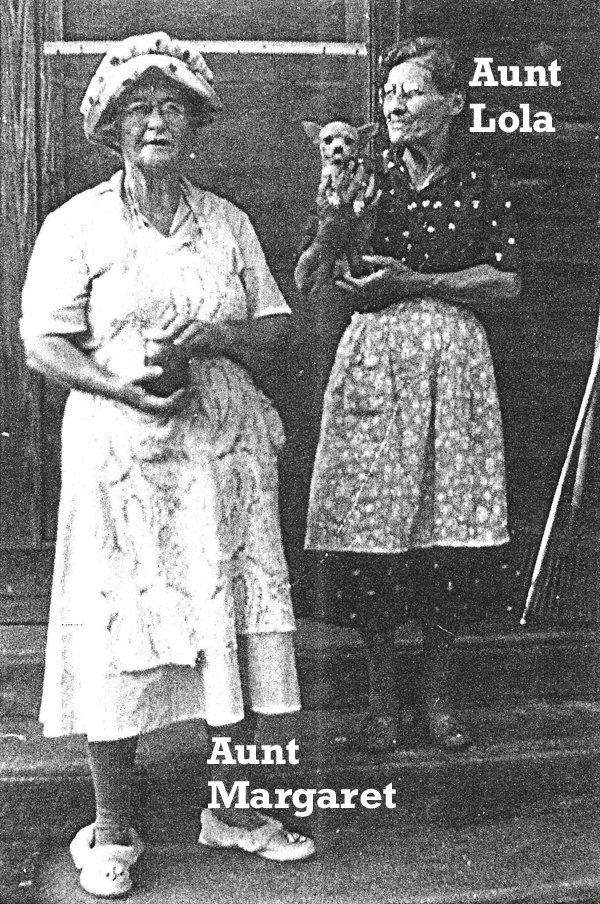
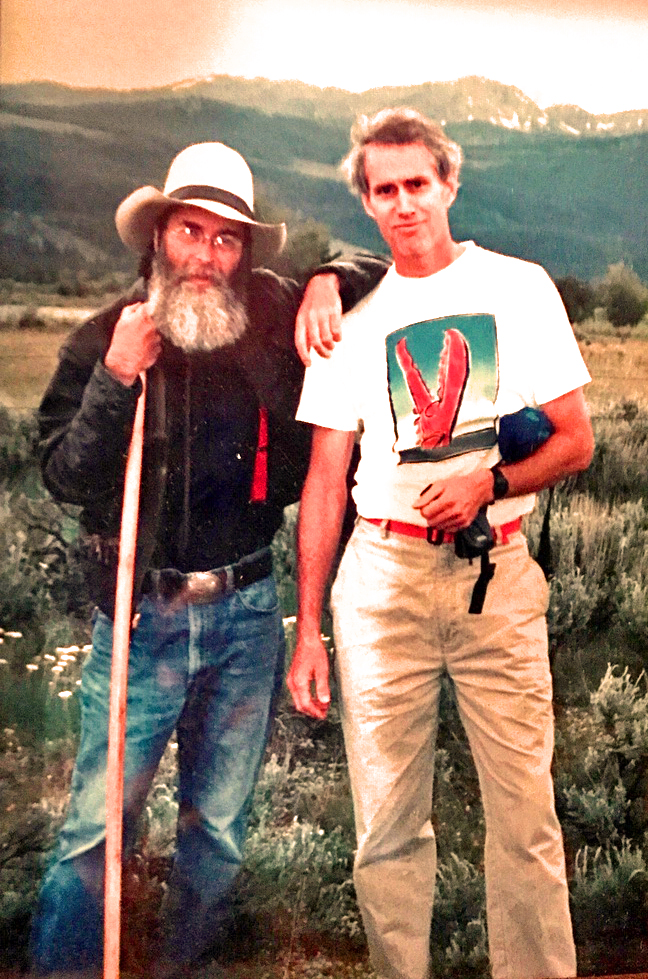
Bob Wall went by many names—Robert to family, Hondo or just plain Wall to friends, but to me he was always The Dirty Drifter. He’d been given that title by his Aunt Lola. She had whispered conspiratorially over tea to Bob’s favorite aunt, Aunt Margaret, “that Robert ain’t nothing but a dirty drifter.”

Aunt Margaret had replied, “I think he’d like that.”

I first met the Dirty Drifter back in ‘73 at the Mayflower Hotel in Seattle—our VISTA training site. After flying cross-country I arrived well after midnight, and was deep into jet-lagged, rem-sleep when he stumbled into our room and flipped on the lights.

“Wake up ya damn Yankee!”

I squinted up at the silhouette swaying over me. My brain dimly registered a beard, a southern accent, and what appeared to be a gigantic boom box on the figure’s shoulder.

“Wake up, and show some respect for your elders,” the figure commanded. He then set the boom box on my nightstand and stabbed a button on the machine.

The same voice crackled out of the machine, “My 87 year-old great aunt is seeing her first tape recorder and I am going to ask her to share some of her special views on life. Are you willing to do that Aunt Margaret?”

A thin, reedy voice answered, “Yes sir!”

The southern mountain man’s voice asked, “Aunt Margaret, what do you think of this tape recording device?”

“I think it’s mighty special. Science is doing some wonderful things…inventin’ things. I’ve never lived no where’s else, and I’ve lost all my people. But we’ve had a joyful life together and I wouldn’t take nothin’ for it!”

Now fully awake, I tried to introduce myself to the person I assumed would be my roommate during our 6-week VISTA training stint. But the figure directed my attention back to Aunt Margaret who warbled on like an Appalachian Foxfire character about how to cure a country ham (“Lee Hendricks would come up to butcher the hogs…and rub that meat with good old timey salt, not no sugar-cured…wrap it tight in brown paper, put it in a sack, and hang it up to dry”), how cousin Alan shot hisself in the foot tryin to do the fast-draw (“it didn’t bleed nor nothin”), how granddaddy Amos and his three brothers all fought in the Civil War (“they all fought on the right side”), about Robert’s ex-girlfriend from Ohio (“you mean the one who was a Yankee and a Catholic, too?”) and how Robert was going to Seattle, Washington (“and I don’t know if’n I’ll ever see him again”).

While driving cross country to Seattle in his VW microbus, Robert had been sideswiped by a tractor trailer outside Billings, Montana. According to Bob, the bus was “all stove-in” on the driver’s side, but still drivable—good enough to get to the Little Bighorn National Monument for the night. That’s where he recorded the second tape he forced me to listen to that night…

“Vehicle’s crippled. Temperatures droppin outside.
Gettin cold in here. Wind’s howling… rockin the van.
I can hear the ghosts of the Cheyenne circlin’ me.
Lucky if I make it through the night.
(long pause) Gotta keep talkin’.”

The morning after our introduction, we walked from the Mayflower to a parking lot to inspect the damage to Bob’s  VW. Wooden shelves, loaded with cook gear, water jugs, a propane stove, boxes of ramen, bottles of Dr. Bronner’s Soap, and a duffel bag lined one side of the van, and a wood and canvas cot filled the other. The superficial crease on the “stove-in” side of the bus belied the drama of Bob’s Last Stand at the Little Bighorn.

“Who is this guy?” I wondered.

Bob grew up in Monroe, North Carolina, just across the border from South Carolina. Aunt Margaret lived in the mountains nearby and electricity had found its way to her cabin just a couple years prior. The Walls owned a funeral home and sent Bob and brother Buddy out to pick up the carnage from drunken, late-night car crashes. Bob lived in a tent while attending college, only partly to save money. Mostly he loved everything he read about the Wild West and could not wait to get out of Monroe to find it.

Over the next six weeks Bob and I spent a lot of time together—eating fiery two dollar dinners at the Guadalajara Restaurant, drinking, and carousing around Seattle. But just two or three beers would send Bob back to our room’s bathroom at the hotel, throwing-up drunk. Between retching he’d cry out, “Give ‘em hell, Bob.”

VISTA sent Bob to the mountains and lakes of Coeur d’ Alene, Idaho and me to the deserts of Homedale in the southern part of the state. We lost touch for months after VISTA, until finally I received an audiotape postmarked Yokohama, Japan (you can hear his 1 minute/30 second Dramatic War Tape, “Hey Sarge” here):

Bob had moved to Japan and was teaching English to Japanese executives.He drilled them on using the Southern pronoun, “Y’all”.  And taught them useful idioms, like if something is really bad, all Americans say, ‘that’s lower than a snake’s belly in a wagon rut.’”

A fellow American language instructor set him up on a blind date with a Japanese woman. Since Itsuko spoke no English, the instructor taught her one line to say to Robert. When they were introduced, Itsuko solemnly bowed and announced, “I love you, no shit, buy me Honda.” Shortly afterward they married.

In the fall of 1975 my wife, Kay and I put our careers on hold and set off on an around-the-world trip.  Our route connected everyone we knew around the globe…my brother in Colorado, a friend in California, Bob and Itsuko in Japan, a college buddy serving as the CBS news correspondent in Moscow, and Kay’s relatives in Denmark.

Our travel plans, including flights and train tickets were set, with us traveling east to west. But just a month before departure, another audiotape arrived from Japan, with Bob explaining why we should travel west to east instead. That way, he reasoned, we could spend the winter in Japan, then come spring we could all go to Alaska.

You can hear 1 min/40 seconds of this tape below…if you can withstand the profanity and racist language. (I like to believe that Bob’s inappropriate and racist language is actually mocking racists…because this was a guy who married a Japanese woman and spent a year in VISTA and 4 years in the Peace Corps.)

We ended up sticking to our original east-west route, spending most of December, including Christmas day in Yokohama with Bob and Itsuko. Most days Itsuko served as our tour guide while Bob was teaching. But one Saturday I accompanied Bob to a Bōjutsu shop…a store that sold nothing but wooden staffs, or “Bō’s” for the Japanese martial art form of stick fighting, or Bōjutsu.

Bob explained to me that when he tried to sign up for the class, the sensei refused to accept him. When Bob persisted, the sensei asked him why he didn’t take karate or jujitsu, like most westerners.

“I don’t want to get that close to the guy,” Bob told him.

“But why Bōjutsu?” the sensei probed.

“I like it ‘cause it’s dirty,” Bob told him.

“Dirty?”

“Yeah, like in the cowboy movies, when the guy gets knocked down, he grabs a fistful of dirt and throws it in the other guys’ eyes.”

“Cowboy movies?”

“Or, like, when the angry crowd gathers, and some guy in the back of the crowd yells out, ‘get a rope’—I always wanted to be that guy.”

Somehow Bob talked his way into the class, which led us to the Bōjutsu shop. The sticks hung neatly from the shop’s low rafters in twelve foot lengths. As traditional Japanese fighting sticks are between five and six feet long, one of the shop keepers cut the stick Bob selected in half with a tight-kerfed handsaw. While he chamfered the sharp edges of one half, Bob took out his pocketknife and started working on the other.

When our clerk said something in Japanese to the second shop keeper, Bob looked up sharply from his work, stared at them and growled, “it works, don’t it?” Both men froze, and bowed continuously, one after the other, until we left.

Outside on the sidewalk, I asked what the guy had said.

“What he said was, look how I cut away from myself and the stupid American cuts toward himself,” Bob explained. “All that bowing was just them tryin’ to save face.”

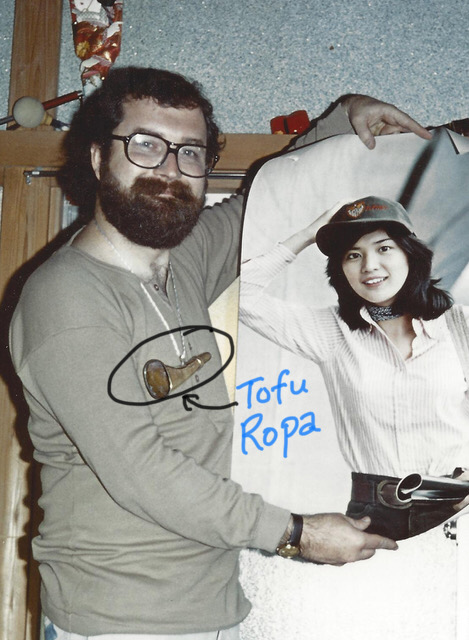
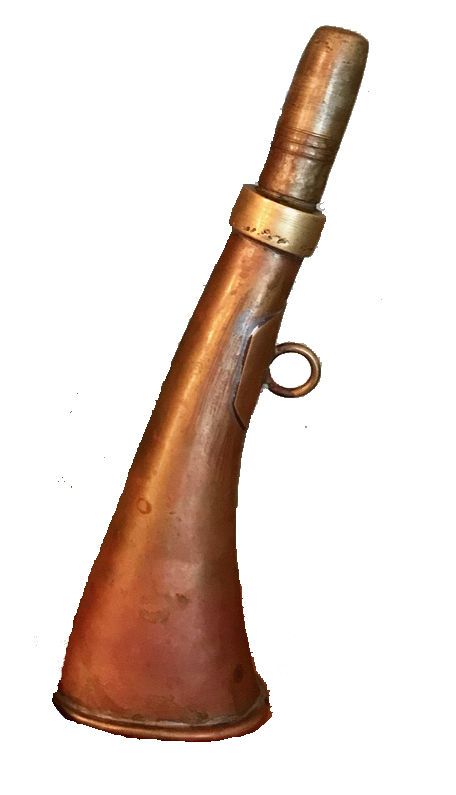
In Yokohama, at least in those days, you could phone restaurants and bars to have food and drink—even a single beer—delivered to your home via bicycle. Delivery men roamed the city, with wooden crates strapped to their bike racks, filled with bricks of fresh tofu. The delivery men announced their arrival by blowing on a brass horn, called a tofu ropa—Japanese good humor men, but for curdled soymilk.

On Christmas Eve, Kay and I visited food wholesalers with Itsuko, in search of the only Christmas gift Bob wanted—a tofu ropa.  We were told it is illegal for individual citizens to own them. But we begged one supplier after another to sell us one for a “crazy American friend who would soon be leaving the country”—until one finally relented.

When Bob opened his gift on Christmas morning, he bellowed “Wagh” (apparently favored

Christmas morning ’75.

by the old Rocky Mountain trappers and mountain men), ran downstairs, jumped on his motor scooter, and blasted around the neighborhood tooting on his tofu ropa. Neighbors streamed out of their houses, empty containers in hand, searching for the phantom tofu man.

One of Bob’s students arrived after dinner one evening for private language tutelage. Kay and I offered to go for a long walk during the lessons, but Bob insisted we stay and participate. The four of us sat cross-legged on tatami mats, drinking sake and smoky-sweet dried squid, warmed on top of the room’s kerosene space heater. The entire lesson consisted of Bob telling stories—including one about riding his motorcycle into the Silver Dollar Saloon in Leadville, Colorado. (You can hear this 3 minute story, in Bob’s own words, right here:)

But Bob spent most of that evening trying to convince poor Mr. Furuhashi to move to Brazil. When his student left, I asked Bob what that was all about.

Bob explained that most of the businessmen he taught questioned nothing, but he recognized a spark of independence in Mr. Furuhashi. So, he was simply trying to get Mr. Furuhashi to be a little bit more adventurous.

“You know, for his own good,” Bob clarified.

My face probably registered the skepticism I was feeling.

“Besides,” Bob continued. “I heard it’s really fat in Brazil. So, if I can get him to check it out, and if it’s really good, then maybe I’ll go there too.”

This made me question whether traveling around the world—particularly the next leg of our trip on the Trans-Siberian Railroad—had actually been my idea. In his correspondence Bob had talked up the route—particularly the price. Just $140 for a private compartment, including meals. But as we were about to leave Japan, Bob expressed his anxiety.

“Watch what you say, ‘cause your compartment will definitely be bugged by the KGB.”

Almost cartoonishly, two hulking men in black wool overcoats and kludgy black leather shoes intercepted us in the airport in Niigata and announced in thick accents, “you are going to Khabarovsk.” They were KGB agents (but that’s a whole other story).

Bob and Itsuko eventually moved to Montana, outside West Yellowstone. The land was dry and therefore cheap. They built a log cabin but had to truck in their water. It may have been the water or the grizzly bears, but after a couple years, Itsuko flew back to Japan to visit family, leaving her collection of prized silk kimonos in Montana. She never returned.

In 1988, the summer that Yellowstone burned, Kay and I flew to Wyoming to climb the Grand Teton. From the summit, the vistas just appeared hazy. However, descending at night, ash from the forest fires drifted across the beams of our headlamps. Driving toward Yellowstone afterward, the south entrance appeared abandoned, and we drove through the park with trees on both sides of the road ablaze. We exited the park at West Yellowstone, and spent several days visiting Bob at his cabin. “Don’t even think about goin’ to the outhouse at night,” he warned us. “Grizzlies.”

A year later I received the postcard from Bob about his pancreatic cancer and having just a few months to live. I flew to Montana the following weekend to say goodbye. The cabin overflowed with visitors—Snake, from North Carolina, sister-in-law Nita, nephews Colt and Tex, a friend and his Thai wife from Peace Corps days, plus several Blackfoot Indian friends (“Hide the firewater!” Bob shouted when he learned they were coming).

Sayin’ goodbye.

Visitors slept all over the cabin, on the floor, in chairs, on couches, with Bob settled onto a bed in the living room because he was too weak to safely navigate the stairs to his bedroom in the loft.

“Somebody here deserves to get some sleep, so take my bed upstairs,” Bob told me. “No arguments.”

“Oh, and there’s a six-shooter on the nightstand,” he continued. “It’s loaded, so if any bats land on the big logs supportin’ the roof, shoot ‘em. Just don’t shoot ‘em if they’re on the planks,” he explained. “Puts holes in the roof.”

The next day, dozens of friends staged an afternoon cookout on the shores of nearby Hebgen Lake in Bob’s honor—a preemptive wake of sorts. After a couple hours of greeting everyone, Bob pulled me aside and asked me to take him home.

Mementos from Bob’s travels covered one two-story wall inside his cabin…cowboy hats, a Chunichi Dragons baseball cap, Buddhist prayer beads, an Indian headdress, a buffalo skull, a yellow “wildcatter’s” hardhat blackened with oil, Japanese fans, a photo of Aunt Margaret in a rocker with a shotgun across her lap, an Alaskan license plate, a bamboo flyrod. A lifetime’s worth of memories receded into shadows higher up.

“I think you should have this,” Bob said, handing me the tofu ropa.

“Fetch that pole over there, will ya’ Ned?”


Bob took the pole and reached high into the shadows of the wall, searching. When he brought it down, he handed me the brass tofu ropa, and said, “I think you should have this.”

Bob held on twice as long as the doctors predicted. Six months after he died, I received a postcard in his handwriting. It carried a recent postmark from Montana —

Hey Ned,

Just wanted you to know that I’m livin on another planet, where I’ve fulfilled my dream of becoming a singing cowboy. I love you like a brother,

The Dirty Drifter

P.S. That Tofu Ropa looks good on your wall there!

I Was Never a Boy Scout

At the time we moved to yet another fading upstate New York mill town—this one with an open sewer running through its heart—I still clung to scouting like a security blanket. I felt the Boy Scouts would be the one thing I could count on, no matter where I lived. I could not have been more wrong.

I landed at Pleasant Avenue Elementary on my first day, my fifth school in as many grades.  I did my usual—hanging out in the back row, quietly studying my new classmates and teacher.

Miss Giles pulled down a large, window shade-style map of New York State, and beckoned me of all people, to the front of the class to locate Johnstown, my new hometown.

As thirty faces stared at the new kid, I scanned the map for anything recognizable. I located Albany by the star marking it as the state capital. Just below it was Delmar where I had attended kindergarten.

My eyes tracked the Hudson River downstream to Kinderhook, where we had lived next door to the old Martin Van Buren house, and I had marched on Memorial Day in my Cub Scout uniform. We had followed the buglers, drummers, and veterans out to the old town cemetery, where Billy Downing keeled over face-first into the grass. The rest of our troop remained at attention, immobilized by the speeches about ultimate sacrifice.

Due north of Albany, I found Lake George, where I always spent summers at my grandmother’s camp. I followed the lake to its northern end, and the black dot marking Ticonderoga. I first attended the Weedville School, where our janitor sliced oranges and apples for us at lunchtime. The following year for fourth-grade, they bused me to the school attended mostly by mill workers’ kids. One girl wore a freakish Halloween witch’s wig.  Another’s hands were stainless steel claws. Her parents said she crawled onto the train tracks when she was little. Townspeople whispered that the father had slammed her hands in a drawer when she would not stop crying.

I distracted myself by earning gold and silver arrowhead merit badges, mostly by memorizing things—the Morse Code, all the states and their capitals, the makes and models of cars, the Gettysburg Address. One assignment for our Blue and Gold Supper required us to compose an original cigarette jingle. I called mine the “Big O”:

Indians who know now smoke the Big O
Smoke signals go now by the Big O
They’re clear and they’re legible, they get there quick
Even signals sent with the new filter tip.

 The evening of the dinner, our pack lined up in front of our parents and scout masters to deliver our jingles. Everyone before me stole one-liners from existing cigarette ads: ”Winston Tastes Good Like a Cigarette Should” …”Lucky Strike Means Fine Tobacco”. Embarrassed to be the only kid to have taken the assignment seriously, I offered, “I’d walk a mile for a Camel”.

A sharp clicking sound drew my attention to Miss Giles. She stared at me impatiently with arched eyebrows. One hand perched on her hip while the other tapped a piece of chalk on the blackboard in a once-a-second beat.

“Do we not know where we live?” she asked, prompting a smug tittering from my classmates.

As I said, I expected to find refuge in scouting as I always had in these new strange places. I met my new scout mates on the ground floor of Johnstown’s Methodist Church for my first meeting. Technically we were now Webelos (We’ll Be Loyal Scouts) — the transition phase from Cubs to Boy Scouts. Mr. Simpson, our Scout Master, said we would become real scouts when he took us camping.

I showed up at Mr. Simpson’s house on North Perry Street the following week for our next troop meeting, joining nine or ten other scouts in his unfinished basement. The space had a moldy, fuel-oil smell and corners barely lit by bare bulbs hanging from the low ceiling.

“We’ll be working on our knots tonight, boys. These lally columns are really good for practicing them,” he explained, rapping his knuckles on one of the metal posts.

He introduced a thin, quiet man as his assistant. I may have missed it, but I don’t believe he mentioned the new man’s name.

They started us off with the square knot, half-hitch, and clove hitch — all knots I already knew from tying up boats at Lake George.

“You gotta know ‘em so well, you can untie ‘em behind your backs,” Mr. Simpson said. “So, let’s have a contest!”

With that, he and his assistant secured each scout to one of the metal posts, with their hands behind their backs. I reacted the way I always did in unfamiliar situations. I shifted away from the group to where I wouldn’t be noticed.

“Ready, set, go!” Mr. Simpson shouted.

At first, the two men playfully whacked a couple kids with ropes, as if encouraging them. “Knowing your knots could save your life someday,” Mr. Simpson said.

When his assistant noticed one kid wrestling with his constraints, he whipped the kid hard across his upper thighs. “Concentrate!” he commanded.

“I’m getting it, I’m getting it,” a kid named Eric said, clearly eager to be the winner.

“How…about…under…pressure?” Mr. Simpson asked, emphasizing each word with a sharp lashing.

As both men whipped the kids on the far side of the room, I walked as nonchalantly and as quietly as I could to the steps leading upstairs.

“Hey, meeting’s not over,” Mr. Simpson called after me.

“Bathroom,” I answered, as if I really had to go. I took the steps two at a time, ran out the front door, and abandoned the Boy Scouts forever.

Since that time, sexual abuse charges from more than 12,000 men against their Scout Masters have come to light. I feel grateful that my reticence—probably the same survivor’s instinct that helped me cope with constantly shifting schools, classmates, houses, and communities—instructed me to flee that evening. But I also carry feelings of guilt about what might have happened to those boys I left behind. At the very least, I should have told my parents. Perhaps they would have talked to the right people. It wasn’t until decades later I realized that would be giving my parents way too much credit.

It was late in my father’s life while I was capturing his memories on videotape. He spoke of sipping his first beer when he was fourteen years old with his Scout Master in an Albany bar. I commented on how inappropriate that would be today. When he appeared puzzled, I told him how scouting was the glue that held everything together for me as his job took us from town to town—until we arrived in Johnstown and the Scout Master and his assistant tied up and whipped those boys in his basement.

My father listened gravely to my story. When I finished he looked me in the eye, shook his head sadly and with complete derision proclaimed, “You were never a Boy Scout.”

[Author’s Note: Every part of this story is true, except the name of the Scout Master which has been changed to Mr. Simpson.]

Going To(ward) Woodstock

“If you could go back in time would you kill Hitler?” I asked my friend Kevin.

“Nah, I’m not your guy,” Kevin answered. “If I could go back in time I’d go to Woodstock.”

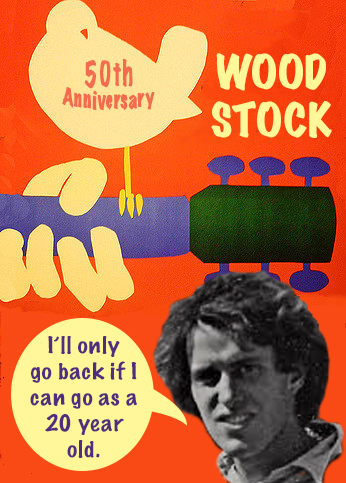
Now, when my time-travel opportunity arrives I’m sure as hell not wasting it on Woodstock. And I won’t be attending the 50th anniversary either — unless I can return as a twenty year-old.

Looking back, it’s a miracle anyone showed up for the original Aquarian Exposition — so named for a shift in constellations responsible for a new era of peace and love (as it turned out, a wildly overblown expectation). There were no cell phones, no computers, no social media back then to spread the news. I only learned of the event when my college roommate Newt called me a couple days beforehand.

It had already been a hot, tense summer. Martin Luther King Jr. had been assassinated in March. Campuses were a tinder box of anti-war protest and violence. College deferments were still in place, however taking a gap year back then likely earned you the privilege of studying abroad — in Southeast Asia. It’s no wonder a half million kids were ripe for three days of peace and music.

Newt and I planned to meet on Friday at a farmhouse on a high ridge overlooking Troy, New York, which housed an unlikely commune of engineering students from nearby Rensselaer Polytechnic Institute. The weathered house sat at the end of a three-mile long dirt utility road, beneath two immense radio towers.

The towers had been my sole navigational aid in getting me to our rendezvous spot. I wandered inside and found Newt in the kitchen talking to Steven, one of the RPI students from Newt’s hometown of Holyoke. Newt also introduced his friend Michelle, who would be joining us on our pilgrimage. The three of us headed south on the Thruway in my mother’s Chevy Malibu convertible — deemed only slightly less embarrassing than Newt’s parent’s station wagon, which we left at the farmhouse.

Newt rode shotgun, with Michelle in the back, hanging over the front seat.

“You guys, you guys,” she said, rapping Newt on the shoulder insistently with her knuckles. The familiarity of the gesture made me wonder if she and Newt were more than just friends.

“I peeked in the refrigerator and there was a box of sugar cubes in there.” She lowered her voice conspiratorially, “I think it was LSD.”

“Come on, Steven’s an engineer, for Christ’s sake,” Newt said, as if that explained everything.

“But why would they keep sugar in the refrigerator?” Michelle asked.

In my rearview mirror, her dark eyes sparkled so mischievously, I wondered if she had popped one of the sugar cubes for the ride.

What should have been a two hour drive stretched into six. Eventually we were barely moving, slowed by cars abandoned in the breakdown lanes, then clogging the highway itself. Hundreds of kids on foot streamed by us like third-world refugees, carrying their possessions in their arms. By the time we inched off the main road and found a place to park, it was midnight and teeming. We agreed to sleep in the car and worry about a plan in the morning.

Bedding down three people in a car with two bench seats is fraught with social awkwardness. I couldn’t cuddle up on one seat with either Newt or Michelle. And I didn’t want to force them together — in the event they really were just friends. So, I volunteered to sleep in the trunk. I removed the spare tire, propped the trunk lid partially open with the jack, lined the space with my sleeping bag and crawled in.

The mosquitoes, sharp angles, and an inexplicable hissing noise made sleeping impossible. At dawn I discovered and tossed out a punctured aerosol can of Foamy Lemon-Lime shaving cream (which, when you think about it is an odd thing to bring to Woodstock). When I emerged from the trunk, Newt and Michelle witnessed a ghost covered in desiccated shaving cream, imbedded with dead mosquitoes. The rain ticked insistently on the Chevy’s vinyl top as we sat inside discussing what to do next.

Somehow we surmised we were five miles from the festival. That may have been wishful thinking, given that none of us could pinpoint where we were on our roadmap. Driving any further was out of the question due to all the cars left helter-skelter on the roads. Newt and Michelle argued that we should walk the rest of the way. Embarrassingly, I admitted to worrying about my parent’s car getting towed, trashed, or stolen.

“Here we are, a five mile walk from what may be the countercultural event of our lives,” Newt said. “And you’re worried about a car?”

Newt and Michelle had the votes, but I had the car. So, just five miles from Woodstock we drove home.

As it turned out, Newt was right about one thing. Woodstock did become the defining countercultural moment for our generation. Officials put the attendance at Yasgur’s Farm at 400,000, while Joni Mitchell’s lyrics counted “half a million strong”. A hundred thousand “Children of God” unaccounted for is a lot. Newt, Michelle, and I were undoubtedly in that number.

It’s no wonder so many of us were stranded or lost along the way. Nearby thruway exits were closed, forcing us to navigate serpentine back roads. Adding to the confusion, the town of Woodstock had backed out just a month before the scheduled date, and the organizers hastily relocated the event forty-six miles away to a farm field in the hamlet of White Lake. It’s entirely possible we had erroneously followed thousands of others to the wrong town.

I never admitted it to anyone but as the legend of that weekend grew, so did my relief over having missed three days of rain, mud, no food or water, and overflowing portable toilets. I did however wrestle with where our near-miss placed us in history. It would be a lie to say we were at Woodstock. But in my mind we did go— we just never arrived.

The sixties’ cosmic haze of protest, pot, idealism and patchouli oil dissipated over the ensuing years as the Woodstock Generation built marriages, careers, and families. Twenty years passed, at which point the event felt ancient and abstract amidst our thicket of bills, work deadlines, and dirty diapers — until late one evening when I drove our Last Chance babysitter home.

“So, did the kids eat their dinners?” I asked.

My wife and I called her Last Chance because she wasn’t good with kids and she lived too far away. I especially dreaded driving her home, because she had either no desire, or ability to carry on a conversation.

“Yeah, I guess,” she said, snapping her gum.

“Did they go to bed with no trouble?”

She distractedly riffled the pages of a thick, dog-eared paperback in her lap.

“Did you get to read your book,” I tried.

“A little,” she said.

“What’s it about?” I asked.

Her head spun toward me so fast, I feared it might go full-circle, Linda Blair-like.

“Omigod, it’s unbelievable,” she said, her voice revving up to 78 rpm. “It’s about this rock concert, and this girl really, really wants to go, and her mother won’t let her, and she goes anyway, and there’s like drugs, and peace and free love…” She ran out of steam and gasped to a halt, staring at me wide-eyed for several uncomfortable seconds.

Reverently and hopefully, she asked, “Were you from — THEN?”

“Meaning?” I asked, buying time.

“I mean, did you go to Woodstock?”

I wheeled into the babysitter’s driveway, fished out my wallet, and overpaid her.

“Yeah, I went,” I said, hoping that would send her on her way.

“Omigod, what was it like,” she shrieked, now back to her 78 rpm voice. “Did it really have all the drugs, and rock and roll, and free love?”

I weighed my answer carefully, which only increased her impatience.

I recalled the sugar cubes that may or may not have been LSD…sleeping in the trunk…possibly being the only person to have brought shaving cream and a razor to Woodstock…the rain…the abandoned cars…and fighting our way to (perhaps) within five miles of the event.

“So, was it just like in the book?” she prodded.

“Yeah, it was pretty much like that,” I said.

The Reunion

I abducted my old friend Steve Wadsworth and whisked him off to England in NovemberAbbeyRd of ‘03. It was a friendly sort of kidnapping though, mostly inspired by Steve’s leukemia. What could be a better last hurrah than going to find Malcolm Howorth — who we hadn’t seen since he moved away from Johnstown when we were kids? Somehow I cajoled Dan Duross, the fourth member of our childhood gang, into joining the adventure.
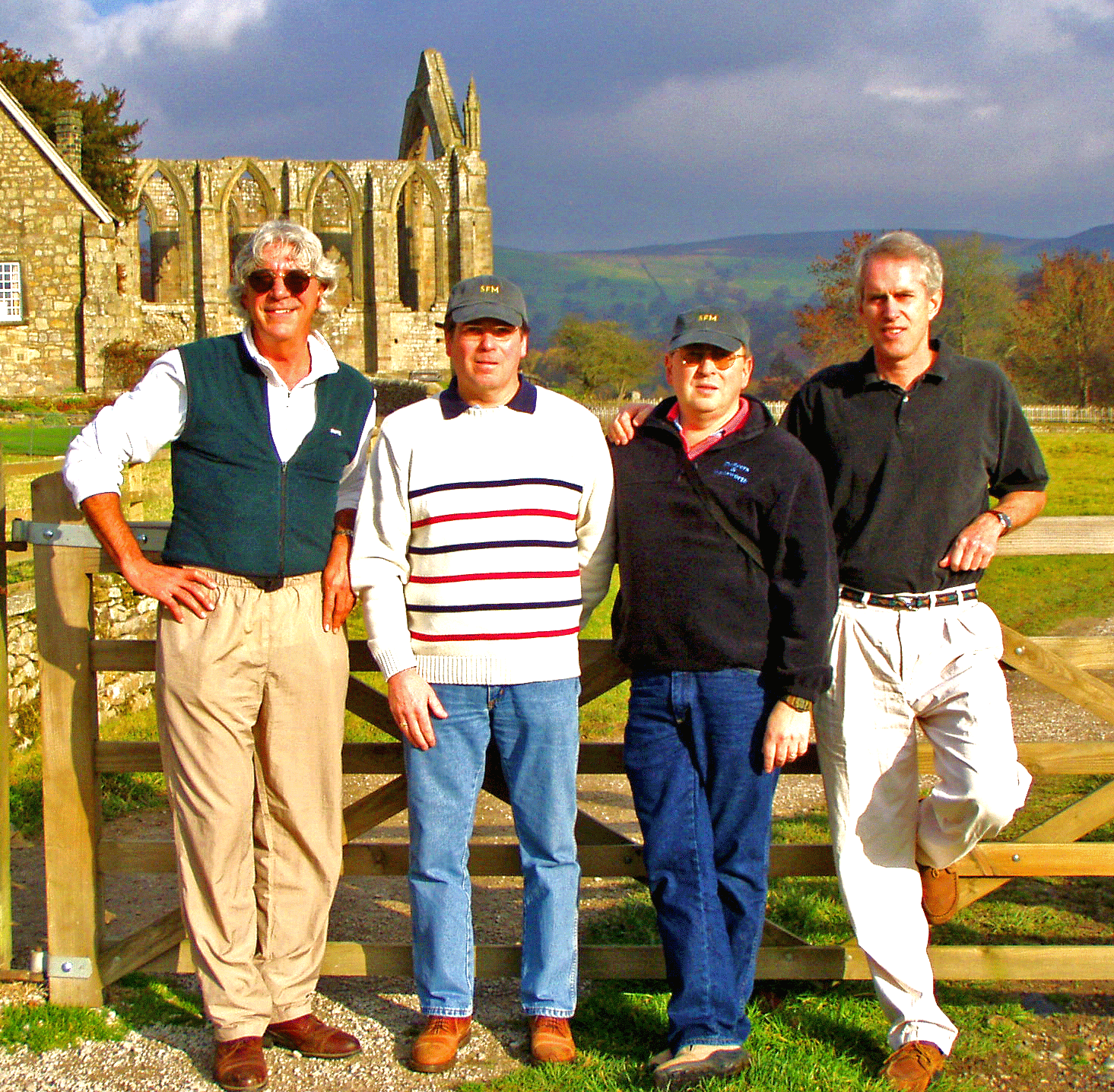
I sleuthed my way online to an email address for Malcolm’s daughter, Sarah. She proposed luring her dad to The Higher Trapp Inn near where they lived in Lancashire.

The place was a drafty, overly decorated country inn right out of Fawlty Towers. We arrived just before dinner in a turmoil, because that morning I had left my video camera in a cab back in London. But after several phone calls, a local video shop delivered a rental replacement to the inn.

“You look like you’re from the Channel Six News Team,” Steve said as I balanced the suitcase-sized camera on my shoulder.

I tested the camera as we wandered into the inn’s pub, which smelled as sour and malty as a frat house. The matronly bar maid who introduced herself as Margaret knew right away that we were The Americans. She took us on a tour, introducing us to the kitchen and wait staffs who all looked to be expecting us. Margaret next showed us the private room reserved for Malcolm and his family, and then hustled us back to the bar.

She wagged her finger at us and said, “No peeking. I’ll come and get you when they arrive.”

It’s not like we had a plan, but with the outlandish video camera as a prop, we decided to use it when we confronted Malcolm. After a round of pints, Margaret summoned us from the pub back into the private room.

I hid my face behind the big camera as I walked in and announced, “We’re a film crew from America doing a documentary on typical English pub life. Would you folks be kind enough to tell us what brings you out mid-week?”

A perky blonde woman who I took to be Malcolm’s wife spoke right up, “My name is Sally and that’s my husband Malcolm,” she said, gesturing across the table to a man dressed in black. “We’re taking our daughter Sarah and her boyfriend Thomas out for a meal.” The woman spoke energetically, answering for everyone.

I panned the camera around the table, pausing on Sarah.

“Sarah, can you look right at the camera and say, “All you need is love. Love is all you need?” Steve asked Malcolm’s daughter.

Sarah barely managed to recite the lines, clearly excited by her role as co-conspirator.

Next to her perched her boyfriend, a thin twenty-something young man with wire rim glasses and close-cropped hair. He sported a two-day old beard and spoke the Beatles’ lyrics with such uncertainty, I wondered if he was too young to know who they were.

“How about you?” Steve said, addressing the man in black. “Can you say it?”

As I studied Malcolm from the anonymity of the camera’s viewer, I easily recognized the thirteen-year old we had known. Though you wouldn’t call him heavy, he carried his weight comfortably, you might even say athletically. The slimming effect of his all-black, Johnny Cash style outfit certainly helped. If I had not been zoomed in on his face, I would never have seen the flash of contempt in his eyes.

Steve continued to badger him. “Come on, you look like you must have grown up with the Beatles.”

That sparked another dangerous look. Malcolm seemed to be weighing his options. He stared at the camera, and in a monotone muttered, “All you need is love. Love is all you need.”

Dan may have sensed the same tension. “Do you have any friends or family in America you’d like to say hello to?” he asked.

Malcolm slowly raised his head and looked closely at Dan for the first time. “Actually, I once lived in America. But that was long ago.” His eyes seemed to warm, then just as quickly hardened.

Dan cocked his head and peered into the lens. “This is an amazing coincidence ladies and gentlemen.” He turned back to address Malcolm. “And where did you live in America, my good man?”

Malcolm half rose from his seat and hesitated, clearly caught between fight and flight. He slumped back down, the fight draining out of him, and looked up at Dan. “Believe me, you’ve never heard of the place.” He paused before adding, “My good man.”

Fearing we were pushing our luck, I removed my hat and moved my face out from behind the camera, while continuing to record. The movement caught Malcolm’s attention. I felt certain that I detected a flicker of recognition in his eyes.

“Any old friends you’d like to give a shout out to?” I asked.

Malcolm slowly turned to me and stared intently for an uncomfortable length of time. He looked like a man coming out of a daze. His gruff exterior seemed to wash away in streaks, like the dust off of a car left out in the rain. Finally, he softly said, “I would suggest that you are Ned.”

“No way!” Steve immediately cried out.

I kept right on taping, but gestured to Dan with my free hand and asked, “And do you know who this is?”

Malcolm studied Dan for a good twenty seconds. Each second seemed like either a repudiation of our old friendship, or an indictment of how much Dan had changed. I figured Malcolm would identify him through association. Instead, he shook his head sadly, and said, “I’m sorry, too much time has passed. He just looks a weary world traveler to me.”

Steve cackled victoriously. Nonplussed, Dan stepped forward and said, “I’m Dan Duross.”

Malcolm’s squeezed his eyes shut tightly as if he were in pain. Dan immediately reached out and embraced him. Malcolm buried his face into Dan’s chest. They held each other as the rest of us watched in silence. I felt like an eavesdropper but kept the camera rolling. Finally, Dan stepped back and asked, “And who do you think this guy is?”

“This would have to be Steve,” Malcolm said, as Steve stepped forward. They embraced until Malcolm finally inhaled a mighty sniff, quickly blotted one eye then the other on his upper sleeves as he composed himself, and declared, “I am absolutely gob-smacked.”

“Gob-smacked,” Steve, Dan, and I cried out in unison. “What’s that mean?” Steve asked.

“A total loss for words,” Malcolm said. “I just can’t believe it.”

“Did you think there was something a bit quirky going on tonight,” Dan asked in a surprisingly good British accent.

“Yes, I definitely did,” Malcolm admitted. “Normally I’d be having an evening soak right about now after a hard game on the pitch.” Noticing the puzzled looks on our faces, he clarified, “Wednesday is four-on-four football night. It’s just so unusual for us to be going out midweek. I’ve been thinking me daughter is engaged and this is how they’re going to break the news — in a public place where I can’t rant and carry on.”

“They should give you some medication to calm you down like they did for me,” Steve said, which made all the Brits laugh a bit nervously.

Malcolm shook his head sadly. “They probably wouldn’t work on me. I’m the most miserable bloke you’ll ever meet.”

“Why?” Steve cried out. “What have you got to be unhappy about?”

“It’s true, he’s miserable,” Sally laughed. Sarah and Thomas nodded their heads in agreement.

“The bloody taxes, and the government, and the Royal Family,” Malcolm said.

“He always told Sarah here and our son to forget the U.K. and move to America,” Sally said softly.

Malcolm’s slumped body language told the story as he filled in the missing blanks about his sudden departure so many years prior. His family had moved back to the U.K. spontaneously because his grandfather had grown too ill to care for himself.

“Wouldn’t most people check out the situation first?” Malcolm asked. He stared at us, as if expecting an answer. “Just one letter from home and they pack up the whole kit and caboodle and move us back here?”

“So, did you all move in with your grandfather?” I asked.

Malcolm shook his head sadly. “We were all split up between various relatives. I lived the first year in Manchester with me aunt and uncle.”

“I had to use an outhouse to go to the toilet,” Malcolm continued, the tone of his voice neutralizing my beer buzz. “I’m not sure which was worse — freezing me arse off in the winter — or the retching stench when it was hot.”

There was an embarrassed pause around the table until Steve said, “Well, we still had the Cayadutta Creek and that stunk.”

“But you had indoor plumbing,” Malcolm pointed out. “It seems to me that every morning back in Johnstown, I’d wake up to blue skies and clean, fresh air. True or not, that’s the way I remember it.”

We watched Malcolm, more curious than ever about the parts of his life we had missed.

“I wore me old football jerseys from Johnstown and all the Manchester kids who wore nothing but black called me Yank and said I wore clown clothes.”

It was impossible not to notice that Dan, Steve, and I all sported colorful outdoor clothing, while Malcolm’s dress shirt, trousers, and shoes were all black.

“You know, in Johnstown, me mum would occasionally return home from work with a ball glove or a ball as a surprise. It wouldn’t be Christmas or my birthday or anything,” Malcolm said. “But when we came back here, there was no more of that,” he said, shaking his head. “I barely saw me parents.”

Our waiter set a tray down in front of Dan, choked with half a dozen pints. Dan passed the glasses around the table in both directions.

“The thing is it all felt so innocent and pure,” he continued.

“What was innocent?” Steve asked.

“Everything,” Malcolm said. “Walking to the movies, playing football on the Knox Gelatin lawn, dreaming about playing under the lights at Knox Field, discovering our Indian village. Anything seemed possible.” He stared down at his hands and inhaled deeply.

“And when I went back, it wasn’t anything like I remembered it,” Malcolm continued.

“Wait a minute. You went back to Johnstown?” I asked. “When?”

Malcolm looked puzzled. “I don’t know,” he said. “I think it was the summer of ’72 or ‘73. I’d been working as an auto mechanic and had an accident in the pit. I got burned pretty badly and had to get my head back on straight.”

Steve looked focused for the first time that evening. “That was just before I had my bout with mental illness, too.”

“And you never tried to find any of us?” I interrupted.

“That’s what I’m tryin’ to tell ya. Everything had changed,” Malcolm said. “I remembered the air as a kid as being fresh and every day was sunny. But when I went back it wasn’t like that at all. The town seemed broken down, like an old man.” He looked at us sadly. “I couldn’t grasp which had changed more — me or the place. I had planned to stay, but I didn’t know anyone, so I came back after two or three weeks.”

Woody stood up, raised his glass, and toasted us all. “I just want to say that I’m having the best night of my life.”

He swept his glass in the direction of Dan, Malcolm, and me, and said, “Here’s to old 4somefriends.” Then he raised his glass to Sally, Sarah, and Thomas and said, “And here’s to new friends.”

We all raised our glasses. “Here’s to Searching for Malcolm — the movie,” Dan toasted. “To Searching for Malcolm,” everyone repeated, as we stretched across the table to clink our glasses.

“Tell me,” Dan said, turning to Malcolm. “Now that Searching for Malcolm has become such a big hit, what do you plan to do with your newfound fortune?”

Malcolm’s eyes danced, relishing the role-playing. “If Searching for Malcolm becomes a big hit, I hope to…”

“Now that,” Dan corrected him. “Now that Searching for Malcolm has become such a big hit.”

Malcolm grinned with delight just like he did when we were kids. Then he composed himself and started again, acting serious. “Now that Searching for Malcolm has become such a big hit I plan to take the Rochdale Football Club to the premier league.”

“And be the coach,” Steve suggested.

“The player-coach,” Dan corrected.

“Yes, as player-coach, and owner of the team, I plan to take the team to the English premier league championship,” Malcolm continued.

“And lead the league in scoring,” I threw in.

“And score the winning goal in the championship game,” Dan concluded.

“Money will be no object,” Malcolm went on, explaining the success of the team.

Then Malcolm turned the tables and acted as the interviewer, posing the same question to us. When he got to Steve, I suspected that Steve might have wished for a lifetime supply of Gleevec, the forty thousand dollar a year drug that was keeping him alive. But Steve had yet to tell Malcolm about his leukemia. So instead, Woody raised his glass and said, “I’ll remember this night for as long as I live.”

Malcolm frowned. “That’s not even a wish.”

Woody raised his glass and tried again. “Let’s get together again before another forty years blips by on the calendar.”

“Here, here,” Malcolm called out. It sounded so quaintly English, like the comical huzzahs from the white-wigged Members of Parliament in the House of Commons, we all joined in. “Here, here,” we echoed.


AFTERWORD

Later that evening Steve pulled Malcolm aside to tell him about his leukemia. In the space of one dinner we managed to lift Malcolm out of a forty-year funk…only to drive him right back in. The following morning Malcolm and Sally sat us down for a conference in their living room. After talking most of the night, they had reached a decision. They would remortgage their house to help pay for Steve’s medication.

Steve never took them up on their offer. Instead, he simply stopped taking Gleevec — refusing to be extorted by Novartis Pharmaceuticals. His doctors expected him to die. But as it turned out, spiriting Steve off to England was a total bust as last hurrahs go. He has tested negative for leukemia ever since. I like to tell him it was the trip that cured him.

As if that weren’t enough of a happy ending, Malcolm and Sally did return to America and Johnstown the year after our reunion. That visit and others since have helped Malcolm reconcile leaving the U.S. so many years ago and he no longer claims to be the most miserable bloke in the world.WHW4Text


For me, the reunion unleashed a flood of childhood memories about days that are always fresh and sunny. I have written these stories as if they were fiction, about characters with made up names. I don’t know what I was thinking. A story in which someone remortgages his home in order to save a long-lost childhood friend is mediocre fiction at best. Yet that really did happen, along with Steve’s cure, both of which are truly remarkable. This is why I have decided to come out of the closest so to speak—and just use our real names from now on.

Like life itself, not every outcome of our reunion had a storybook ending. In Steve, I kept one friend who I feared I would soon lose. With Malcolm, I found a friend I believed had been lost for forty years. But for Dan and myself, friends of more than half a century, we have only grown more distant since that reunion fifteen years ago. This has left me to ponder whether there is some cosmic order that determines how many true friends we are allowed to have in our lives. If we regain two, are we destined to lose one? I’m not suggesting that losing a friend isn’t painful and sad, but if that’s the equation, I’ll take it every day.

The Kidnapping

When I tell the story about kidnapping my friend Woody, I always start by going back to 1961. That was just before our childhood cocoon began unraveling, accelerated by a drumbeat of national headlines: Families Building Backyard Bomb Shelters… Bay of Pigs…Cuban Missile Crisis…Medgar Evers…JFK…Martin Luther King…Bobby Kennedy…Viet Nam.


We were still happy and oblivious on that first day of seventh-grade, when Dondi, Woody, and I stopped by Malcolm’s house to pick him up on our way to school.

We expected Malcolm to be waiting for us on his front porch. Instead, we had to ring the bell to the upstairs flat. When he appeared, framed behind the aluminum storm door, he stood barefoot, sporting plaid boxer shorts and a white t-shirt. Instead of caroming between us, joking, and calling us blokes, he took just one step out onto the porch, while continuing to use the door as a shield.

“Hurry up man, you’re going to make us all late,” Dondi said.

Wedged behind the door, Malcolm said nothing.

“You’re not feeling a little peaky are you?” I asked, teasing him with one of his own expressions.

“Yeah, you can’t play hooky on the first day of school,” Woody said.

We all watched Malcolm more closely now, waiting for his response. That’s when I realized he actually did look a bit peaky.

“If you’re scared you’ll have to sing, we’ll protect you,” I said. On the first day of school, older kids would corner the younger ones and try to make them sing the alma mater.

“On your bike,” Malcolm said — his polite way of telling me to piss off.

“We’re walking,” I said, playing dumb.

“You know what I mean,” Malcolm said. “That singing shite don’t scare me.”

But his eyes betrayed his words. He looked like his faithful dog had died. But he didn’t have a dog.

That’s when Malcolm dropped his head, mumbled something, and disappeared as the storm door wheezed behind him and clunked shut.

We couldn’t even agree on what his parting words were.

“He said he was sick,” Dondi insisted.

“I thought he said he had to move,” I argued.

“Bowels no move,” Woody suggested, reciting the punchline to one of our favorite jokes.

Whatever he said, Malcolm’s behavior rattled us, and we did what we always did when one of us got out of sorts — we gave him some space.

By the time we circled back the next day, Malcolm’s front door was locked. Neighborhood kids informed us that the family had returned to England.

If we had been a little older, we might have hunted down our friend’s new address and written to tell him we would miss him as quarterback of our south end football team. We could have told him what a loyal friend he had always been and that our group wasn’t the same without his enthusiasm. Perhaps we would have admitted that life in our little upstate town had become flavorless without his English ways. If we weren’t twelve-year old boys, we might have even confessed that we felt guilty about taking his positive nature and loyalty for granted.

I joked with Woody and Dondi for the next 40 years that we should embark on a grand international adventure to find Malcolm. They never took me seriously. But when Woody wrote to tell me he had been diagnosed with leukemia — likely from inhaling compounds of benzene while shaving skins as a young man in the leather mills —I decided to kidnap Woody and take him to England, to find our long-lost friend.

I lured Woody to Williamstown, Massachusetts on the pretext of seeing a college soccer game, insisting at halftime that we leave to grab some lunch. We wound south on Route 7 with the promise of a great sandwich place, but by the time we passed through New Ashford and kept going, Woody started getting twitchy.

“I’ve got a knot in the pit of my stomach,” he complained, both hands clutching his belly.

“You’re probably just hungry,” I said, hoping to change the subject.

“I’m not hungry,” Woody said. “I’m nervous.” He held up two fingers. “Despite taking a Paxil this morning, and another one when you kidnapped me.”

Woody had clearly stopped believing my ruse about lunch.

“Are we going to be gone overnight?” he asked.

This question caught me off guard. I wanted to keep him in suspense at least until we reached the airport. “Why would we be gone overnight?”

“You tell me. But if you didn’t bring my meds, I’m a dead man.”

“Don’t worry, I’ve got your drugs,” I replied, with more conviction than I felt. Woody’s wife had promised to stow his suitcase of clothes, his Paxil, and his Gleevic in the trunk of my car when she went to find the ladies room during the game. Upon returning, she gave me a wink and a quick thumbs-up. At the time, I took that to mean the luggage transfer had been a success. In hindsight, I worried that it simply meant she had found the bathroom.

As I veered toward the East Lee entrance to the Mass Pike, Woody continued complaining about the pain in his stomach. That’s what made me cave on my original plan to keep him in the dark.

“There’s a present for you in the glove box,” I told him.

Woody pressed the button, reached inside, and removed a brand-new black ball cap with the letters “SFM” stitched in gold on the front. He sat there studying it, rolling the cap back and forth, as if seeing the letters from different angles would suddenly reveal their meaning.

We barreled eastward on the Mass Pike for a good half hour.

“So, does he know we’re coming?” Woody asked quietly, finally breaking the silence.

I studied my old friend, wondering if he was just trying to flush out a clue. “Does who know we’re coming?”

Woody tapped the letters on his hat one at a time as he answered, “Searching… for… Malcolm.”

Even though I knew the next question was coming, I still had no idea how to answer when Woody asked, “Will Dondi be joining us?”

“He wanted to come, but I think he’s wrestling with a bit of agoraphobia,” I said, attempting to obfuscate my answer.

“What-aphobia?” Woody asked.

“Let’s just say he’s really uncomfortable about flying to England right now.”

Both of us knew the trip wouldn’t be complete without him, but I didn’t have the strength to relate all I had been through trying to convince Dondi to join our pilgrimage.

I’d had to change the dates for our flights three times after Dondi consulted his astrologer. Her skittishness didn’t feel completely crazy, given that two airliners had been flown into the World Trade Center Towers just a few weeks earlier. But after her second cancellation, when I suggested to Dondi that he have his astrologer book our tickets, he bristled and said, “You may think these precautions are funny, but I happen to take them very seriously.”

He was wrong though. They didn’t strike me as funny; I found the discovery that Dondi even had an astrologer to be downright disturbing. But fortunately, the stars eventually aligned and Dondi agreed to surprise Woody by meeting us at Logan International. I expected to be equally surprised if he showed up.

After shuffling through security, Woody and I settled at a table near the British Airways terminal. I saw no sign of Dondi.

Perhaps the pressure of the trip had triggered a new round of his frequent migraines…or his astrologer lady had detected a shift in the cosmos.

Scanning the concourse, I noticed a figure in a navy turtleneck sweater, khakis, English brogue-style boots, and a dark chocolate leather flight jacket window-shopping in front of the Burberry store. A casual observer would notice nothing amiss. But to the eye of a friend of forty years, the man was working awfully hard at appearing composed.

“How long do you think it took that guy over there to pick out his travel outfit?” I asked Woody.

Woody stared in the direction of my gaze, then stood up and waved. “I thought you said he wasn’t coming.”

The man locked in on Woody’s gesture, sagged in relief and strode toward us. Woody opened his arms.

After a long embrace, Woody leaned back, still clasping Dondi’s arms and smiled up at his old friend. “What are you doing here?” he asked.

“I’m catching a flight to ah, Greece,” Dondi said.

Woody laughed, nodded his head my way, and said, “Lucas told me you had some disease or something that keeps you from leaving home.” Dondi looked at me and raised one eyebrow — a trick he always did for laughs when we were kids.

I shrugged and said, “Agoraphobia,” as if that clarified anything.

“That’s it, Viagra-phobia,” Woody said. “Fear of needing Viagra.”

Stifling a laugh, Dondi snorted. “Well, I’m here.”

Within the hour, we boarded the plane and were surrounded by accents just like Malcolm’s. Woody knelt backwards on his seat, explaining our adventure to the older couple behind us.

“What a wonderful story. Your friend is going to be chuffed to bits,” I heard the woman tell Woody.

When he turned back around, Woody leaned over and whispered to me, “I hope Malcolm still speaks American, because I can’t understand a damn thing these Brits are saying.”

“What do you remember most about him?” I asked.

“What I remember most about Malcolm was Aunt Bea,” Woody said.

“Who was Aunt Bea?” I asked.

“I don’t know. At the time I thought she was Malcolm’s Aunt or maybe even mine. But she wasn’t either. She fed us peanut butter sandwiches after school.”

“What about you?” Woody asked. “What do you remember about him?”

I doubted I could properly articulate my belief that viewing our small-town existence through Malcolm’s eyes had somehow reeled us back from the abyss of young adulthood, allowing us to revel a bit longer in the fantasyland of boyhood.

“What I remember most about Malcolm was how he gave us an appreciation for all the things we had probably stopped noticing,” I said.

“Like what?” Dondi asked, sounding skeptical.

“I think Malcolm loved all the romance in American history and culture because it was all fresh to him — like the way we loved Davy Crockett when we were younger.”

“I still love Davy Crockett,” Woody admitted.

“Think about it,” I said. “Wasn’t it Malcolm who spotted that bluff overlooking the Cayadutta and convinced us that Indians had to have lived up there?”

“That’s where Malcolm insisted we become blood brothers,” Dondi remembered.

“Blood Brothers of the Cayadutta,” Woody added.

“We took a blood oath to have each other’s back forever,” I said.

With that, we fastened our seatbelts and rode an adrenaline high across the Atlantic, sharing stories from when we were last all together as kids. The plane was our time capsule, leaving contrails of toxic leather mills, leukemia, astrological curses, migraine headaches, and anti-anxiety medications hanging in the skies behind us as we hurtled ahead through the pure black air toward dawn.


Fancy Nancy

—How a Mail Order Scam Nearly Turned Me into a
Peeping Tom in the 7th Grade.

I charged into my bedroom after school, and stopped at the sight of a small brown package propped on my pillow. I ripped open the package and a box labeled Amazing Illusory X-Ray Spex dropped into my lap.

The illustration of the man leering at a woman through his X-Ray Spex made this moment worth the six week wait. The man’s eyes bugged out, and the caption promised, “See thru clothing…blushingly funny!”

I rattled the box, which felt strangely light in weight. I pried open one end and removed an unconvincing pair of glasses with cardboard frames. I put them on and held out my hands. A blurred double edge appeared around my hands and arms. I walked around my room examining everything. If those were bones I was seeing in my fingers and arms, then my Y.A. Tittle football, my Yankees baseball, and even my arrowheads had bones inside them too.

I carefully folded up my glasses, tucked them into the back pocket of my jeans, and biked over to Knox Field. Perhaps they worked better in broad daylight. If they had looked more like real glasses, I might have watched the high school girls bouncing around on the tennis court. Instead, I parked myself out of the way on one of the benches at the top of the hill overlooking the football field.

Eventually a girl approached on the cinder path that snaked along the top of the hill. She was a ninth-grader everyone called Jacki, and she clutched a stack of books to her chest with one arm and carried a field hockey stick in her free hand. Strictly in the pursuit of scientific research, I popped on my X-Ray Spex after she passed. Daylight did nothing to improve the double image of one slightly less-heavy girl walking in lockstep, inside the real one. I took off the glasses and in a moment of spite briefly considered ripping them up. Remembering they cost me a full month’s allowance, I stowed them back in my hip pocket instead.

I forgot all about the glasses until the next day during recess. I was standing under the big pine tree off to the side of the playground when Kevin Knight snuck up behind me and pulled the glasses out of my pocket.

“Cool. 3-D glasses. Where’d you get these?” Kevin asked as he started to put them on.

“They’re not 3-D, they’re x-ray glasses,” I said, snatching them back.

“Hey, come on. Let me try ‘em.” Kevin said, reaching to get them back.

“Tell you what. I’ll sell them to you for a dollar,” I suggested, knowing he always had money from his paper route.

He took a step back, and held out his hand. “Let me try them first. If they really work I’ll pay up.”

I put on the glasses and held my hand up in front of my face. “Of course they work. I can see the bones in my hand.”

Kevin fished a dorky blue plastic change purse out of his front jeans pocket, squeezed it open and pulled out a dollar bill. “I’ll pay you if you let me try them first.”

“Yeah, right. You’ll probably take a long look at those girls over there,” I said redirecting my gaze through the glasses at the nearest circle of girls. I raised my eyebrows and opened my mouth in an attempt to mimic the leering man in the ad.

“You can’t see through their clothes,” Kevin said, shaking his head.

“It’s blushingly funny,” I laughed, stealing the line that had hooked me.

“Lucas,” Kevin whispered urgently. “Let me try them on and I’ll tell you an amazing secret.”

“Why are you whispering?” I whispered back.

“It’s about Mrs. Delancey,” he said even more softly.

I removed the X-Ray glasses and stared at him. Nancy Delancey, the divorcee who lived at the top of my street, was a legend in the neighborhood. Some referred to her as Fancy Nancy because of her revealing short shorts and halter tops. The gossipers claimed she sunbathed nude. The only proof seemed to be that she had an eight-foot high fence around her backyard. I sometimes overheard snippets of conversation from mothers in the neighborhood.

The joke was that on the sunniest weekend days, Mrs. Delancey’s male neighbors became uncharacteristically industrious, climbing ladders to clean gutters, wash windows, and fiddle with the roof shingles on their houses.

I leaned toward Kevin so our faces were close and asked, “Okay, what’s your secret?”

“Promise you’ll let me try your glasses if I tell you?”

“Promise.”

“And you won’t tell anyone?”

“Okay, okay. What’s the big deal?”

He inhaled and puffed out his cheeks as he held his breath, and then exhaled. “Okay, get this.” He took a step closer to me. “You know how I have a paper route, right?”

“Yeah, I know.”

“Well, Mrs. Delancey is on my route,” he continued.

“So?”

“So last week when I went to collect, I think I kind of surprised her when I came to her door.”

“Surprised her how?”

“Well I rang the doorbell and nobody answered. So I was standing there playing “Mary Had a Little Lamb” on the buzzer. I figured no one was home.”

“Okay, okay, what happened?”

“I was about to leave, when suddenly the door opened and there was Mrs. Delancey standing in her full glory, if you know what I mean.”

I stared at him wide-eyed. “You mean…?”

Kevin urgently nodded his head yes, as if afraid to say it out loud.

“She wasn’t wearing anything?” I studied him for some sign of agreement.

Kevin kept the same solemn expression on his face, but changed his up and down head motions, to side-to-side ones.

If any other kid shared such a story, I would not have believed it. But Kevin Knight did not have it in him to make up something this fantastic. He wanted to be an Eagle Scout and spent all his free time tying knots and memorizing the states in alphabetical order.

“Do you swear on Scout’s Honor that this is really true?”

Kevin held up his right hand, made the Boy Scout sign and said, “Scout’s Honor.”

I grabbed him by his shoulders and looked directly into his eyes. “You must have been right at her chest level.”

“I wasn’t going to look there,” he said, recoiling, and pulling out of my grasp.

“You mean to tell me you were face to face with the most famous knockers in town, and you didn’t even look?”

“I couldn’t just stand there and gawk,” he protested.

“When do you go back to collect for your paper route again?” I asked.

“Next Thursday,” he replied hesitantly. He took a step back. “Why?”

“Let me collect for you next week.”

“No way,” he said, crossing his arms. “I never should have told you.” He turned to walk away.

But I grabbed his arm. “Wait, take them. I held out my X-Ray Spex as a peace offering. “A deal is a deal.”

Kevin donned the x-ray glasses and studied his hands.

“Say, about what time will you be at her house to collect again?” I asked. I wondered if he didn’t hear me, or didn’t want to answer.

Kevin looked up at me through the glasses. They were so dopey-looking, I was glad I had given them away. “Why do you want to know?” he asked.

“I could just hide in the bushes across the street before you get there,” I said. Kevin’s eyebrows pulled together so tightly I thought he was going to cry. “Come on,” I said, “No one will even know I’m there.”

Ultimately, I did reveal the plan to Woody, because he was the one friend who talked about wanting to see girls naked more than anyone. But I made him promise not to tell anyone. We figured the two of us could keep ourselves hidden as well as one.

The following Thursday while walking with me along a sunny section of Colonial Avenue, Woody rolled back his sleeve and held out his hand, as if checking for rain. “It feels like a perfect day for sunbathing to me.” Then he stretched his arms over his head and faked an exaggerated yawn. “Someone could get awfully drowsy out in sunshine like this.” He sauntered ahead of me, rolling his hips from side to side, and said, “So drowsy it’d be easy to forget to put on your clothes when you went to answer the door.”

Colonial Avenue normally saw little traffic, but on this particular afternoon, every time we approached our intended hiding spot, cars appeared. We slowed our pace to try to let the cars pass, but then the drivers slowed down even more to watch us.

Woody whispered, “It’s like we’re wearing signs that say we’re Peeping Toms!”

A nervous, guilty feeling nearly paralyzed me when we finally dove into the bushes across the street from Mrs. Delancey’s house. I parted the bushes slightly to open up a good view. We were more than a half hour early. Within a couple minutes we heard footsteps coming up the sidewalk from the direction of Knox Field. I held my breath as Abs Calhoun walked by so close I could have reached out and touched him.

Like many nicknames, most kids had long forgotten the origin of this one and associated Abs with his stomach muscles, which he always showed off. But his name had originally come about because of the abscesses in his teeth. Before his dentures, he used his tongue to hide his bad front teeth when he smiled, which had the unfortunate effect of making him look crazy and mocking, when he was trying his hardest to be friendly. This led to many arguments and fights, launching Abs’ current reputation as a tough guy and a bully.

After Abs passed by, I whispered to Woody, “What’s he doing here? He never comes to this part of town.”

Before Woody could answer, Abs spun around, and headed back our way. Nearing our hiding place, he looked up and down the street several times, put his head down with his forearms protecting his face, and charged like a fullback into the hedge, landing right next to Woody.

“Am I too late?” Abs asked.

“Too late for what?” Woody asked.

“For the peep show. This is the place, right?”

Soon, three more kids approached with so little stealth I hoped they were just passing through, but they joined us in the bushes. Within fifteen minutes the bushes were swaying with boys jostling for position. When Kevin scurried up Melrose Street looking nervous, his mouth dropped when he took in the scene of at least a dozen of us overflowing the bushes.

He shook his head, as if planning to abort the mission, but a chorus of pleas bleated out from across the street, “Do it…ring the doorbell!”

Slowly, he turned to look at the house, put his finger to his lips and walked up the steps and rang the bell. This instantly silenced the crowd as everyone strained for the best view. No one inhaled until the door opened, just a crack.

Someone inside appeared to be talking to Kevin, through the barest of openings in the door. Kevin handed the bill through the opening. All eyes strained to see; it appeared to be a woman’s hand. The hand withdrew back into the house, and Kevin surveyed the ceiling of the porch as he waited.

“You think she’s going to get her pocketbook?” I whispered to Woody.

“She’ll have to open the door wider to pay him,” Woody said.

“Hey, shut the fuck up down there. Ya gonna ruin it,” came a hoarse whisper from further along in the bushes.

Suddenly someone was back at the door. The collective yearnings of a dozen junior high school boys willed Kevin to back away, so we could see inside. Magically, he stepped back and the door opened wider, revealing Mrs. Delancey in a polka-dotted mini skirt with a revealing matching halter-top. She handed Kevin her payment for the newspaper. Then, as Kevin descended the front steps, Mrs. Delancey looked across the street, and blew a kiss. Then she spun around, causing her skirt to flare out just like Marilyn Monroe’s, stepped back into the house, and softly shut the door.

The Putty Story

Two lessons learned from being caught white-handed on my first day of 6th grade at Pleasant Avenue Elementary, 1960.

When we became the big kids at Pleasant Avenue Elementary, entering the sixth grade — we figured we knew the ropes. For example, we knew never to stray anywhere near Hank Riley and Walter Munson, especially in the cafeteria.

Hank was a sadistic fireplug of a kid with strawberry blonde hair and freckles. He held the school record for the softball toss. Then Walter Munson arrived at Pleasant Ave by way of reform school and smashed Hank’s record by forty feet. Walter’s advantage may have been hormonal; he was the only kid in the sixth grade sporting a goatee.

On our first day of school, we sat together at lunchtime making juicy noises by sucking up Jell-O through our straws. Malcolm laughed so hard milk ran out of his nose — the highest score on our humor barometer. I watched a nervous fourth-grader an aisle over, scanning the cafeteria for a friendly face. Hank Riley smiled up at the kid as he walked by. “Have a nice trip,” Hank said.

“Huh?” the kid asked, quickening his pace, just as Hank stuck out his leg. As Walter Munson shoved the kid he called after him, “See you next fall.”

Like the delay between the puff of smoke shooting out of the starter’s pistol at Knox Field and the crack of sound, I pointed and then the plates and silverware crashed across the linoleum. The place exploded with cheers and whistles — mostly expressions of relief it wasn’t one of us sprawled on the floor all covered with Sloppy Joe sauce.

Some kids took advantage of the mayhem by catapulting spoonfuls of Jell-O across the room. Our principal, Mr. Jewell, grabbed the big, silver microphone parked next to the stage. “Settle down,” he boomed over the PA system. The noise level fell as Mr. Jewell watched and waited. An errant spoon sailed end over end from the far side of the cafeteria and pinged across the floor. Mr. Jewell intoned into the microphone in a deathly monotone, “I am now taking names.” His threat sucked all the noise out of the cafeteria, except for the ticking of the big clock on the wall.

I counted seventeen ticks before Mr. Jewell finally announced, “Homeroom B-4 can now line up for recess.”

The girls huddled together on the playground, mainly for protection from the packs of howling boys darting everywhere like wolves on the hunt. Dondi, Malcolm, Woody, and I clung to a sliver of shade along the edge of the cool brick school building, rehashing the recent melee in the cafeteria.

“That kid flew in perfect Superman pose, with his lunch tray straight out in front of him,” Malcolm said.

“If he was Superman, then Walter Munson is Lex Luthor,” I said, referring to Superman’s evil archenemy.

“I heard Walter got sent up the river for knifing some guy,” Dondi said.

“His stepfather,” Woody corrected him.

“Say, do you think Superman needs to have his arms out in front of him to fly?” Malcolm asked, extending his arms overhead to demonstrate.

“That’s just for less wind resistance,” Dondi said, sounding exasperated for having to point out something so obvious.

“So could he fly in a sitting position if he wanted to?” Malcolm asked.

“Yeah, but that would just look stupid,” Woody said.

Bowing out of the discussion, I leaned back against the big plate glass classroom window behind me and my elbows sank deeply into something very soft and sticky. Startled, I turned around and discovered a thick line of fresh putty.

I scooped out a small handful of the pliable, white material, and passed it around to my friends. Its earthy smell and oily consistency must have cast a spell over us, because we were soon racing from one set of classroom windows to the next, mining out virgin strips. Within minutes, each of us held shot put sized putty balls.

By the time the warning bell rang, signaling three minutes until the end of recess, every window along the entire length of the school had inch-deep gouges scooped out of the frames. We couldn’t bring the evidence back into school. So we sprinted across the playground to heave it out into the neighboring field.

Walter Munson and Hank Riley appeared out of nowhere, blocking our path.

“What’ve you peckerheads got there?” Walter asked, raising his head and pointing his wispy-haired chin at us.

We held out our merchandise for him and Hank to see. “We’re going to see who can throw them the farthest,” I said.

Walter slowly reached out and took mine from my hand, as if daring me to pull it away from him. He raised it to his nose and sniffed. “What is this shit?”

“It’s cookie dough,” Dondi said.

Walter turned his head toward Dondi and smiled, revealing little crescents of decay between his front teeth. “What are you, some kind of wise ass, Duquette?”

I held my breath. The last hot bugs off in the distance buzzed a mournful reminder that summer vacation really was over. I wanted to be anywhere else, rather than staring down these two.

“These lunkers are probably too heavy to throw very far anyway,” Dondi said, offering his to Walter.

That was all Hank and Walter needed.

We stepped back to watch what was certain to be the world’s first putty-ball heaving contest. I figured it might even qualify for the Guinness Book of Records, right alongside the man with The World’s Longest Fingernails (they touched the ground when he was standing), or my favorite, The Metal-Eating Man who had eaten 18 bicycles.

As it turned out, Dondi was right; even the best softball throwers in school couldn’t throw fat putty balls far enough to make them disappear. They sat in the field like four lonesome snowballs that would never melt. But at least they were out of our hands and as the final bell rang we ducked back into the dark, cool halls of the school.

I forgot all about our putty episode until Mr. Jewell appeared in the doorway of my social studies classroom later that afternoon. He conferred with my teacher Mr. Robinson, who bore a disturbing, perhaps cultivated resemblance to Abraham Lincoln. Mr. Robinson strode across the classroom to my desk and solemnly stared down at me. He paused dramatically as if preparing to deliver the Gettysburg Address.

“Mr. Jewell would like to meet with you in the hall,” he said. Thirty-two sets of eyes followed me as I made my way to the door. I placed one foot mechanically in front of the other, as if relearning how to walk.

It didn’t surprise me to find Woody, Dondi, and Malcolm already out in the hallway. What surprised me was the way they were holding their hands out in front of them, as if waiting to be cuffed. Their heads were bowed prayer-like, which suddenly seemed like a good idea to me. Mr. Jewell was holding his hands behind his back.

“Lucas, show me your hands,” he said.

When I held out my hands, I noticed fine lines of whiteness packed into every crevice around my fingernails.

“Do you boys know anything about these,” asked Mr. Jewell, as he produced four filthy, weed-encrusted balls of putty from behind his back.

The four of us stood silently.

“Did you boys dig this putty out of the school’s windows and throw these into the field?”

I was surprised to hear Dondi say, “No, we didn’t, sir.”

I supposed this was technically true. We hadn’t collected the putty and thrown it away.

“Well, who did throw these out into the field at recess, then?”

Again somewhat telling the truth, Dondi replied, “Hank Riley and Walter Munson did, sir.”

“If that’s the case, then why do you boys have putty all over your hands?”

I didn’t see any way around this question. But Dondi was on a roll so I let him keep going.

“They bet us they could throw those farther than we could. But we knew we couldn’t out throw those guys, sir,” Dondi said.

I noticed that the first part of his answer was an outright lie, followed quickly by a statement with which no one in school could argue.

Mr. Jewell stared at each of us for a long time, as if waiting for a better explanation. Finally he said, “Okay then. I am going to have a talk with Mr. Riley and Mr. Munson to see what they have to say about this. You boys can go back to your classes. I will follow up with you later.”

For the next week we traveled everywhere together, carrying Woody’s BB gun pistol in a gym bag for protection from Walter and Hank. But we gave up on that idea when Woody accidentally shot Malcolm in the belly at point blank range. Malcolm immediately called out, “bagsies” — which was just his British way of claiming the right to shoot Woody to even the score. Neither of them even flinched.

In the end the whole thing just blew over and we wasted a lot of time worrying about nothing. That was my first inkling into the meaning of a Mark Twain quote that later in my life would emerge as a favorite. When he was quite old, Twain said, “I’ve had a lot of worries in my life, most of which never happened.”

That episode was also the first time it occurred to me that Dondi’s ability to sidestep trouble wasn’t just beginner’s luck. It was survival skill honed from living in the same house with his father.

Ringo

I may be crazy, but my 50th high school reunion is calling me back. Mostly I  just want to see Woody again. He should be in rare form, given that for a long time he never expected to reach this milestone, with his diagnosis and all. Even before that, we shared enough dumbass stunts to preclude any notions of ever toasting such escapades in our old age.


Like the time on spring break when we tried to walk from Daytona Beach to Ft.Lauderdale, wearing only flip-flops, t-shirts, and our bathing trunks. No hats, no sun block, no underwear, and certainly no cell phones.

If we had consulted a map—free at any gas station back then—we might have realized there is no contiguous beach from Daytona to Ft. Lauderdale. We might have also learned we were biting off a two hundred mile walk.

After less than ten miles the beach simply ended. Backtracking would have been sensible, but instead we chose to battle westward through fields of saw grass and mangrove swamps until we came to a road and stuck out our thumbs. By then the heels of our flip-flops had completely worn away, forcing us to walk ballerina-style on the balls of our feet, which may have explained the difficulty we had in getting rides. So we accepted any ride, regardless of the length or the direction, taking a long, rambling inland loop through alligator swamps and dry landscapes crawling with armadillos.

“Race riots,” was all one driver said when he dropped us off in a section of Jacksonville up in flames. To be fair, we had told him he could drop us anywhere, so it may have been his idea of a joke. Forty-eight sleepless hours later we landed right back in Daytona Beach where we started.

Boredom drove us to Newton’s Auction House, with Woody brazenly bidding up items of jewelry at three and four thousand dollars a clip. Neither of us had the slightest idea of how auctions worked.

“Hey,” I whispered to Woody. “What happens if you win one of these bids?”

“Relax. I’m just playing these guys,” Woody assured me.

“Them?” I asked, inclining my head toward the Mafioso-looking guards in the back of the room in their black muscle shirts.

There were two auctioneers. One rallied up the bids while the other quietly showed upcoming items to the high bidders in the audience. The guy working the crowd introduced himself to us as George and said he had an “exquisite” man’s gold ring coming up, with diamond and tear-drop ruby insets. Woody tried it on and said he had to have it.

They started the bidding for Woody’s ring at one hundred dollars. The lead auctioneer called out in nasally, machine gun bursts, “Bid’s at a hunert, do I hear a hunert ‘n ten, a hunert ‘n ten, who’ll bid a hunert ‘n ten?” At this point George leaned over to Woody and whispered, “Say one-hundred-ten and leave the rest to me.”

Woody raised his hand and called out, “One hundred and ten.” His bid felt completely safe—given that this ring, like the ones before it, would surely sell for thousands more.

The auctioneer at the front of the room was just revving up his sermon about the value of the ring and how it had been owned by Dean Martin…or at the very least Dean Martin owned the matching “twin” to this ring.

Just when the head auctioneer was reaching the climax of his pitch, George interrupted him and said, “Tony, the gentleman back here has tried on this ring. He really admires the design. I say we let him have it for a hundred and ten bucks.”

Tony argued that the ring was worth fifty times that amount, but eventually relented — too quickly, in my opinion — and slammed down the gavel, shouting, “Sold to the young man in the back of the room, for a hunert ‘n ten dollars!”

The auction house required a twenty percent deposit on winning bids, but they called it square at eighteen dollars and a handful of change when that was all Woody and I could scrape together. Woody carefully tucked the receipt in his wallet.

Later that night Woody stepped under a light next to the door of a seaside condo to pull a cactus spine from his finger. He was lucky it was only his finger. After we had downed several beers, Woody had stepped into an abandoned lot filled with cactus to take a leak.

If we hadn’t been such cactus virgins, I might have known better than to break off a pad and toss it toward my friend to check out, and Woody definitely would not have tried to catch it.

As he leaned against the door of the condo trying to get in the best light to examine his wound, the door suddenly opened, pitching Woody into the arms of a stunning blonde. Our luck seemed to be turning when she and her two girlfriends invited us in for dinner. Woody poured gin and tonics, and attempted to charm the pants off the shortest, dark-haired girl.

“So Rosie, are you a riveter?” he asked her.

I had no idea what that meant, and I don’t think Rosie did either. But like a lot of Woody’s banter, it felt flirtatiously suggestive and seemed to be working.

“What would you like me to rivet?” she asked him.

I took the helpful, serious approach, stirring the risotto, while Shelly leaned lightly against me, streaming sauvignon blanc into the rice and mushroom mixture.

But the evening’s promise was shattered when Audra — the blonde — revealed that her boyfriend George would be arriving as soon as he got off work at the local auction house. That news threw Woody into a theatrical frenzy, claiming he had a score to settle with that “bastard,” which promptly cost us our dinner invitation.

That was the last time Woody and I traveled together for many years. Shortly after our return from Florida, everything changed. Woody’s girlfriend announced she was pregnant, he married her, dropped out of college, and went to work shaving skins for the next seven years, snorting leather dust by day and blowing dark, stringy mucous into his handkerchief at night.

I moved out of the area and Woody and I saw each other less and less. But whenever we did get together, Woody always produced the dog-eared receipt for his ring from his wallet. He spoke with regret of his failure to claim the ring — as though the ring was a talisman and by forswearing it he had somehow altered the trajectory of his life.

I finally lost contact with Woody altogether, hearing rumors that he had moved to Florida. When he reconnected with me ten years later with news of his diagnosis, he joked that he had caught the disease — an aggressive form of leukemia — while vacationing in Mexico.

He shrugged off my suggestion that his illness may have had more to do with the skins he had once shaved.

“Don’t even go there,” he said, waving me off. “The doctors say I have a defective Philadelphia chromosome.”

“Right, I said, “but those skins were soaked in benzene and benzene is known to cause DNA strand breaks like those detected in your form of leukemia.

Woody just shook his head, rejecting my theory.

“As Yogi Berra said, ‘you can look it up,’” I added.

In fact, I had looked it up. Benzene was first reported to induce cancer in humans as far back as the 1920’s. But the chemical, leather, and rubber industries denied any link to cancer until 1979. By then, Woody had already fled the leather mills before they got the best of him (or so he thought). Maybe his brain somehow detected the chromosomal breaks in his body and silently whispered to him, “I can’t tell you why, but you must leave this place…leave your wife… leave your five year old daughter…leave now before it’s too late.”

Luckily Woody had enough time left for me to shanghai him for one final trip — to England to find our old childhood mate, Malcolm. It was a raucous, happy, and at times tearful farewell tour.

More than fifteen years have now passed since that epic “last” trip. Since then — after abandoning all medications out of sheer stubbornness due to the extortion of the pharmaceutical companies, and to the total puzzlement of his doctors — Woody’s leukemia simply disappeared.

So, I look forward to toasting memories with Woody at our 50th high school reunion — a milestone neither of us expected him to reach. I am certain he still carries the receipt for his ring. I hope to touch it, caress its feathered edges, and absorb its good karma through my fingertips.

Duck and Cover Drills

Back in the early 60’s my boogeyunnamedman didn’t come tap dancing out of the shadows of some past lifetime trauma; he threatened me from the future. I knew he would surprise me with a light tap on my shoulder. Turning to see who was there, my eyeballs would melt out of my skull by the flash of a thermonuclear blast.
Call me paranoid, but who could escape the signs? There was Nikita Khrushchev on the evening news, taking his shoe off at the U.N., pounding it on his desk and screaming, “We will bury you!” To me he looked and acted a lot like Curly on The Three Stooges, which was not reassuring.

At school, sirens regularly sent us ducking under our desks. We knelt there on the gritty linoleum floor as if praying — and I suspect some kids were. Our sixth-grade teacher walked around our classroom demanding silence, and instructing us to cover the backs of our necks with our hands—as if that might bump up our odds of survival.

The part I never understood was why we had to be quiet if we were about to be incinerated anyway. Wouldn’t this be the best possible time to crack a joke that everyone could savor for eternity?

As our teacher patrolled the far side of the classroom, Woody whispered to me, “Bend over and kiss your ass goodbye.”

I’d have rather kissed Bethany Larson’s ass goodbye, but saved that line for when I thought the world really might be ending.

During one hallway drill, when we were sent out of the classroom to lean our heads against our lockers, Malcolm celebrated his last few seconds on earth by unleashing what he liked to call in his weird British parlance, a Drifter.

“More tea, vicar?” he whispered to me, which was his way of claiming ownership.

A wave of throat-clearing retching sounds rippled down the hallway. Sensing unruliness in the face of nuclear attack, our principal Mr. Thompson race-walked our way.

“Quiet!” he commanded in a hoarse whisper, trying not to alert any enemy aircraft roaming the skies. Little did he suspect that the real enemy bomber was working from inside the school. When he got within the Circle of Doom (as Malcolm proudly called it later) Mr. Thompson executed a perfect about-face, and marched back as if he had forgotten something.

We spent several hours hanging out on Malcolm’s front porch after school that day, hoping Malcolm could summon the urge to drop another Drifter into an empty Skippy peanut butter jar. He clammed up with a rare case of stage fright, and we walked home disappointed in the failure of our science project.

But Malcolm brought the Skippy jar to school in his lunchbox the next day with reports of success. We agreed to unleash the doom jar in the cafeteria at lunchtime.

We should have simply opened it and walked away. Instead, we tossed it around, as if it were a hot potato. Dondi held it up to the light and claimed it had a purple tinge to it, which got us all laughing.

“What’s in the jar, boys?” Mr. Thompson asked, appearing out of nowhere.

“Nothing sir,” Dondi said, holding up the jar to prove his point.

“Well I don’t see why an empty jar should create this much interest then,” Mr. Thompson said, taking the jar from Dondi’s hand. He too held the jar up to the overhead fluorescent lights, and peered inside while rolling it around in his hand.

“Who brought this to school?” he asked.

“I did,” Malcolm admitted.

“And for what purpose?” Mr. Thompson asked.

“Ah, it was for a science experiment,” Malcolm said.

“And did this science experiment involve smuggling alcohol into school?” Mr. Thompson asked, sounding like Perry Mason when he pops the surprise question that makes the defendant crack on the witness stand.

“Whaa—aat?” Malcolm stuttered. He sounded guilty even to me.

“If you are lying to me I will know,” Mr. Thompson said. He moved one hand to the lid of the jar, as if to open it.

“Don’t do that,” Malcolm blurted out — loudly enough to hush the entire cafeteria.

“Oh really?” Mr. Thompson said as he made a big show of doing just the opposite, unscrewing the lid, and plunging his nose into the jar.

In my memory, what happened next was remarkably uneventful. Thompson backed his face away from the jar and screwed the lid back on in one quick motion. Then he said, “That’s some bad peanut butter,” and slid the jar back across the table to Malcolm.

In retelling the story forty years later, when I kidnapped Woody (after his leukemia diagnosis) and cajoled Dondi into joining us on a quest to England to find Malcolm, Dondi retold the story of Principal Thompson opening the peanut butter jar much differently…

*           *        *

“A great magenta cloud swirled out of the jar and filled the cafeteria,” Dondi recalled, raising his arms and looking skyward in a Charlton Heston, Moses kind of pose.

“I’m not remembering this part,” Malcolm said.

“Don’t you remember?” Dondi persisted. “Kids trampled each other, running for the exits and Thompson fell face-first onto the floor?”

I knew Dondi was exaggerating mostly for effect. Still, the insistence in his voice suggested to me that regardless of the history we shared, memories mutate in our brains until after four decades all that’s left is the enjoyment of arriving at a new version of the truth.

Clearly not buying Dondi’s story, Malcolm shrugged and said, “Must have been me pre-curry phase.”


Melcher Street Hill

Anticipating what’s ahead in 2017 has me feeling a bit waterlogue-2017-01-01-11-31-52like I’m eight years old again, staring down Melcher Street hill in my Radio Flyer Wagon…
I knelt in my old red wagon, with one foot anchored to the ground, weighing my odds. The wagon’s D-shaped handle had broken off years prior, leaving the sharp, jagged metal digging into my chest.

So instead of sitting, I placed one foot in the wagon, then the other, and began coasting downhill standing up. The stockade fence flashing by on the left reminded me of the words in the song “Hot Rod Lincoln:”

“Now the boys all thought I’d lost my sense.
And telephone poles all looked like a picket fence.”

The muscular roots of the giant elms lining the street had pitched the sections of concrete sidewalk at crazy angles. The bump — pause — bump cadence slowly increased as the front, then the back wheels hit the cracks.

“They said, Slow down! I see spots!
The lines on the road just look like dots.”

By the time I reached Dead Man’s Tree, the bumpbump of the wheels rattled a constant staccato sound with no pause in between. The tempo increased as I shot down the sidewalk, faster than I ever traveled on a sled. As my eyes darted around searching for a soft landing spot, the wagon went airborne, launching off one of the sidewalk slabs angled upward like a ski jump.

“My fenders was clickin’ the guardrail posts.
The guy beside me was white as a ghost.”

For a split-second I imagined I could land on my feet in the wagon and keep right on going. But when the wagon hit the sidewalk, the front wheels violently jerked to the side at nearly a ninety-degree angle. The wagon pitched onto its side, catapulting me in a long, clawing arch through the air until I landed and bounced on the concrete. I lay in a stunned heap, the final lines of the song, which my friends and I always shouted out in unison when the song played on the radio, running through my brain:

“Son, you’re gonna drive me to drinkin.
If you don’t stop driving that Hot Rod Lincoln!”

The next morning I awoke to discover that overnight my New York Giants pajama bottoms had stuck and dried to the gigantic raspberry covering my right buttock. It hurt way too much to pull the fabric away from the wound. So, I pulled my jeans on over my pajamas and walked the three blocks to school with portraits of Alex Webster, Frank Gifford, Rosey Grier, and Sam Huff hidden underneath. I felt bogged down by the extra weight and heat of the flannel during recess. Walking back into class, I caught a cluster of girls stealing glances at me, and whispering to each other. That was unusual enough to prompt me to glance down to check my fly. What I saw was even worse. My pajama bottoms were hanging out well below the cuffs of my jeans.

After school, in the privacy of my bedroom, I examined the damage. The flannel was so thoroughly embedded in my skin it sounded like plywood when I rapped on it with my knuckles. I snipped away the fabric around the perimeter of the wound, leaving behind a portion of Y.A. Tittle’s face. But without his helmet or the other players around him, the bald quarterback wasn’t even recognizable. He just looked like a wizened old man — a creepy thing for a kid to be walking around with on his butt.

The next day I sensed doom. Our gym teacher, Mr. Collins, brought the class outside for a monster tug-of-war contest over the little stream that ran behind the school. Both sides of the stream were slick with wet clay. Normally I loved this kind of free-for-all, but Mr. Collins would surely patrol the locker room, enforcing showers after this mud bath. After hauling the other team slipping and sliding through the mud, I pretended to celebrate with my teammates.

“Okay, everyone hit the showers,” Mr. Collins shouted causing thirty-two mud-covered boys to scream like monkeys as we ran for the locker room. I sprinted to the front of the pack, stripped down to my jockey shorts, wrapped a towel around my waist, and headed toward the showers ahead of everyone else. At the stainless basin sink I stepped on the pedal to turn on the water and dunked my head under the stream. By the time I got back to my locker and was toweling my hair, the other boys were just heading toward the showers.

I had seen far too many kids branded forever with unfortunate nicknames to risk baring my behind in this crowd. Alex Snyder, who was plagued by allergies in the first-grade, was still Snot Rag Snyder. A kid with asthma was renamed Wheezer. The one born with a harelip became Mumbles. Kenny Deerfield who lived one block up the street from me was simply Moan. His mistake in life was being born to parents who were Christian Scientists. When Kenny tried to do the pole vault in his backyard and the bamboo pole snapped, his parents believed that God would relieve their son’s back pain. All these names were ingenious in their simplicity and cruelty. I even had a pretty good idea what my new name would be if my secret were discovered — I would be forever known as Butt-Face.

I could sense Mr. Collin’s presence as I went through the motions of drying off.

“Showered already, Lucas?” he asked.

I turned to look at him. “Yes sir, I already washed up,” I said, which wasn’t entirely a lie.

“Looks like you missed a few spots,” Mr. Collins said, pointing at my leg.

I looked down at the mud smeared from one thigh to my ankle.

“You better get back in there and use soap this time.”

I shrugged and began walking back in the direction of the showers.

“What, are you going to shower in your jockey shorts?” Mr. Collins called after me.

I walked back to my locker and stalled, hoping he would leave.

“Well, what are you waiting for?”

I looked up at the man, took a deep breath, and said, “I’ve got a cut I’m not supposed to get wet, so how about if I just towel off at the sink?”

“Son, there’s nothing to be embarrassed about. If you want to play sports you better get used to showering with a bunch of guys.”

“It’s not that, honest.” I stared down at my feet for a long time before mumbling, “I’ve got this cut that I can’t get wet.”

Mr. Collins inhaled deeply and looked up at the ceiling. He looked back down at me impatiently. “Look, I don’t like getting the run around, Parker. Unless you have a note from home about this so-called wound, get in there and shower up like everyone else.”

I heard the voices of several boys heading back into the locker room and knew I didn’t have much time. “Okay, I’ll prove it to you.” I turned my right butt cheek toward him, and hiked down my shorts on that side for a quick look. I turned back to Mr. Collins, and stared up at him stone-faced, awaiting his reaction.

His eyes conveyed a bewildered, almost frightened look. “Is that a tattoo?” he asked, clearly trying to make some sense of what he had just witnessed.

“No, it’s my pajamas,” I said.

“Your pajamas,” Mr. Collins repeated blankly.

“Yeah, my New York Giants pajamas — what’s left of them. Y.A. Tittle stuck to the giant strawberry I got when I skidded on the sidewalk.”

Four kids noisily rounded the corner and immediately stopped talking when they saw Mr. Collins standing over me.

Mr. Collins looked at the boys, then back at me. His face changed from anger to confusion, and then seemed to soften just a little.

“What are you guys waiting for? Dry off and get yourselves dressed,” Mr. Collins said to the group of boys. “And you, Mr. Parker,” he said, turning back to me. “You don’t have time to shower up again. Just take your towel and go back to the sink and wash that mud off your leg.”

Kong

Q: If Paper covers Rock, Scissors cut Paper, and switchbladeRock breaks Scissors, what defeats a Switchblade pulled on you by the school bully?

A: A Slush Puppie.

“Hit me, hit me,” Dukey screamed as he raced down court.

Arm cocked, I froze at the sight of Royal Eaton pawing through my gym bag at the far end of the Briggs Street court.

Royal had been held back so many grades no one knew his real age. He went by the name of Kong, probably because it sounded way tougher than Royal—and more flattering than the one that kids uttered behind his back. When teachers called “Eaton” during roll call, some of the braver boys whispered, “Turds.”

Kong pulled something out of my gym bag, held it up over his head, and shouted, “Hey, Parker, ya think you’re some hot shit or something?” As I got closer, I realized he was holding up an Ace bandage rolled up, the brand name Ace neatly framed between the two metal tabs securing it.

“Just give it back, Kong,” I said, hoping to distract him from my fourteen-dollar fortune. He hadn’t yet noticed the wallet among the sweatshirt, candy wrappers, dirty socks, and peanut butter sandwich.

“What, ya think you’re such a hot shit, you write Ace on your stuff?” Kong asked.

What an idiot this guy is, I thought. “That’s the brand name, Kong. Hey, if you’re going to keep my gym bag, at least give me my dirty socks out of it.”

“I’m not interested in no dirty socks,” Kong snarled as he slammed the bag into my chest, knocking the wind out of me. “But I’m keeping this — Ace,” holding up the rolled bandage as his prize.

Locating my wallet in the bag, I fished out the remainder of my sandwich as a decoy, and stuffed half of it into my mouth. Kong stared at me while I chewed. He held out his hand and said, “Let’s see what else ya got in the bag, Ace.”

I calmly walked away, grabbed my basketball, stuffed it in the bag, and zipped it shut. As I picked up my bike, Kong bellowed, “Hey, I’m talkin’ to you, Ace!”

Without saying a word, Dondi nonchalantly jaywalked, positioning himself in a way that blocked Kong from me. I took several quick strides, jumped on my bike and pedaled off. “I’d love to stick around, Kong, but I have to go,” I called back over my shoulder, standing up on my pedals to accelerate.

Kong made his move to the left of Dondi. As he did, Dondi maneuvered to block his path. When Kong reversed course to veer around behind him, Dondi moved again. By then, I was safely out of reach.

Kong glared at Dondi through the thick lenses of his black-framed glasses. Standing there with his jaw jutting out, he looked a lot like one of the Marquis Chimps on The Ed Sullivan Show. They put the same glasses on some of them to make them look more human. “You know, Kong, there’s no name for that,” Dondi said.

“The hell you talking about?” Kong asked, backing off slightly from his attack-mode pose.

“It’s like when you meet someone in the hall in school and you block each others’ paths. One guy jogs one way, but the other guy accidentally goes the same way, so they’re still blocked. There’s no name for that maneuver,” Dondi replied.

“Yeah, right, like you didn’t do that on purpose, so your faggot friend could get away.”

“There’s no name for this, either,” Dondi rambled on, pointing with his forefinger to the spot between his nose and upper lip.

“You’re a real dipshit, you know that?” Kong leaned forward and placed his finger in the cleft above Dondi’s lip and twisted it back and forth, like his finger was a cigarette he was grinding out. “And it has a name. It’s called your mustache!” With that he jabbed him so savagely he snapped Dondi’s head back, drawing a faint line of blood with his fingernail.

Dondi interpreted Kong’s threat as permission to leave. He grabbed his bike and pedaled out Briggs Street, across The Arterial Highway to the Dairy Queen, where we always went after playing hoops. I sat on one of the picnic tables on the side of the building in the shade. Dondi walked out of the Dairy Queen carrying two drinks and joined me.

“Here, this one’s for you,” he said, handing me one of the cups.slush

I took it and stared at its bright-blue contents. “What is it?”

“It’s a Slush Puppie. It’s new. Just don’t drink it too fast,” he warned.

“Sorry to leave you hanging back there,” I said, noticing the red mark above Dondi’s lip. “Thanks for covering my escape.”

“That dumb ape…” Dondi started to say and then stopped. I followed his gaze to the other side of the parking lot. Locked in on us like a heat-seeking missile, Kong walked straight up to me with murder in his eyes. “Give me the gym bag,” he demanded.

I went as icy-cold as my drink when I noticed the unopened switchblade in his hand. I raised my cup to him in a friendly, toast-like gesture. “Hey, Kong,” I said in a voice that even to me sounded far away, like someone else had said the words.

“I’ll take this first,” Kong said, as he reached out slowly and took the slush from my hand. He looked at me accusingly. “Dirty socks, my ass. Let’s see what else ya got in the bag.”

Instinctively I closed my hand on the loop handles of the bag sitting next to me, never taking my eyes off of Kong.

“We’ll give it to you without a fight on one condition,” Dondi said.

“One condition? That’s a laugh,” Kong said. He flicked the switchblade open.

Even though I thought the blade was mainly for show, I dug my elbows into my knees to stop my legs from shaking. Kong flashed a crazy smile, drunk on his powers of intimidation.

“If you can down that Slush Puppie in under a minute,” Dondi said, “we’ll give you the gym bag and everything in it.”

I shot Dondi a skeptical look.

Kong straightened up, puffed out his chest and smirked. “I can suck down a beer in ten seconds. Why would this candy-ass little drink take me a minute?”

“It’s not as easy as you think,” Dondi warned him.

Kong slowed down, thinking hard. “Tell you what,” he said. “Throw in a dollar with the bag if I win, and you’re on.”

Dondi fished a dollar bill out of the front pocket of his jeans and placed it under my gym bag. “Okay, you win the bag and a buck if you can down that slush in sixty seconds or less. But if you can’t do it, we have to get something in return.”

Kong looked at Dondi warily. “Yeah, what’s that?”.

“If you lose, we get to call you by your other nickname — the one you don’t like,” Dondi said. “And you can’t get pissed at us when we do,” he added.

Kong inhaled noisily through flared nostrils, glaring first at Dondi, then me. “Okay. That’s fair, especially since I get to call you assholes whatever I want all the time.”

Dondi studied his watch, waiting for the second hand to come around. “You ready then? Five, four, three, two, one, go.”

Kong leered at us, scribing small circles in the air with his switchblade and paying no attention to the drink in his other hand.

Dondi counted down the seconds. With twenty seconds remaining, Kong tilted his head back and dumped half the contents of the cup into his gaping mouth. His Adam’s apple danced up and down like the bobber on a fish line when a little sunny hits the hook and struggles to pull the bobber under. Swallowing that first huge gulp, he poured the remainder of the drink into his upturned mouth.

Dondi watched Kong intently, glanced down at his watch and softly said, “Ten seconds left, Turd.”

That’s exactly when Kong emitted a thunderous, enraged bellow. I raised my arms instinctively, to protect myself. Instead, Kong sank to his knees, lowered his forehead to the ground, and let out a deep, vibrating moan. I turned back to Dondi looking baffled. He smiled at me, shrugged, and said, “Brain freeze — I tried to warn him.” I picked up my gym bag and Dondi pocketed his dollar bill and we rode away on our bikes before Turd’s brain thawed out.

Jockstraps and Flying Machines (or how in the 7th grade I almost invented hang gliding)

When JFK announced his Presidential Physical Fitness Awards, I Presidential_Physical_Fitness_Awardunfortunately sucked at chin-ups. Four or five honest pull-ups were my limit, with one more leg-pumping, neck-stretching cheater thrown in at the end. But my salvation was the 600-yard run.
For this event I secretly perfected a new running technique that involved two normal length steps, followed by a bounding, energy-saving stride. I got the idea by watching antelopes on Mutual of Omaha’s Wild Kingdom. While evading cheetahs, the antelopes occasionally catapulted themselves into the air where they hung suspended for an unnatural length of time. I figured that was their rest step.

When my technique made me famous, I would call it the Antelope Running Technique, or ART for short (which I particularly liked with its double meaning and all). As I trained, running circles in my backyard, I could hear the sports announcers on ABC’s Wide World of Sports narrating my race:

“Leading down the final backstretch in the 800-meter finals is New Zealand’s Peter Snell. Closing quickly from the back of the pack is Lucas Parker, from the United States, employing his unique Antelope Running Technique. It may not look like ART, but that’s what they call it and that’s the result! Parker is gobbling up the track, passing Snell for the lead. The new Olympic 800-meter gold medal winner is Lucas Parker — The Antelope — from the USA!”

On the first day of gym class I was ready to unveil my new running style. But instead of taking us out on the track, our gym teacher — we all called him “Prof” — sat us down for a lecture about the importance of jockstraps. Our assignment for the following week was to purchase one. “Prof” specifically mentioned Bike as a reputable brand.

Purchasing a jockstrap at Ahearn’s Pharmacy was socially risky, because packs of girls frequented the record section, milling through the latest Chubby Checkers and Bobby Rydell releases.

I wandered up and down the aisles for so long that a matronly female clerk finally cornered me. “Can I help you, young man?” She studied me intently through her rhinestone-studded eyeglasses.

“I’m just looking, thanks,” I said, pretending to study the laxative labels in front of me.

She frowned, but didn’t move away. So I drifted around the store, pausing at denture adhesives, then wart removers. Finally, the male pharmacist behind the counter was free.

“Do you have any Bike Supporters?” I whispered.

He looked up at me and scrunched his mouth to one side, thinking. He held a yellow, Ticonderoga number two pencil between his fingers like he was holding a cigarette, and bounced its eraser on the counter. “I think we’ve put those away for the season.”

This caught me totally off guard because I didn’t know there was a season for jockstraps. He surprised me even more when he shouted over to the rhinestone eyeglass lady, “Charlene, would you go down in the basement and see if you can find one of those Bike Supporters for this young man? Look in the back corner, next to the inflatables.”

I felt my face burn as several people turned to check out the jockstrap shopper.

“Hey Lucas, what are you doing here?”

My heart stopped. It was Bethany Larson, and as usual she looked perfect.

“Oh hey, Bethany, are you buying something?”

She held up a single 45-rpm record of Chubby Checker’s Limbo Rock. “I just love this song,” she said. “Are you in line?” she asked, motioning toward the counter and the cash register.

“No, they didn’t have what I needed.”

But before I could escape, I heard the sales lady with the eyeglasses say, “I hope you really want this young man, because it took some digging.”

Bethany cocked her head to the side with a puzzled look as she stared at the woman. I spun around. In the woman’s hand was a bicycle kickstand. Naturally I purchased it on the spot (carefully circling back several days later to exchange it for a Bike Brand Athletic Supporter).

The following week, “Prof” lined us up for the start of the 600-yard run and started his stopwatch. I settled into my Antelope stride-stride-bound rhythm on the Knox Field track. I settled into third place, waiting for the two in front of me to tire from their orthodox, energy wasting gaits.

As I went by him after the first lap, “Prof” glowered at me and barked, “Parker, what the hell are you doing?”

Startled, I began sprinting conventional-style, passing both of the guys in front of me. Though I secretly attributed my blazing finish to how much energy I had saved doing the Antelope up until that point, I never dared display my new running technique in public again.

Rather than improve on running, which humans had been doing for thousands of years, I decided it might be easier to invent an entirely new sport. That’s when my thoughts drifted toward figuring out a new way to fly.

I showed up at Dondi’s back door one night with a twenty by forty-foot sheet of plastic bundled under one arm and my Woolworth’s football helmet under the other. The wind was blasting so hard it tore the aluminum storm door out of my hands, slamming it into the aluminum siding where the handle left a sizeable dent.

“What’s with the tarp?” Dondi asked.

“It’s not a tarp,” I said. “It’s a flying machine.”

“Your ass. Who’s going to fly it?”

“We are,” I said. “Grab your helmet.”

We stood at the top of the bank at Knox Field, each holding two corners of the giant plastic sheet. The sail yanked and pulled us, making great snapping sounds, as if it were an enraged beast. We ran down the bank, holding the sail high over our heads.

Instead of lifting us up, the wind catapulted us down the bank, forcing us to run at twice our normal speed. Our maiden flight ended in a twisting fall entangled in plastic, before thudding and sliding across the cinder running track below.

That night my dreams took me over Knox Field, suspended by a harness from something above that I could not see. There was no risk of falling, so it was beautiful just watching the twinkling lights below.

The next day in school I shared my dream with Dondi.

“What were we thinking?” he asked. “Trying to fly.”

“The problem is the plastic sheet,” I argued. “We need something that will hold the air better.”

“What do you mean we, Kemo Sabe?” he asked, distancing himself from future flights.

The limitations of plastic led me months later to Vrooman’s Army Surplus in Fultonville. Vrooman’s was full of so much cool military stuff it was easy to imagine you might discover an old bazooka in a dusty corner—or at the very least a live hand grenade.

I did find a silk parachute, with the lines still attached. It was a steal for three bucks. And the big wind I wanted arrived one Sunday afternoon in January. The snow on the ground at Knox Field had been thickly glazed over with ice. Sitting on a flying saucer in the northern end zone of the football field, with the silk parachute tucked under my butt, I carefully tied the chute’s lead lines to the belt loops on the front and sides of my jeans. Then, I unfurled the chute, casting it in front of me. At first nothing happened. My theory was that the wind would fill the chute, and with so little friction between the icy surface and the flying saucer, I would hit flight speed by the time I reached the spot where the football field terraced down ten or twelve feet to the level of the baseball field. If everything went according to plan, at this instant I would become airborne.

A gust snapped the chute open with a resonant “thunk” and the acceleration nearly flipped me backwards off the saucer. I hadn’t accounted for steering though, which was of increasing concern as I rocketed toward one of the steel light towers on the east side of the field. Dragging my hands and leaning my body had no effect on my direction. I could have reached out to touch the tower as I blew by.

When I dropped off the terrace to the baseball outfield I did become airborne —just long enough to lose my flying saucer. I slid toward the infield in Superman position, with the chute taut in the wind and the lead lines tied to my pants. I slammed headfirst into the chain link fence backstop behind home plate, producing a bright red checkerboard of lines on my face.

That officially ended my attempts to fly. Not that I stopped thinking about it. The same peaceful image of floating over our town kept coming to me in my dreams. It was always nighttime, the air was cool and fresh, and the twinkling lights of the town below were beautiful and reassuring. Eventually the lights grew smaller and smaller as I drifted away until everything below turned black.


Knox Field

The x-ray photo in Life magazine of the big ghostly silIMG_0355ver spike inside the kid’s chest convinced us to never risk climbing over the spiked wrought iron fence surrounding Knox Field again. From then on, we snuck into games by going under it…

I dragged my knuckles along the iron bars of the fence as I walked alongside it, straining to hear the loudspeaker announcements over the buzz of the crowd.

The steel towers above us lit the night sky brilliantly as we bucked the current of fans making their way to the main entrance. Shafts of blue smoke wafted upward, drawn to the lights. Cigar and cigarette odors mingled exotically with aromas of pizza and popcorn from the vendors lining Perry Street.

“Welcome ladies and gentlemen to beautiful Knox Field for the Sir Bill’s lid-lifter against the Blue Streaks from Saratoga. Our sponsors tonight are Teens and Tots and Dandy Landry.”

“Pssst.” I pointed with my thumb toward the inside of the fence. “Let’s hurry up. They’re already naming the sponsors.”

“So, if you want to get taken to the cleaners,” Dondi said. “Go to Dandy.” He always made the same joke, and we always laughed at it, pretending we were cool and calm.

Woody, Dondi, Malcolm, and I reached the corner of the fence where it jogged east toward the junior high school.

“Not yet,” I said to my companions. “Just keep going straight.”

In less than twenty yards, walking in slow motion away from the field, the announcer’s voice crackled over the loudspeakers.

“Everyone please rise for our national anthem.”

We stopped walking and listened attentively.

“Oh-oh say can you see…”

That was our cue that all the patrolmen inside would be standing at attention, facing the flag down on the field, with their backs to the fence. We had a minute and a half to break in. The four of us bolted back in the direction we had come, to the deepest shadows near the school, to a depression in the ground under the fence. Woody wriggled under in seconds and dissolved into the crowd. Dondi went next and waited to help pull Malcolm through.

“Hurry up,” I said to Malcolm, as I pushed from the outside.

“I can’t. I’m caught somewhere.”

“Where, here?” Dondi asked.

I could feel Malcolm spasming with laughter.

“Or here?” Dondi repeated.

“Come on, hurry,” I hissed. “Stop tickling him and help.”

Already, the raspy recording over the P.A. system was building to its closing crescendo and I was still on the outside…

“O’er the land of the freeeeeee….”

Frantically running my hands underneath each iron post, I found the belt loop of Malcolm’s jeans that was snagged. “Okay, you’re free,” I said, unhooking him. “Go. Go.”

I squirted under, just as the closing line began that I knew would send the crowd into a frenzy.

“…and the home…of the… braaaave!”

With that final note, an officer not fifty feet away turned to scan the fence line behind him, pointed at me with his finger like he was aiming a gun, and shouted, “You, right there. Freeze!”

I did freeze — but for just for a split-second — as I weighed my odds. Then, when the cop took one step toward me, I sprinted a wide arc around him. He immediately brought both hands together and went into a half-crouch, as if getting ready to shoot. He continued tracking me with his make-believe gun as I disappeared into the crowd at the top of the bank.

I burrowed into the crowd, stripped off my green plaid jacket, turned it inside out, and put it back on with its reversible khaki side out. When I emerged out of the crowd at our rendezvous spot near the grandstands, I watched the cop as he scanned the crowd.

I shielded myself behind three men with stogies clenched in their teeth. They were taking hits off a bottle wrapped in a brown paper bag.

“Thing of beauty,” the guy with the really big gut said, shaking his head in wonder. His black leather coat was unzipped to give his belly some air. I looked up at him and followed his gaze down to the emerald playing field below. He handed the paper bag to one of the men standing next to him.

“We ought to give Leo and Bob undefeated jackets whenever the team gets ‘em,” the bald man said. He was wearing a deerskin jacket that was cut to look like a shirt. He took a swig from the bottle.

I knew they were talking about Leo Davis and his sidekick, Bob “Boomer” Bennet, the groundskeepers. Leo and Boomer manicured the field with matching walk-behind Locke Reel Mowers – the same model used to mow the Yankee Stadium field, the White House lawn and the grass at the Kremlin.

“Shit,” the third man said, exhaling a blue cloud of smoke. “We gave Coach Jehlinek a goddam, gold Caddie for producing back-to-back undefeated seasons.”

“Should’ve been undefeated and unscored-upon,” the bald man corrected him. “Except for one piece-of-crap defensive play by that Keszey kid.” He shook his head sadly.

“And the school board made Jehlinek principal,” the big gut guy pointed out, waving his cigar like he was conducting an orchestra.

I stared at the field with them. It really was beautiful, but I wasn’t the fan of Leo and Boomer that these guys were. Whenever we gathered to play pickup games, Leo would come storming out of his maintenance shed shouting, “Goddamn it! Get the hell off that field!”

Then he and Boomer would come racing up in their motorized cart. Boomer was a tall, rangy man who looked a lot like Chuck Connors on The Rifleman. But instead of a rifle, he carried a pitchfork.

For revenge, one day after school Dondi and I dragged a box of old 78-rpm records from my parent’s basement to the top of the bank overlooking the field and whipped them off into space. They almost disappeared as a thin edge, and then suddenly reappeared as they flashed broadside, twisting and turning, before knifing into the pampered turf below. We had been so mesmerized watching them soar, we had failed to notice Leo and Boomer tearing up in their little motorized wagon until it was almost too late.

The loudspeaker on the tree over my head boomed, “Ladies and gentlemen, Johnstown High School now presents the Sir Bills.” Two thousand heads — almost a fifth of the town’s population — swiveled to the left to watch their team lined up at the top of the bank above the north end of the field.

“You made it.”

I turned around to see Dondi, with Malcolm and Woody. They were all smiling.

Leaving my hands in my jacket pockets, I shrugged and opened my jacket enough to reveal the plaid side. “Works every time,” I said.

The fact that the cops never caught on to our reversible jacket trick only reinforced our belief that we were way smarter than they were.