Back in the early 60’s my boogey man didn’t come tap dancing out of the shadows of some past lifetime trauma; he threatened me from the future. I knew he would surprise me with a light tap on my shoulder. Turning to see who was there, my eyeballs would melt out of my skull by the flash of a thermonuclear blast.
Call me paranoid, but who could escape the signs? There was Nikita Khrushchev on the evening news, taking his shoe off at the U.N., pounding it on his desk and screaming, “We will bury you!” To me he looked and acted a lot like Curly on The Three Stooges, which was not reassuring.
At school, sirens regularly sent us ducking under our desks. We knelt there on the gritty linoleum floor as if praying — and I suspect some kids were. Our sixth-grade teacher walked around our classroom demanding silence, and instructing us to cover the backs of our necks with our hands—as if that might bump up our odds of survival.
The part I never understood was why we had to be quiet if we were about to be incinerated anyway. Wouldn’t this be the best possible time to crack a joke that everyone could savor for eternity?
As our teacher patrolled the far side of the classroom, Woody whispered to me, “Bend over and kiss your ass goodbye.”
I’d have rather kissed Bethany Larson’s ass goodbye, but saved that line for when I thought the world really might be ending.
During one hallway drill, when we were sent out of the classroom to lean our heads against our lockers, Malcolm celebrated his last few seconds on earth by unleashing what he liked to call in his weird British parlance, a Drifter.
“More tea, vicar?” he whispered to me, which was his way of claiming ownership.
A wave of throat-clearing retching sounds rippled down the hallway. Sensing unruliness in the face of nuclear attack, our principal Mr. Thompson race-walked our way.
“Quiet!” he commanded in a hoarse whisper, trying not to alert any enemy aircraft roaming the skies. Little did he suspect that the real enemy bomber was working from inside the school. When he got within the Circle of Doom (as Malcolm proudly called it later) Mr. Thompson executed a perfect about-face, and marched back as if he had forgotten something.
We spent several hours hanging out on Malcolm’s front porch after school that day, hoping Malcolm could summon the urge to drop another Drifter into an empty Skippy peanut butter jar. He clammed up with a rare case of stage fright, and we walked home disappointed in the failure of our science project.
But Malcolm brought the Skippy jar to school in his lunchbox the next day with reports of success. We agreed to unleash the doom jar in the cafeteria at lunchtime.
We should have simply opened it and walked away. Instead, we tossed it around, as if it were a hot potato. Dondi held it up to the light and claimed it had a purple tinge to it, which got us all laughing.
“What’s in the jar, boys?” Mr. Thompson asked, appearing out of nowhere.
“Nothing sir,” Dondi said, holding up the jar to prove his point.
“Well I don’t see why an empty jar should create this much interest then,” Mr. Thompson said, taking the jar from Dondi’s hand. He too held the jar up to the overhead fluorescent lights, and peered inside while rolling it around in his hand.
“Who brought this to school?” he asked.
“I did,” Malcolm admitted.
“And for what purpose?” Mr. Thompson asked.
“Ah, it was for a science experiment,” Malcolm said.
“And did this science experiment involve smuggling alcohol into school?” Mr. Thompson asked, sounding like Perry Mason when he pops the surprise question that makes the defendant crack on the witness stand.
“Whaa—aat?” Malcolm stuttered. He sounded guilty even to me.
“If you are lying to me I will know,” Mr. Thompson said. He moved one hand to the lid of the jar, as if to open it.
“Don’t do that,” Malcolm blurted out — loudly enough to hush the entire cafeteria.
“Oh really?” Mr. Thompson said as he made a big show of doing just the opposite, unscrewing the lid, and plunging his nose into the jar.
In my memory, what happened next was remarkably uneventful. Thompson backed his face away from the jar and screwed the lid back on in one quick motion. Then he said, “That’s some bad peanut butter,” and slid the jar back across the table to Malcolm.
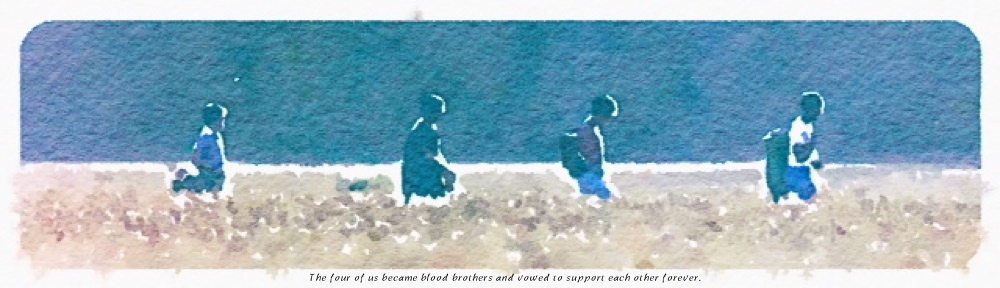
In retelling the story forty years later, when I kidnapped Woody (after his leukemia diagnosis) and cajoled Dondi into joining us on a quest to England to find Malcolm, Dondi retold the story of Principal Thompson opening the peanut butter jar much differently…
* * *
“A great magenta cloud swirled out of the jar and filled the cafeteria,” Dondi recalled, raising his arms and looking skyward in a Charlton Heston, Moses kind of pose.
“I’m not remembering this part,” Malcolm said.
“Don’t you remember?” Dondi persisted. “Kids trampled each other, running for the exits and Thompson fell face-first onto the floor?”
I knew Dondi was exaggerating mostly for effect. Still, the insistence in his voice suggested to me that regardless of the history we shared, memories mutate in our brains until after four decades all that’s left is the enjoyment of arriving at a new version of the truth.
Clearly not buying Dondi’s story, Malcolm shrugged and said, “Must have been me pre-curry phase.”
 Searching for Malcolm