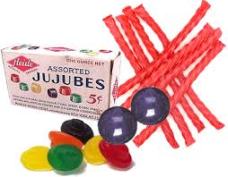
No adults ever suspected that Old Lady Hoeppner dealt drugs to elementary and junior high school kids out of her store on the corner of Maple and Cady Street. The drug of choice was sugar, dispensed in the form of Atomic Fireballs, malted milk balls, grape jawbreakers, Red-Hot Dollars, licorice laces and other odd-named penny candies.
Many of these candies had the same rubbery consistency and no taste other than a mucky sweetness. But the taste didn’t matter all that much; it was all about the sugar buzz.
The penny candies were unwrapped and protected from shoplifting fingers in a walnut and glass display case that looked like it might have previously been used to display bodies in a funeral home.
Dealing sugar wasn’t the only commerce that took place in Hoeppner’s. Mrs. Hoeppner’s adult son, Aldo, ran a radio repair business somewhere in the back part of the building. I doubted many radios were repaired there, at least judging by how often Aldo wandered out into the candy store to check in on his mother’s customers.
Mrs. Hoeppner glared at us one at a time through her old-world glasses – the ones that were just glass, with no rims – and with a slight nod of her head said, “What’s yours.” It wasn’t a question; it was a demand. Her gray hair was pulled into a bun at the back, and she moved angrily about the little shop draped in a floral print housedress, stomping on the oily, blackened wooden floor with her lace-up heeled shoes.
Her oddness intimidated us into an inoffensive form of politeness – not unlike the phony kind practiced by Eddie Haskell on Leave it to Beaver. Dondi especially would say things like, “Hello, Mrs. Hoeppner, it is so good to see you today. Those new Chunky candy bars for only ten cents certainly look like a terrific value.” The fact was Chunky was the worst deal in the store, maybe in the entire world of candy.
But when Aldo walked into the store, we didn’t mess around. He looked to be in his early-forties and wore a buzz cut, even though he was balding (Woody called it his “buzzard cut”). Tufts of back and chest hair sprouted out around the neckline of his white T-shirt. He carried his arms out away from his body, as if holding invisible suitcases in each hand.
I often wondered about the radio repair business supposedly squirreled away out back somewhere. I pictured racks of vacuum tubes of all different sizes that had been purchased as part of the Radio Repair Correspondence Course. Of course, transistors had become such a big deal that vacuum tubes were pretty much obsolete. But our real fear was that what Aldo really had hidden out back was a big chest freezer, with children stacked up in it like cordwood.
While the penny candies provided us with sugar on the go, for instant injections we perched on the round swivel stools and o rdered from the soda fountain. Gleaming silver hand pumps, lined up like toy soldiers behind the counter, squirted thick, sweet syrups in all flavors — Coca-Cola, 7-Up, Pepsi, root beer, cherry, chocolate, strawberry, vanilla, and grape. We were forever experimenting with new flavor combinations. For several weeks Malcolm tried to convince us that Chocolate 7-Up would soon sweep the country. I told him it tasted like dirt.
“When I become famous and you’re bragging to everyone that you knew the bloke who invented it, I won’t give you the time of day,” he said.
Woody worked with cherry as a base flavor and hit on something decent with Cherry 7-Up. My signature drink was Vanilla Coke. But Dondi never ordered the same thing twice. When he ordered a Pepsi-Cokesy, the name sounded so cool we all knew he was onto something. But Old Lady Hoeppner scowled and shook her jowls, refusing to mix it. It was so unlike her to turn down a dime, we figured that Pepsi and Coke probably had a law against mingling the brands.
Shortly after graduating from the sixth grade, we streamed into Hoeppner’s all sweaty from a game of basketball on the courts across the street. When it came my turn, Mrs. Hoeppner nodded at me. “What’s yours.”
“May I please have a glass of water to start, Mrs. Hoeppner? I’m awfully thirsty.”
Magnified through her glasses, her eyes blinked owl-like several times before looking down to locate a glass. She filled the glass from the tap and clanked it down in front of me on the marble counter. As she turned to fill Woody’s Cherry 7-Up with cold seltzer, I dug a foil packet of Fizzies out of my jeans and dropped the two strawberry-flavored tablets into my glass of water. Fizzies were flavored sparkling tablets, from the same folks who brought us Bromo Seltzer. They didn’t really taste that great. But if you put them in your mouth they would foam up and you could run around pretending to be a dog with rabies or a crazy man. Of course, parents hated seeing their kids being so good at that kind of thing. So they started a rumor that if you swallowed a Fizzie whole, your stomach would burst.
 Woody, who was watching me attentively, suddenly cried out, “It’s Fizzling!” He said it in the same excited voice as the dopey kid in the Fizzies commercials. That got Old Lady Hoeppner’s attention in a hurry. She whirled around faster than I’d ever seen her move, locked her eyes on my glass of water fizzing away, and latched onto my glass with both hands.
We played a back and forth tug of war that looked like two lumberjacks working a bucksaw. For an old lady she was pretty strong. So I pulled harder, and surprised her with my strength, pulling her up on her tiptoes. Then she dropped her big butt for leverage, hauling me halfway across the counter. I was just fighting for my Fizzie. But she was fighting something much bigger — a dangerous, new-fangled trend.
Malcolm, Woody, and Dondi were cheering wildly, like it was a TV game show. I gritted my teeth and searched Mrs. Hoeppner’s face for some sign of weakness. That’s when I noticed Aldo in the doorway, looming behind his mother. He walked quickly over and squeezed both of my wrists, forcing me to release my grip.
“What are you a tough guy?” he said, trapping both my wrists in one of his mitts. “Fighting with a woman? The hell’s wrong with ya?”
“She was trying to take my drink away,” I said.
“He no pay,” said Mrs. Hoeppner, wagging her boney finger in my face. I jerked my head back startled by her sharp, yellow fingernail. Aldo held my wrists tighter.
He put his face uncomfortably close to mine, exhaling sour coffee breath. “You didn’t pay?” Clearly this was a worse sin than arm-wrestling with his elderly mother.
“It was just a glass of water,” I said, hoping my voice didn’t sound as whiney to my buddies as it did to me.
“He no pay,” Mrs. Hoeppner said again.
“Get the hell out of here and don’t come back,” Aldo said, leading me to the door. He opened the door for me, which I thought was quite polite of him until he flung me to the sidewalk. As he stood over me, I noticed a brief look of concern in his eyes. Perhaps he worried that he had been too rough. But then he said, “And don’t come back for two weeks.” That’s when I knew his real fear was the lost revenue if he banned me for life.
Occasionally Hoeppner’s attempted to branch out of the candy and soda business into other merchandise. Experimental racks of yo-yo’s, rocket-shaped crystal radios, or cap guns would mysteriously appear. We always inspected the stuff just in case there was something interesting, but never bought anything. If we could get the same item for a nickel less, we would ride our bikes downtown to get it at Gould’s or Newberry’s. Besides, Hoeppner’s never had anything new and different — at least until the day we stood staring at a display of peashooters.
We walked out of the place armed and in search of targets. Malcolm took aim at the white Ford Falcon parked across the street. Ping! He raised his fist triumphantly and shouted, “Bulls-eye.”
Dondi rolled eyes. “It’s a car for Christ sakes. Let’s see you hit that stop sign.”
Malcolm, Woody, and I all fired at once. Ping! Ping! Ping! We immediately went back into Hoeppner’s and bought more ammo.
We wandered over to Knox Field and parked ourselves on the bank behind the tennis courts. The two men in front of us were running around under the hot sun, diving for shots on the hard court.
“What d’ya think the odds are of me shooting a pea clean through that chain link fence?” Woody asked.
The guy on the court in front of us was bouncing the ball, preparing to serve. I gave Woody a skeptical look.
“You know,” Woody said, “kind of like a science experiment.”
When Woody fired, the guy duffed his serve into the net, double-faulting. He turned and glared at us. I wasn’t sure if the sound from the peashooter had distracted him or if he had been hit. The man walked across the court, meeting his opponent at the net, suggesting to us that their match was over.
“I thought that clot was going to come after you,” Malcolm said to Woody.
“Think again,” Woody said, pointing across the court. The man had exited the gate on the far side, and was circling around the court toward us. His opponent joined in, heading in the opposite direction to catch us in a pincer attack.
The Chase was what we both hoped for and feared. In the same way that the Swamp Fox on Walt Disney made the British look foolish, and Zorro outwitted Sergeant Garcia, every eleven-year-old boy secretly believes that through superior wit and guile he can outsmart and outrun the enemy. We knew every secret shortcut, path, and hiding place at Knox Field. So, as terrifying as it was to have two grown men with tennis rackets in their hands closing in on us from two different directions, we knew we held the advantage.
Surveying the angle of attack of our pursuers, we sprinted down the stone-dust path paralleling First Avenue. The guy coming at us clockwise believed he had us trapped. “I’ve got you, you little shitheads,” he screamed, waving his racket overhead as he closed in on us. There was no exit in the high, spiked wrought-iron fence in the direction we were headed. But what we knew and he didn’t was that there was one bar in the fence that had been bent when a garbage truck backed into it. The gap had been widened just enough for us to squeeze through.
We piled up at our exit spot like subway commuters at a turnstile. We pushed Malcolm through first, and then Woody and I slipped through behind him. The closest pursuer was closing in fast on Dondi as he squatted down to angle his head through the widest part of the opening. Believing he was about to catch one of us, the man bellowed, “Come to papa, you little bastard!”
Dondi jammed his head through the bars, bending his ears back in the process, and lunged forward, just as the man dove. It may have been our volley of peas shot at point blank range that made the guy flinch and miss grabbing Dondi’s legs.
Dondi bounced to his feet and stood just beyond range of the man’s outstretched arms. “You are not my papa,” Dondi said in a calm voice that was spooky, especially considering that the guy’s hands were so close to reaching Dondi’s neck.
We raced down First Avenue toward the junior high school building. But Dondi stopped short, as if he had forgotten something, and turned back toward the man at the fence.
“What the heck are you doing?” I asked. “Let’s get out of here.”
Dondi stared back at the man. “If that was my father, he would have caught me,” he said.
I grabbed his arm, and we both turned to catch up with Woody and Malcolm. The number of cars parked around the school suggested an event inside, so we raced across the front lawn and ducked in the main entrance on Perry Street. Inside, we heard muffled, discordant sounds emanating from the bowels of the school, as if the building had indigestion. The high school spring band and chorus concert was in full swing.
Fearing that our pursuers were close behind, we hid out in the projection booth above the balcony. Far below, Mrs. Gates was conducting the chorus in a sappy rendition of “Sleep Kentucky Babe.” We peered through the portholes normally used for the lights and projectors. The chorus was singing, “Skeeters am a hummin…” when Woody fired a salvo of peas out his porthole. Mrs. Gates was stretching her arms outward, directing the singers. Her right hand suddenly snapped to the back of her neck as if slapping at a mosquito.
“Hey, did you see that?” Woody whispered. He studied the peashooter in his hand, and then us. “We couldn’t really have the range from up here, could we?”
So we all joined in. At first nothing happened. We put more into our shots, arching our backs, and then snapping forward as we fired. Members of the chorus started flinching and swatting. Excited that we were on target, we rained destruction down on the performance below. It wasn’t easy because we were laughing so hard.
“Awck. I think I inhaled a pea,” Malcolm said. He held his throat with both hands as if choking.
That’s when the door to the projection room burst inward. A silhouette of a huge man swung crazily from side to side in the doorway, apparently trying to peer through the darkness. “Who is it and what are you doing up here?” the form asked. I realized it was Mr. Gates, the teacher the high school kids called Norman, as in Norman Bates from the movie Psycho. He was a tall, severe-looking man…and the husband of the embattled woman trying to conduct down below.
I was about to say we weren’t doing anything when I heard Dondi say, “We’re working the lights for the concert. Mr. Rhodes asked us to.”
One lone spotlight at the far porthole bathed the stage below in light. It certainly didn’t take four of us to work it, especially since it hadn’t moved. And it wouldn’t take much for Mr. Gates to ask the band instructor Mr. Rhodes if Dondi’s claim was true.
“Then concentrate on your work and stop making so much noise.” With that, he quietly shut the door.
We stood motionless for a good five minutes, listening. Malcolm finally said, “Let’s get the F out of here.”
“Get the F out of here?” Woody repeated. “What the fuck’s that supposed to mean?”
“It’s code in case he’s out there laying for us,” Malcolm whispered.
“Right. Like wrecking his wife’s concert is okay, but swearing would be the final straw,” Woody said.
“Why don’t we go one at a time and make a rendezvous, like in The Great Escape,” I suggested.
Dondi offered to go first. “If he’s out there, I’ll just say I’m going to the bathroom. If I don’t come back in five minutes, you’ll know it’s safe.”
So we snuck out one at a time and regrouped two blocks away on Malcolm’s front porch. In The Great Escape — in our opinion the best movie ever made — we had watched in disbelief as the escapees were recaptured one by one, and about fifty of them were machine-gunned by the Germans. In the movie, only Danny, Willie, and Sedgwick made it to freedom. Yet we all escaped our peashooter caper unscathed, further reinforcing our belief that we were invincible.
 Searching for Malcolm